
Penny Dreadfuls, 1854 · page 163 of 394
Joseph Wilmot, or, The Memoirs of a Man-Servant — page 163: what you’re looking at
A restored page from Penny Dreadfuls, 1854. Page through the whole issue in the reader above.
📄 Transcribed text from this page (OCR, searchable)
Machine-transcribed from the original scan — historical spelling and the odd misread are preserved.
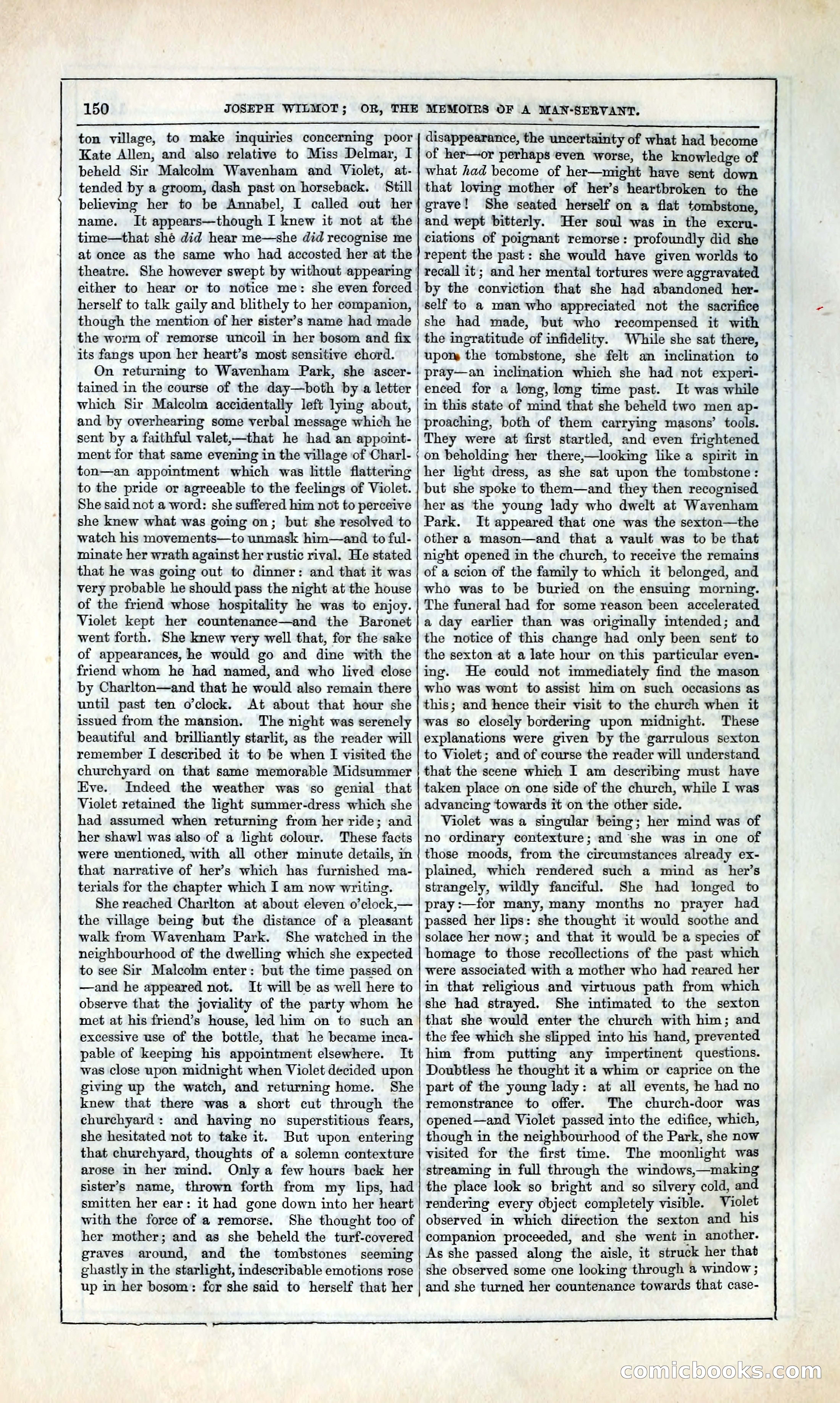
150 JOSEPH WILMOT; OR, THE MEMOIRS OF A MAN-SERVANT. ton village, to make inquiries concerning poor Kate Allen, and also relative to Miss Delmar, I beheld Sir Malcolm Wavenham and Violet, at- tended by a groom, dash past on horseback. Still believing her to be Amnabel, I called out her name. It appears—though I knew it not at the time—that she did hear me—she did recognise me at once as the same who had accosted her at the theatre. She however swept by without appearing | either to hear or to notice me: she even forced herself to talk gaily and blithely to her companion, though the mention of her sister’s name had made the worm of remorse uncoil in her bosom and fix its fangs upon her heart’s most sensitive chord. On returning to Wavenham Park, she ascer- tained in the course of the day—both by a letter which Sir Malcolm accidentally left lying about, and by overhearing some verbal message which he sent by a faithful valet,—that he had an appoint- ment for that same evening in the village of Charl- ton—an appointment which was little flattering to the pride or agreeable to the feelings of Violet. She said not a word: she suffered him not to perceive she knew what was going on; but she resolved to watch his movements—to unmask him—and to ful- minate her wrath against her rustic rival. He stated that he was going out to dinner: and that it was very probable he should pass the night at the house of the friend whose hospitality he was to enjoy. Violet kept her countenance—and the Baronet went forth. She knew very well that, for the sake of appearances, he would go and dine with the friend whom he had named, and who lived close by Charlton—and that he would also remain there until past ten o'clock. At about that hour she issued from the mansion. The night was serenely beautiful and brilliantly starlit, as the reader will remember I described it to be when I visited the churchyard on that same memorable Midsummer Eve. Indeed the weather was so genial that Violet retained the light summer-dress which she had assumed when returning from her ride; and her shawl was also of a light colour. These facts were mentioned, with all other minute details, in that narrative of her’s which has furnished ma- terials for the chapter which I am now writing. She reached Charlton at about eleven o’clock,— the village being but the distance of a pleasant walk from Wavenham Park. She watched in the neighbourhood of the dwelling which she expected to see Sir Malcolm enter: but the time passed on —and he appeared not. It will be as well here to observe that the joviality of the party whom he met at his friend’s house, led him on to such an excessive use of the bottle, that he became inca- pable of keepmg his appointment elsewhere. It was close upon midnight when Violet decided upon giving up the watch, and returning home. She knew that there was a short cut through the churchyard: and having no superstitious fears, she hesitated not to take it. But upon entering that churchyard, thoughts of a solemn contexture arose in her mind. Only a few hours back her sister’s name, thrown forth from my lips, had smitten her ear: it had gone down into her heart with the force of a remorse. She thought too of her mother; and as she beheld the turf-covered graves around, and the tombstones seeming ghastly in the starlight, indescribable emotions rose up in her bosom: for she said to herself that her cid a “ disappearance, the uncertainty of what had become of her—or perhaps even worse, the knowledge of what had become of her—might have sent down that loving mother of her’s heartbroken to the grave! She seated herself on a flat tombstone, and wept bitterly. Her soul was in the excru- ciations of poignant remorse: profoundly did she repent the past: she would have given worlds to recall it; and her mental tortures were aggravated | by the conviction that she had abandoned her- self to a man who appreciated not the sacrifice she had made, but who recompensed it with the ingratitude of infidelity. While she sat there, upon the tombstone, she felt an inclination to pray—an inclination which she had not experi- enced for a long, long time past. It was while in this state of mind that she beheld two men ap- proaching, both of them carrying masons’ tools. They were at first startled, and even frightened on beholding her there,—looking like a spirit in her light dress, as she sat upon the tombstone: but she spoke to them—and they then recognised her as the young lady who dwelt at Wavenham Park. It appeared that one was the sexton—the other a mason—and that a vault was to be that night opened in the church, to receive the remains of a scion of the family to which it belonged, and who was to be buried on the ensuing morning. The funeral had for some reason been accelerated a day earlier than was originally intended; and the notice of this change had only been sent to the sexton at a late hour on this particular even- ing. He could not immediately find the mason who was wont to assist him on such occasions as this; and hence their visit to the church when it was so closely bordering upon midnight. These explanations were given by the garrulous sexton to Violet; and of course the reader will understand that the scene which I am describing must have taken place on one side of the church, while I was advancing towards it on the other side. Violet was a singular being; her mind was of no ordinary contexture; and ‘she was in one of those moods, from the circumstances already ex- plained, which rendered such a mind as her’s strangely, wildly fanciful. She had longed to pray :—for many, many months no prayer had passed her lips: she thought it would soothe and solace her now; and that it would be a species of homage to those recollections of the past which were associated with a mother who had reared her in that religious and virtuous path from which she had strayed. She intimated to the sexton that she would enter the church with him; and the fee which she slipped into his hand, prevented him from putting any impertinent questions. Doubtless he thought it a whim or caprice on the part of the young lady: at all events, he had no remonstrance to offer. The church-door was cpened—and Violet passed into the edifice, which, though in the neighbourhood of the Park, she now visited for the first time. The moonlight was streaming in full through the windows,—making the place look so bright and so silvery cold, and rendering every object completely visible. Violet observed in which direction the sexton and his companion proceeded, and she went in another. As she passed along the aisle, it struck her that she observed some one looking through a window ; and she turned her countenance towards that case- ElO@QO) SS (E@) im