
Penny Dreadfuls, 1854 · page 168 of 394
Joseph Wilmot, or, The Memoirs of a Man-Servant — page 168: what you’re looking at
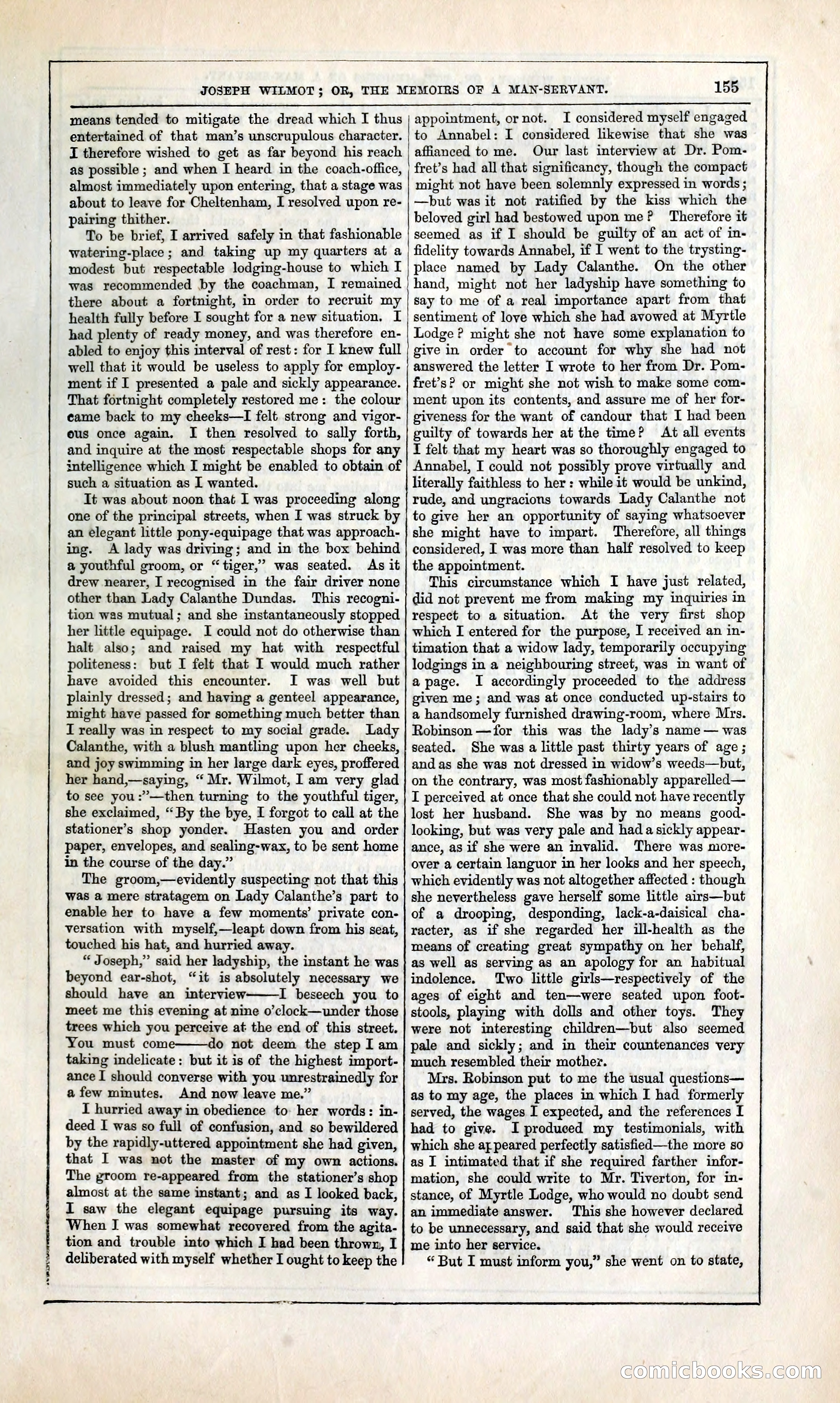
A restored page from Penny Dreadfuls, 1854. Page through the whole issue in the reader above.
📄 Transcribed text from this page (OCR, searchable)
Machine-transcribed from the original scan — historical spelling and the odd misread are preserved.
ji , means tended to mitigate the dread which I thus entertained of that man’s unscrupulous character. I therefore wished to get as far beyond his reach as possible ; and when I heard in the coach-office, almost immediately upon entering, that a stage was about to leave for Cheltenham, I resolved upon re- pairing thither. To be brief, I arrived safely in that fashionable watering-place ; and taking up my quarters at a modest but respectable lodging-house to which I was recommended by the coachman, I remained there about a fortnight, in order to recruit my health fully before I sought for a new situation. I had plenty of ready money, and was therefore en- abled to enjoy this interval of rest: for I knew full well that it would be useless to apply for employ- ment if I presented a pale and sickly appearance. That fortnight completely restored me: the colour came back to my cheeks—I felt strong and vigor- ous once again. I then resolved to sally forth, and inquire at the most respectable shops for any intelligence which I might be enabled to obtain of such a situation as I wanted. It was about noon that I was proceeding along one of the principal streets, when I was struck by an elegant little pony-equipage that was approach- ing. A lady was driving; and in the box behind a youthful groom, or “tiger,” was seated. As it drew nearer, I recognised in the fair driver none other than Lady Calanthe Dundas. This recogni- tion was mutual; and she instantaneously stopped her little equipage. I could not do otherwise than halt also; and raised my hat with respectful politeness: but I felt that I would much rather have avoided this encounter. I was well but plainly dressed; and having a genteel appearance, might have passed for something much better than I really was in respect to my social grade. Lady Calanthe, with a blush mantling upon her cheeks, and joy swimming in her large dark eyes, proffered her hand,—saying, “ Mr. Wilmot, I am very glad to see you:”—then turning to the youthful tiger, she exclaimed, “ By the bye, I forgot to call at the stationer’s shop yonder. Hasten you and order paper, envelopes, and sealing-wax, to be sent home in the course of the day.” The groom,—evidently suspecting not that this was a mere stratagem on Lady Calanthe’s part to enable her to have a few moments’ private con- versation with myself,—leapt down from his seat, touched his hat, and hurried away. “ Joseph,” said her ladyship, the instant he was beyond ear-shot, “it is absolutely necessary we should have an interview I beseech you to meet me this evening at nine o’clock—under those trees which you perceive at the end of this street. You must come——do not deem the step I am taking indelicate: but it is of the highest import- ance I should converse with you unrestrainedly for a few mimutes. And now leave me.” I hurried away in obedience to: her words: in- deed I was so full of confusion, and so bewildered by the rapidly-uttered appointment she had given, that I was not the master of my own actions. The groom re-appeared from the stationer’s shop almost at the same instant; and as I looked back, I saw the elegant equipage pursuing its way. When J was somewhat recovered from the agita- tion and trouble into which I had been thrown, I deliberated with myself whether I ought to keep the JOSEPH WILMOT; OR, THE MEMOIRS OF A MAN-SERVANT. 155 appointment, ornot. I considered myself engaged to Annabel: I considered likewise that she was affianced to me. Our last interview at Dr. Pom- fret’s had all that significancy, though the compact might not have been solemnly expressed in words ; —but was it not ratified by the kiss which the beloved girl had bestowed upon me? Therefore it seemed as if I should be guilty of an act of im- fidelity towards Annabel, if I went to the trysting- place named by Lady Calanthe. On the other hand, might not her ladyship have something to say to me of a real importance apart from that sentiment of love which she had avowed at Myrtle Lodge ? might she not have some explanation to give in order to account for why she had not answered the letter I wrote to her from Dr. Pom- fret’s? or might she not wish to make some com- ment upon its contents, and assure me of her for- giveness for the want of candour that I had been guilty of towards her at the time? At all events I felt that my heart was so thoroughly engaged to Annabel, I could not possibly prove virtually and literally faithless to her : while it would be unkind, rude, and ungracions towards Lady Calanthe not to give her an opportunity of saying whatsoever she might have to impart. Therefore, all things considered, I was more than half resolved to keep the appointment. This circumstance which I have just related, did not prevent me from making my inquiries in respect to a situation. At the very first shop which I entered for the purpose, I received an in- timation that a widow lady, temporarily occupying lodgings in a neighbouring street, was in want of a page. I accordingly proceeded to the address given me; and was at once conducted up-stairs to a handsomely furnished drawing-room, where Mrs. Robinson —for this was the lady’s name — was seated. She was a little past thirty years of age; and as she was not dressed in widow’s weeds—but, on the contrary, was most fashionably apparelled— I perceived at once that she could not have recently lost her husband. She was by no means good- looking, but was very pale and hada sickly appear- ance, as if she were an invalid. There was more- over a certain languor in her looks and her speech, which evidently was not altogether affected : though she nevertheless gave herself some little airs—but of a drooping, desponding, lack-a-daisical cha- racter, as if she regarded her ill-health as the means of creating great sympathy on her behalf, as well as serving as an apology for an habitual indolence. Two little girls—respectively of the ages of eight and ten—were seated upon foot- stools, playing with dolls and other toys. They were not interesting children—but also seemed pale and sickly; and in their countenances very much resembled their mothez. Mrs. Robinson put to me the usual questions— as to my age, the places in which I had formerly served, the wages I expected, and the references I had to give. I produced my testimonials, with which she ay peared perfectly satisfied—the more so as I intimated that if she required farther infor- mation, she could write to Mr. Tiverton, for in- stance, of Myrtle Lodge, who would no doubt send an immediate answer. This she however declared to be unnecessary, and said that she would receive me into her service. “ But I must inform you,” she went on to state, ECORNICLOOO Ss (CO im