
Penny Dreadfuls, 1854 · page 17 of 394
Joseph Wilmot, or, The Memoirs of a Man-Servant — page 17: what you’re looking at
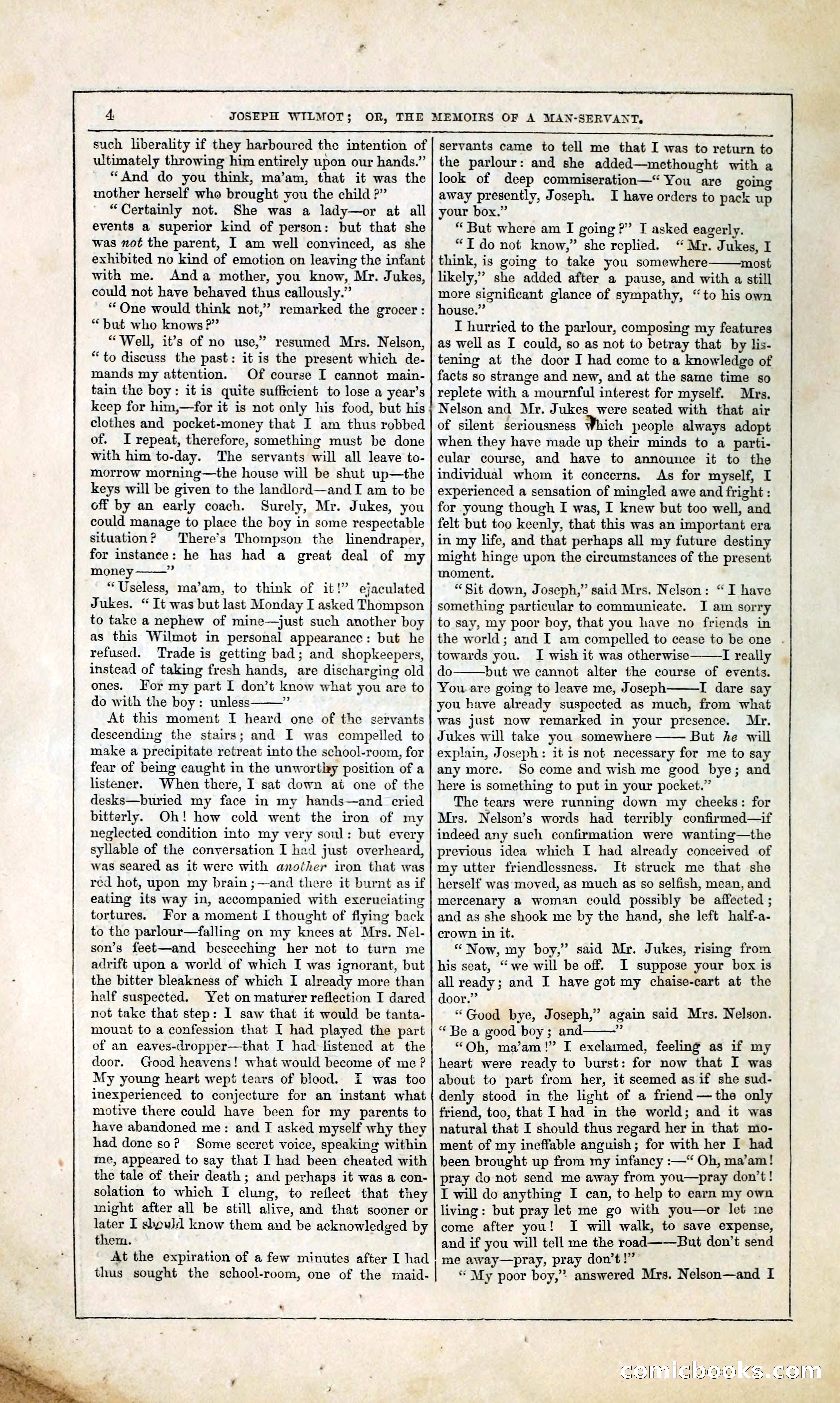
A restored page from Penny Dreadfuls, 1854. Page through the whole issue in the reader above.
📄 Transcribed text from this page (OCR, searchable)
Machine-transcribed from the original scan — historical spelling and the odd misread are preserved.
4 JOSEPH WILMOT; such liberality if they harboured the intention of ultimately throwing him entirely upon our hands.” “And do you think, ma’am, that it was the mother herself who brought you the child ?” “Certainly not. She was a lady—or at all events a superior kind of person: but that she was not the parent, I am well convinced, as she exhibited no kind of emotion on leaving the infant with me. Anda mother, you know, Mr. Jukes, could not have behaved thus callously.” “One would think not,” remarked the grocer: “but who knows ?” “Well, it’s of no use,’ resumed Mrs. Nelson, “to discuss the past: it is the present which de- mands my attention. Of course I cannot main- tain the boy: it is quite sufficient to lose a year’s keep for him,—for it is not only his food, but his clothes and pocket-money that I am thus robbed of. I repeat, therefore, something must be done with him to-day. The servants will all leave to- morrow morning—the house will be shut up—the keys will be given to the landlord—andI am to be off by an early coach. Surely, Mr. Jukes, you could manage to place the boy in some respectable situation? There’s Thompson the linendraper, for instance: he has had a great deal of my money ze “Useless, ma’am, to think of it!” ejaculated Jukes. “ It was but last Monday I asked Thompson to take a nephew of mine—just such another boy as this Wilmot in personal appearance: but he refused. Trade is getting bad; and shopkeepers, instead of taking fresh hands, are discharging old ones. For my part I don’t know what you are to do with the boy: unless fp At this moment I heard one of the servants descending the stairs; and I was compelled to make a precipitate retreat into the school-room, for fear of being caught in the unwortley position of a listener. When there, I sat down at one of the desks—buried my face in my hands—and cried bitterly. Oh! how cold went the iron of my neglected condition into my very soul: but every syllable of the conversation I had just overheard, was seared as it were with another iron that was red hot, upon my brain ;—and there it burnt as if eating its way in, accompanied with excruciating tortures. For a moment I thought of flying back to the parlour—falling on my knees at Mrs. Nel- son’s feet—and beseeching her not to turn me adrift upon a world of which I was ignorant, but the bitter bleakness of which I already more than half suspected. Yet on maturer reflection I dared not take that step: I saw that it would be tanta- mount to a confession that I had played the part of an eaves-dropper—that I had listened at the door. Good heavens! what would become of me ? My young heart wept tears of blood. i was too inexperienced to conjecture for an instant what motive there could have been for my parents to have abandoned me: and I asked myself why they had done so? Some secret voice, speaking within me, appeared to say that I had been cheated with the tale of their death ; and perhaps it was a con- solation to which I clung, to reflect that they might after all be still alive, and that sooner or later I show know them and be acknowledged by them. At the expiration of a few minutes after I had thus sought the school-room, one of the maid- OR, THE MEMOIRS OF A MAN-SERVANT, servants came to tell me that I was to return to the parlour: and she added—methought with a look of deep commiseration—“You are going away presently, Joseph. I have orders to pack up your box.” “ But where am I going ?” I asked eagerly. “T do not know,” she replied. “Mr. Jukes, I think, is going to take you somewhere most likely,” she added after a pause, and with a still more significant glance of sympathy, “to his own house.” I hurried to the parlour, composing my features as well as I could, so as not to betray that by lis- tening at the door I had come to a knowledge of facts so strange and new, and at the same time so replete with a mournful interest for myself. Mrs, Nelson and Mr. Jukes_were seated with that air of silent seriousness ich people always adopt when they have made up their minds to a parti- cular course, and have to announce it to the individual whom it concerns. As for myself, I experienced a sensation of mingled awe and fright : for young though I was, I knew but too well, and felt but too keenly, that this was an important era in my life, and that perhaps all my future destiny might hinge upon the circumstances of the present moment. “Sit down, Joseph,” said Mrs. Nelson: “I have something particular to communicate. I am sorry to say, my poor boy, that you have no friends in the world; and I am compelled to cease to be one . towards you. I wish it was otherwise I really do but we cannot alter the course of events. You are going to leave me, Joseph I dare say you have already suspected as much, from what was just now remarked in your presence. Mr. Jukes will take you somewhere But he will explain, Joseph: it is not necessary for me to say any more. So come and wish me good bye; and here is something to put in your pocket.” The tears were running down my cheeks: for Mrs. Nelson’s words had terribly confirmed—if indeed any such confirmation were wanting—the previous idea which I had already conceived of my utter friendlessness. It struck me that she herself was moved, as much as so selfish, mean, and mercenary a woman could possibly be affected ; and as she shook me by the hand, she left half-a- crown in it. “ Now, my boy,” said Mr. Jukes, rising from his seat, “we will be off. I suppose your box is all ready; and I have got my chaise-cart at the door.” “Good bye, Joseph,’ again said Mrs. Nelson. “ Be a good boy; and 4 “Oh, ma’am!” I exclaimed, feeling as if my heart were ready to burst: for now that I was about to part from her, it seemed as if she sud- denly stood in the light of a friend —the only friend, too, that I had in the world; and it was natural that I should thus regard her in that mo- ment of my ineffable anguish; for with her I had been brought up from my infancy :—“ Oh, ma’am! pray do not send me away from you—pray don’t! I will do anything I can, to help to earn my own living: but pray let me go with you—or let me come after you! I will walk, to save expense, and if you will tell me the road——But don’t send me away—pray, pray don’t!” ‘ My poor boy,”® answered Mrs. Nelson—and I ENO KS (E(@) im