
Penny Dreadfuls, 1854 · page 171 of 394
Joseph Wilmot, or, The Memoirs of a Man-Servant — page 171: what you’re looking at
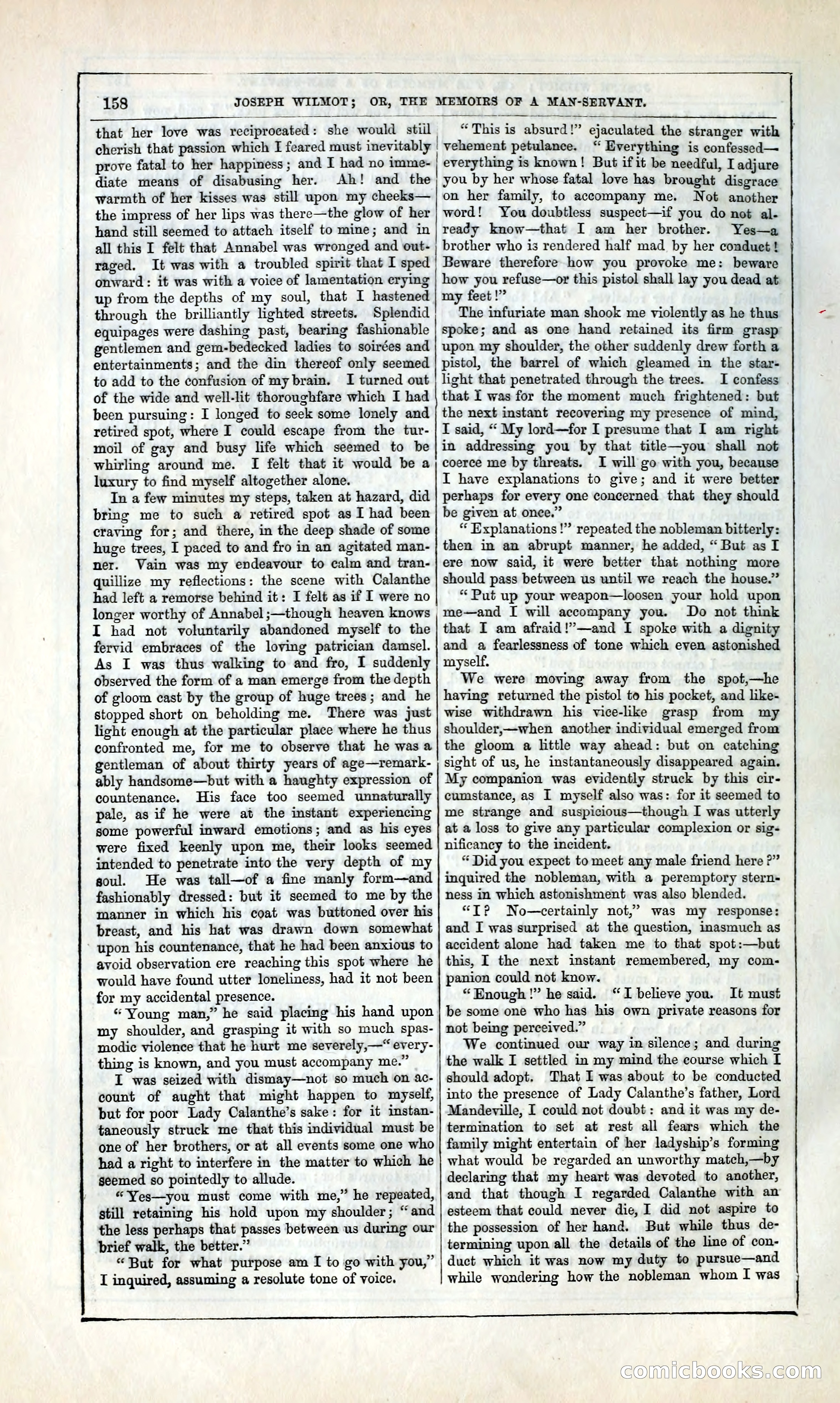
A restored page from Penny Dreadfuls, 1854. Page through the whole issue in the reader above.
📄 Transcribed text from this page (OCR, searchable)
Machine-transcribed from the original scan — historical spelling and the odd misread are preserved.
158 that her love was reciprocated: she would stiil cherish that passion which I feared must inevitably ' vehement petulance. JOSEPH WILMOT; OR, THE MEMOIRS OF A MAN-SERVANT. “This is absurd!” ejaculated the stranger with “ Everything is confessed— prove fatal to her happiness; and I had no imme- | everything is known! But ifit be needful, I adjure diate means of disabusing her. Ah! and the warmth of her kisses was still upon my cheeks— the impress of her lips was there—the glow of her hand still seemed to attach itself to mine; and in all this I felt that Annabel was wronged and out- raged. It was with a troubled spirit that I sped onward: it was with a voice of lamentation erying up from the depths of my soul, that I hastened through the brilliantly lighted streets. Splendid equipages were dashing past, bearing fashionable gentlemen and gem-bedecked ladies to soirées and entertainments; and the din thereof only seemed to add to the confusion of my brain. I turned out of the wide and well-lit thoroughfare which I had been pursuing: I longed to seek some lonely and retired spot, where I could escape from the tur- moil of gay and busy life which seemed to be whirling around me. [I felt that it would be a luxury to find myself altogether alone. In a few minutes my steps, taken at hazard, did bring me to such a retired spot as I had been craving for; and there, in the deep shade of some huge trees, I paced to and fro in an agitated man- ner. Vain was my endeavour to calm and tran- quillize my reflections: the scene with Calanthe had left a remorse behind it: I felt as if I were no longer worthy of Annabel ;—though heaven knows I had not voluntarily abandoned myself to the fervid embraces of the loving patrician damsel. As I was thus walking to and fro, I suddenly observed the form of a man emerge from the depth of gloom cast by the group of huge trees; and he stopped short on beholding me. There was just light enough at the particular place where he thus confronted me, for me to observe that he was a gentleman of about thirty years of age—remark- ably handsome—but with a haughty expression of countenance. His face too seemed unnaturally pale, as if he were at the instant experiencing some powerful inward emotions; and as his eyes were fixed keenly upon me, their looks seemed intended to penetrate into the very depth of my soul. He was tall—of a fine manly form—and fashionably dressed: but it seemed to me by the manner in which his coat was buttoned over his breast, and his hat was drawn down somewhat ' upon his countenance, that he had been anxious to avoid observation ere reaching this spot where he would have found utter loneliness, had it not been for my accidental presence. “Young man,” he said placing his hand upon my shoulder, and grasping it with so much spas- modic violence that he hurt me severely,—“ every- thing is known, and you must accompany me.” I was seized with dismay—not so much on ac- count of aught that might happen to myself, but for poor Lady Calanthe’s sake: for it instan- taneously struck me that this individual must be one of her brothers, or at all events some one who had a right to interfere in the matter to which he geemed so pointedly to allude. “Yes—you must come with me,” he repeated, still retaining his hold upon my shoulder; “and the less perhaps that passes between us during our brief walk, the better.” “But for what purpose am I to go with you,” I inquired, assuming a resolute tone of voice. i —— ——————— —— — —————— ——————— ————— you by her whose fatal love has brought disgrace on her family, to accompany me. Not another word! You doubtless suspect—if you do not al- ready know—that I am her brother. Yes—a brother who is rendered half mad by her conduet t Beware therefore how you provoke me: beware how you refuse—or this pistol shall lay you dead at my feet!” The infuriate man shook me violently as he thus spoke; and as one hand retained its firm grasp upon my shoulder, the other suddenly drew forth a pistol, the barrel of which gleamed in the star- light that penetrated through the trees. I confess that I was for the moment much frightened: but the next instant recovering my presence of mind, I said, “ My lord—for I presume that I am right in addressing you by that title—you shall not coerce me by threats. I will go with you, because I have explanations to give; and it were better perhaps for every one concerned that they should be given at onee.” “ Explanations !”’ repeated the nobleman bitterly: then in an abrupt manner, he added, “ But as I ere now said, it were better that nothing more should pass between us until we reach the house.” “Put up your weapon—loosen your hold upon me—and I will accompany you. Do not think that I am afraid!”—and I spoke with a dignity and a fearlessness of tone which even astonished myself. We were moving away from the spot,—he having returned the pistol to his pocket, and like- wise withdrawn his vice-like grasp from my shoulder,—when another individual emerged from the gloom a httle way ahead: but on catching sight of us, he instantaneously disappeared again. My companion was evidently struck by this cir- cumstance, as I myself also was: for it seemed to me strange and suspicious—though I was utterly at a loss to give any particular complexion or sig- nificaney to the incident. “ Did you expect to meet any male friend here ?” inquired the nobleman, with a peremptory stern- ness in which astonishment was also blended. “TP No—certainly not,’ was my response: and I was surprised at the question, inasmuch as accident alone had taken me to that spot:—but this, I the next instant remembered, my com- panion could not know. “Enough!” he said. “1 believe you. It must be some one who has his own private reasons for not being perceived.” We continued our way in silence; and during the walk I settled in my mind the course which I should adopt. That I was about to be conducted into the presence of Lady Calanthe’s father, Lord Mandeville, I could not doubt: and it was my de- termination to set at rest all fears which the family might entertain of her ladyship’s forming what would be regarded an unworthy match,—by declaring that my heart was devoted to another, and that though I regarded Calanthe with an esteem that could never die, I did not aspire to the possession of her hand. But while thus de- termining upon all the details of the line of con- duct which it was now my duty to pursue—and while wondering how the nobleman whom I was de eters ee CORNICLO@ SS (©) im