
Penny Dreadfuls, 1854 · page 193 of 394
Joseph Wilmot, or, The Memoirs of a Man-Servant — page 193: what you’re looking at
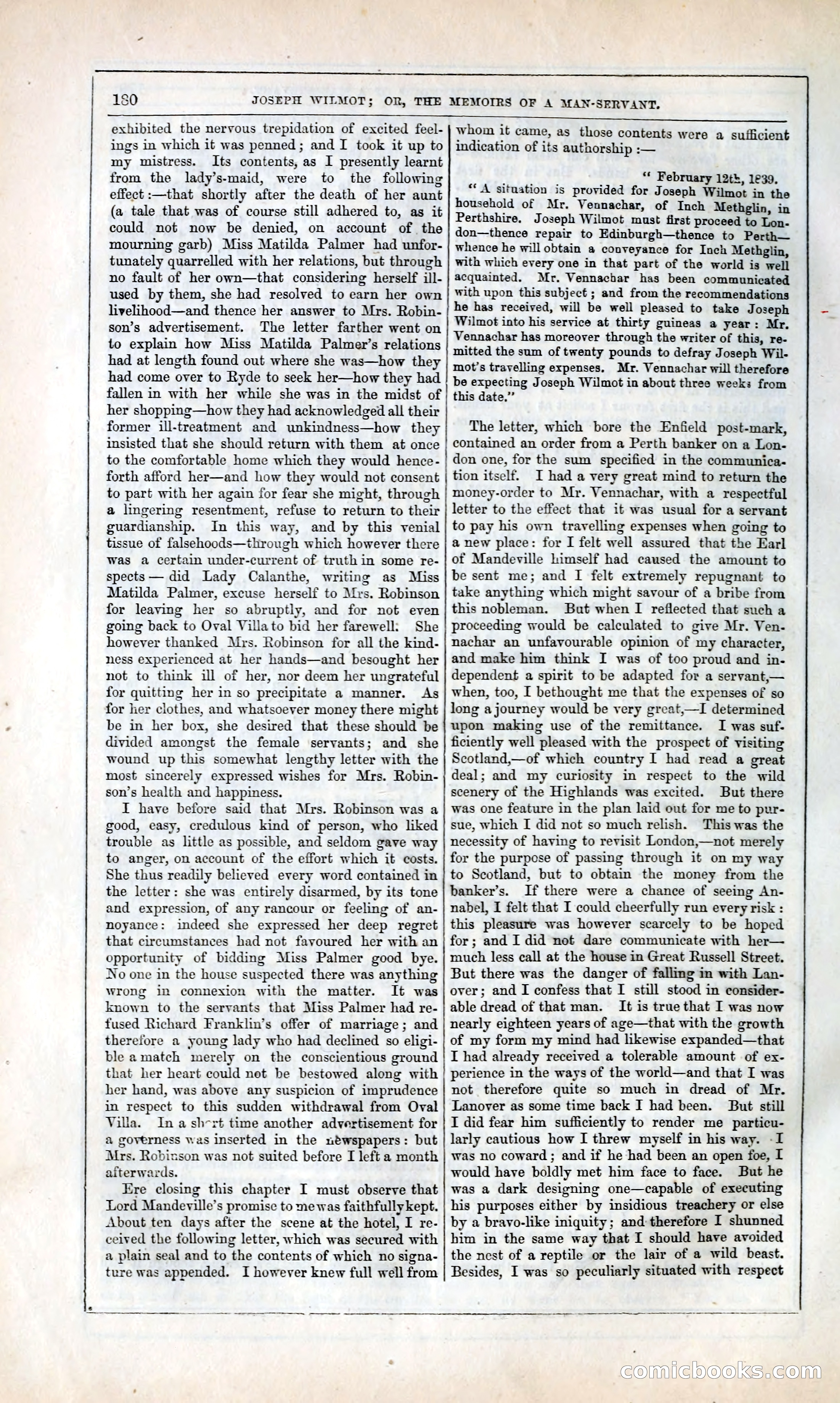
A restored page from Penny Dreadfuls, 1854. Page through the whole issue in the reader above.
📄 Transcribed text from this page (OCR, searchable)
Machine-transcribed from the original scan — historical spelling and the odd misread are preserved.
JOSEPH WIELMOT; OR, THE MEMOIRS OF A MAN-SERVANT. exhibited the nervous trepidation of excited feel- | whom it came, as those contents were a sufficient ings in which it was penned; and I took it up to my mistress. Its contents, as I presently learnt from the lady’s-maid, were to the following effect :—that shortly after the death of her aunt (a tale that was of course still adhered to, as it could not now be denied, on account of the mourning garb) Miss Matilda Palmer had unfor- tunately quarrelled with her relations, but through no fault of her own—that considering herself ill- used by them, she had resolved to earn her own livelihood—and thence her answer to Mrs. Robin- son’s advertisement. The letter farther went on to explain how Miss Matilda Palmer’s relations had at length found out where she was—how they had come over to Ryde to seek her—how they had fallen in with her while she was in the midst of her shopping—how they had acknowledged all their former ill-treatment and unkindness—how they insisted that she should return with them at once to the comfortable home which they would hence- forth afford her—and how they would not consent to part with her again for fear she might, through a lingering resentment, refuse to return to their guardianship. In this way, and by this venial tissue of falsehoods—through which however there Was a certain under-current of truth in some re- spects — did Lady Calanthe, writing as Miss Matilda Palmer, excuse herself to Mys. Robinson for leaving her so abruptly, and for not even going back to Oval Villato bid her farewell: She however thanked Mrs. Robinson for all the kind- ness experienced at her hands—and besought her not to think ill of her, nor deem her ungrateful for quitting her in so precipitate a manner. As for her clothes, and whatsoever money there might be in her box, she desired that these should be divided amongst the female servants; and she wound up this somewhat lengthy letter with the most sincerely expressed wishes for Mrs. Robin- son’s health and happiness. I have before said that Mrs. Robinson was a good, easy, credulous kind of person, who liked trouble as little as possible, and seldom gave way to anger, on account of the effort which it costs. She thus readily believed every word contained in the letter: she was entirely disarmed, by its tone and expression, of any rancour or feeling of an- noyance: indeed she expressed her deep regret that circumstances had not favoured her with an opportunity of bidding Miss Palmer good bye. No one in the house suspected there was anything wrong im connexion with the matter. It was known to the servants that Miss Palmer had re- fused Richard Franklin’s offer of marriage; and therefore a young lady who had declined so eligi- ble amatch merely on the conscientious ground that her heart could not be bestowed along with her hand, was aboye any suspicion of imprudence in respect to this sudden withdrawal from Oval Villa. Ina short time another advertisement for & governess was inserted in the néwspapers: but Mrs. Robinson was not suited before I left a month afterwards. Ere closing this chapter I must observe that Lord Mandeville’s promise to mewas faithfully kept. About ten days after the scene at the hotel, I re- ceived the following letter, which was secured with a plain seal and to the contents of which no signa- ture was appended. I however knew full well from SS EE indication of its authorship :— ** February 12th, 1€39. “A situation is provided for Joseph Wilmot in the household of Mr. Vennachar, of Inch Methglin, in Perthshire. Joseph Wilmot must first proceed to Lon- don—thence repair to Edinburgh—thence to Perth— whence he will obtain a conveyance for Inch Methglin, with which every one in that part of the world is well acquainted. Mr. Vennachar has been communicated with upon this subject ; and from the recommendations he has received, will be well pleased to take Joseph Wilmot into his service at thirty guineas a year: Mr. Vennachar has moreover through the writer of this, re- mitted the sum of twenty pounds to defray Joseph Wil- mot’s travelling expenses. Mr. Vennachar will therefore be expecting Joseph Wilmot in about three weeks from this date,” The letter, which bore the Enfield post-mark, contained an order from a Perth banker on a Lon- don one, for the sum specified in the communica. tion itself. I had a very great mind to return the money-order to Mr. Vennachar, with a respectful letter to the effect that it was usual for a servant to pay his own travelling expenses when going to a new place: for I felt well assured that the Earl of Mandeville himself had caused the amount to be sent me; and I felt extremely repugnant to take anything which might savour of a bribe from this nobleman. But when I reflected that such a proceeding would be calculated to give Mr. Ven- nachar an unfavourable opinion of my character, and make him think I was of too proud and in- dependent a spirit to be adapted for a servant,— when, too, I bethought me that the expenses of so long a journey would be very great,—I determined upon making use of the remittance. I was suf: ficiently well pleased with the prospect of visiting Scotland,—of which country I had read a great deal; and my curiosity in respect to the wild scenery of the Highlands was excited. But there was one feature in the plan laid out for me to pur- sue, which I did not so much relish. This was the necessity of having to revisit London,—not merely for the purpose of passing through it on my way to Scotland, but to obtain the money from the banker’s. If there were a chance of seeing An- nabel, I felt that I could cheerfully run every risk : this pleasure was however scarcely to be hoped for; and I did not dare communicate with her— much less call at the house in Great Russell Street. But there was the danger of falling in with Lan- over; and I confess that I still stood in consider- able dread of that man. It is true that I was now nearly eighteen years of age—that with the growth of my form my mind had likewise expanded—that I had already received a tolerable amount of ex- perience in the ways of the world—and that I was not therefore quite so much in dread of Mr. Lanover as some time back I had been. But still I did fear him sufficiently to render me particu- larly cautious how I threw myself in his way. -I was no coward ; and if he had been an open foe, L would have boldly met him face to face. But he was a dark designing one—capable of executing his purposes either by insidious treachery or else by a bravo-like iniquity; and: therefore I shunned him in the same way that I should have avoided the nest of a reptile or the lair of a wild beast. Besides, I was so peculiarly situated with respect eS Oe ee ee SS 0 OO=e=@a=@=>S>S>=<s—=*=-—- eComicaooolks im (C@)