
Penny Dreadfuls, 1854 · page 195 of 394
Joseph Wilmot, or, The Memoirs of a Man-Servant — page 195: what you’re looking at
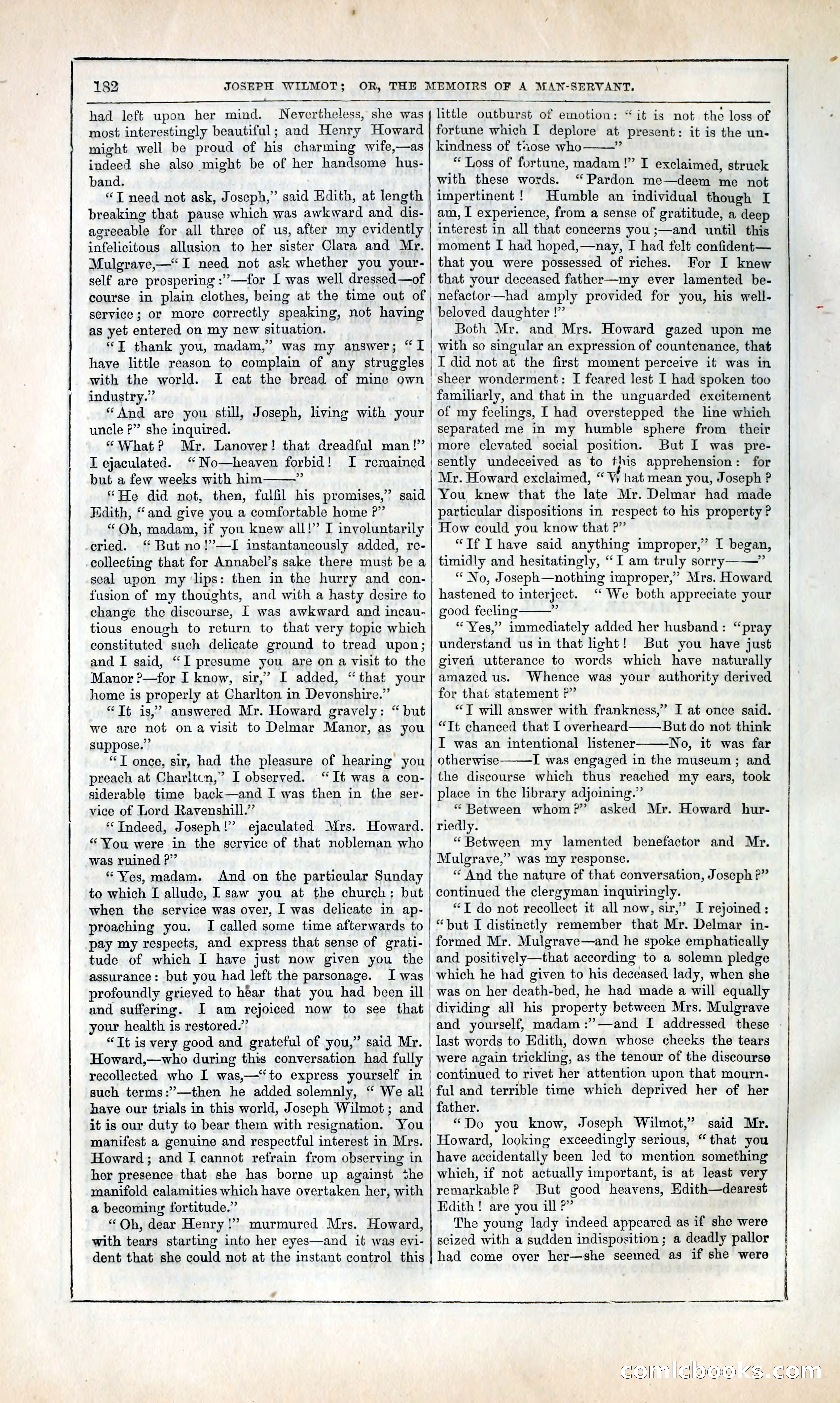
A restored page from Penny Dreadfuls, 1854. Page through the whole issue in the reader above.
📄 Transcribed text from this page (OCR, searchable)
Machine-transcribed from the original scan — historical spelling and the odd misread are preserved.
182 JOSEPH WILMOT; had left upon her mind. Nevertheless, she was most interestingly beautiful; and Henry Howard might well be proud of his charming wife,—as indeed she also might be of her handsome hus- band. “T need not ask, Joseph,” said Edith, at length breaking that pause which was awkward and dis- agreeable for all three of us, after my evidently infelicitous allusion to her sister Clara and Mr. Mulgrave,—‘I need not ask whether you your- self are prospering :”—for I was well dressed—of | course in plain clothes, being at the time out of service; or more correctly speaking, not having as yet entered on my new situation. “T thank you, madam,’ was my answer; “I have little reason to complain of any struggles with the world. I eat the bread of mine own industry.” “And are you still, Joseph, living with your uncle ?” she inquired. “WhatP Mr. Lanover! that dreadful man!” T ejaculated. “ No—heaven forbid! I remained but a few weeks with him 4 “He did not, then, fulfil his promises,’ said Edith, “and give you a comfortable home P” “ Oh, madam, if you knew all!” I involuntarily cried. ‘ But no!”—I instantaneously added, re- collecting that for Annabel’s sake there must be a seal upon my ‘lips: then in the hurry and con- fusion of my thoughts, and with a hasty desire to change the discourse, I was awkward and incau- tious enough to return to that very topic which constituted such delicate ground to tread upon; and I said, “I presume you are ona visit to the Manor ?—for I know, sir,” I added, “that your home is properly at Charlton in Devonshire.” “Tt is,’ answered Mr. Howard gravely: “ but we are not onavisit to Delmar Manor, as you suppose.” “T once, sir, had the pleasure of hearing you preach at Charitcn,’ I observed. “It was a con- siderable time back—and I was then in the ser- vice of Lord Ravenshill.”’ “Indeed, Joseph!” ejaculated Mrs. Howard. “You were in the service of that nobleman who was ruined P” «Yes, madam. And on the particular Sunday to which I allude, I saw you at the church; but when the service was over, I was delicate in ap- proaching you. I called some time afterwards to pay my respects, and express that sense of grati- tude of which I have just now given you the assurance: but you had left the parsonage. I was profoundly grieved to hear that you had been ill and suffering. I am rejoiced now to see that your health is restored.” “Tt is very good and grateful of you,” said Mr. Howard,—who during this conversation had fully recollected who I was,—‘to express yourself in such terms:’—then he added solemnly, “ We all have our trials in this world, Joseph Wilmot; and it is our duty to bear them with resignation. You manifest a genuine and respectful interest in Mrs. Howard; and I cannot refrain from observing in her presence that she has borne up against ‘he manifold calamities which have overtaken her, with a becoming fortitude.” “ Oh, dear Henry!” murmured Mrs. Howard, with tears starting into her eyes—and it was evi- dent that she could not at the instant control this —S—— sss OR, THE MEMOIRS OF A MAN-SERVANT. little outburst of emotion: “it is not the loss of fortune which I deplore at present: it is the un- kindness of tose who a “Loss of fortune, madam!” I exclaimed, struck with these words. “Pardon me—deem me not impertinent! Humble an individual though I am, I experience, from a sense of gratitude, a deep interest in all that concerns you;—and until this moment I had hoped,—nay, I had felt confident— that you were possessed of riches. For I knew that your deceased father—my ever lamented be- nefactor—had amply provided for you, his well- beloved daughter !” Both Mr. and Mrs. Howard gazed upon me with so singular an expression of countenance, that I did not at the first moment perceive it was in sheer wonderment: I feared lest I had spoken too familiarly, and that in the unguarded excitement of my feelings, I had overstepped the line which separated me in my humble sphere from their more elevated social position. But I was pre- sently undeceived as to this apprehension: for Mr. Howard exclaimed, “ W hat mean you, Joseph P You knew that the late Mr. Delmar had made particular dispositions in respect to his property? How could you know that P” “Tf I have said anything improper,” I began, timidly and hesitatingly, “I am truly sorry m “ No, Joseph—nothing improper,” Mrs. Howard hastened to interject. ‘“ We both appreciate your good feeling 3 “Yes,” immediately added her husband: “pray understand us in that light! But you have just given utterance to words which have naturally amazed us. Whence was your authority derived for that statement ?” *T will answer with frankness,” I at once said. “Tt chanced that I overheard But do not think I was an intentional listener No, it was far otherwise I was engaged in the museum; and the discourse which thus reached my ears, took place in the library adjoining.” “ Between whom?” asked Mr. Howard hur- riedly. “ Between my lamented benefactor and Mr. Mulgrave,” was my response. “ And the nature of that conversation, Joseph P” continued the clergyman inquiringly. “T do not recollect it all now, sir,” I rejoined : “but I distinctly remember that Mr. Delmar in- formed Mr. Mulgrave—and he spoke emphatically and positively—that according to a solemn pledge which he had given to his deceased lady, when she was on her death-bed, he had made a will equally dividing all his property between Mrs. Mulgrave and yourself, madam :’—and I addressed these last words to Edith, down whose cheeks the tears were again trickling, as the tenour of the discourse continued to rivet her attention upon that mourn- ful and terrible time which deprived her of her father. “Do you know, Joseph Wilmot,” said Mr. Howard, looking exceedingly serious, “that you have accidentally been led to mention something which, if not actually important, is at least very remarkable P But good heavens, Edith—dearest Edith! are you ill 2” The young lady indeed appeared as if she were seized with a sudden indisposition; a deadly pallor had come over her—she seemed as if she were a eed ae ee oe cS yoo (¢() im