
Penny Dreadfuls, 1854 · page 20 of 394
Joseph Wilmot, or, The Memoirs of a Man-Servant — page 20: what you’re looking at
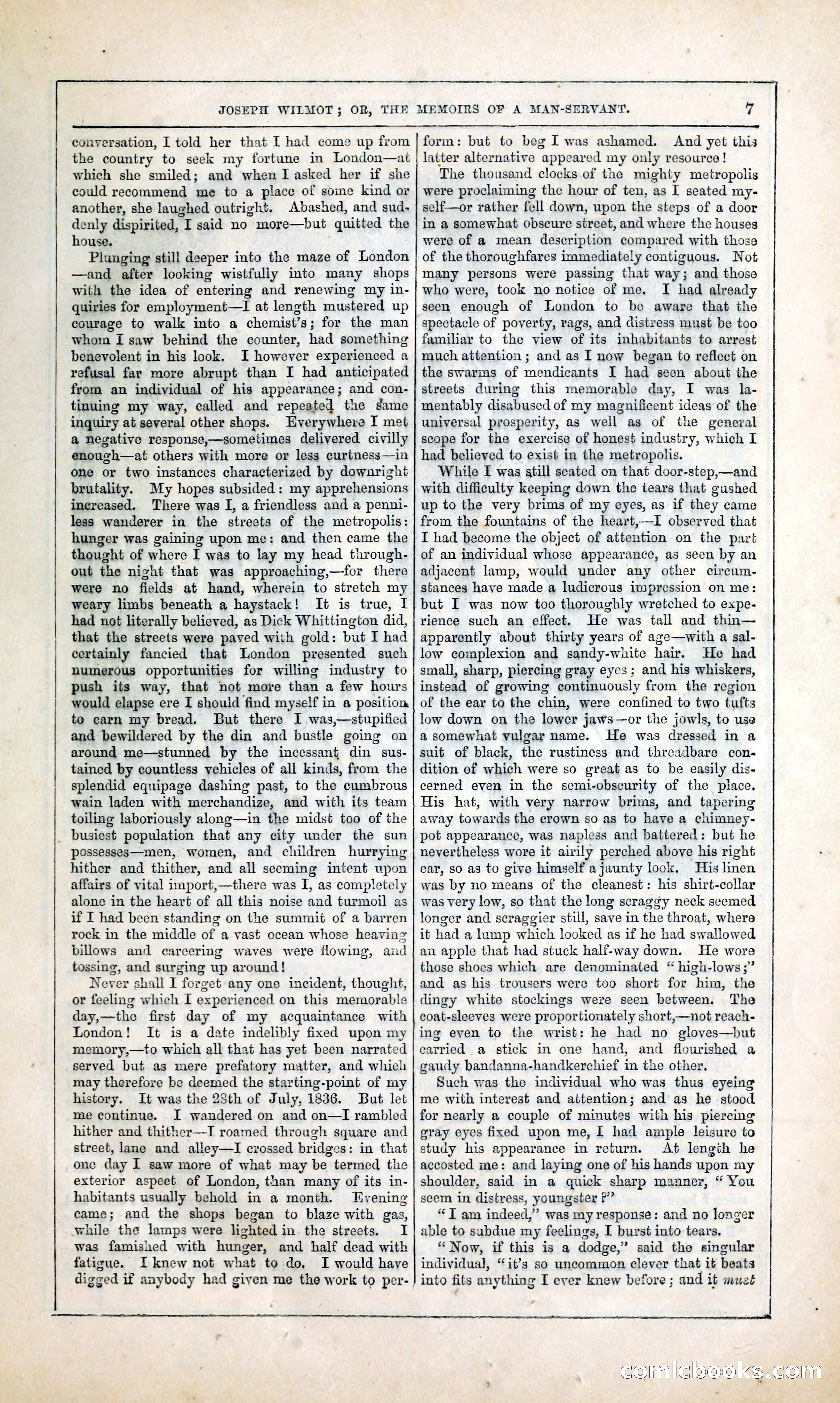
A restored page from Penny Dreadfuls, 1854. Page through the whole issue in the reader above.
📄 Transcribed text from this page (OCR, searchable)
Machine-transcribed from the original scan — historical spelling and the odd misread are preserved.
JOSEPH WILMOT; OR, THE ———— MEMOIRS OF A MAN-SERVANT. 7 conversation, I told her that I had come up from the country to seek my fortune in London—at which she smiled; and when I asked her if she could recommend me to a place of some kind or another, she laughed outright. Abashed, and sud- denly dispirited, I said no more—but quitted the house. Plunging still deeper into the maze of London —and after looking wistfully into many shops with the idea of entering and renewing my in- quiries for employment—I at length mustered up courage to walk into a chemist’s; for the man whom [I saw behind the counter, had something benevolent in his look. I however experienced a refusal far more abrupt than I had anticipated from an individual of his appearance; and con- tinuing my way, called and repeated the same inquiry at several other shops. Everywhere I met a negative response,—sometimes delivered civilly enough—at others with more or less curtness—in one or two instances characterized by downright brutality. My hopes subsided: my apprehensions inereased. There was I, a friendless and a penni- less wanderer in the streets of the metropolis: hunger was gaining upon me: and then came the thought of where I was to lay my head through- out the night that was approaching,—for there were no fields at hand, wherein to stretch my weary limbs beneath a haystack! It is true, I had not literally believed, as Dick Whittington did, that the streets were paved with gold: but I had certainly fancied that London presented such numerous opportunities for willing industry to push its way, that not more than a few hours would elapse ere I should find myself in a position to carn my bread. But there I was,—stupified and bewildered by the din and bustle going on around me—stunned by the incessant din sus- tained by countless vehicles of all kinds, from the splendid equipage dashing past, to the cumbrous wain laden with merchandize, and with its team toiling laboriously along—in the midst too of the busiest population that any city under the sun possesses—men, women, and children hurrying hither and thither, and all seeming intent upon affairs of vital import,—there was I, as completely alone in the heart of all this noise and turmoil as if I had been standing on the summit of a barren rock in the middle of a vast ocean whose heaving billows and careering waves were flowing, and tossing, and surging up around! Never shall I forget any one incident, thought, or feeling which I experienced on this memorable day,—the first day of my acquaintance with London! It is a date indelibly fixed upon my memory,—to which all that has yet been narrated served but as mere prefatory matter, and which may therefore be deemed the starting-point of my history. It was the 28th of July, 1836. But let me continue. I wandered on and on—I rambled hither and thither—I roamed through square and street, lane and alley—I crossed bridges: in that one day I saw more of what may be termed the exterior aspeet of London, than many of its in- habitants usually behold in a month. Evening came; and the shops began to blaze with gas, while the lamps were lighted in the streets. I was famished with hunger, and half dead with fatigue. I knew not what to do, I would have digged if anybody had given me the work to per- form: but to beg I was ashamed. And yet this latter alternative appeared my only resource! The thousand clocks of the mighty metropolis were proclaiming the hour of ten, as I seated my- self—or rather fell down, upon the steps of a door in a somewhat obscure street, and where the houses were of a mean description compared with those of the thoroughfares immediately contiguous. Not many persons were passing that way; and thoso who were, took no notice of me, I had already seen enough of London to be aware that the spectacle of poverty, rags, and distress must be too familiar to the view of its inhabitants to arrest much attention ; and as I now began to reflect on the swarms of mendicants I had seen about the streets during this memorable day, I was la- mentably disabused of my magnificent ideas of the universal prosperity, as well as of the general scope for the exercise of honest industry, which I had believed to exist in the metropolis. While I was still seated on that door-step,—and with difficulty keeping down the tears that gushed up to the very brims of my eyes, as if they came from the fountains of the heart,—I observed that I had become the object of attention on the part of an individual whose appearance, as seen by an adjacent lamp, would under any other circum- stances have made a ludicrous impression on me: but I was now too thoroughly wretched to expe- rience such an effect. He was tall and thin— apparently about thirty years of age—with a sal- low complexion and sandy-white hair. He had small, sharp, piercing gray eyes; and his whiskers, instead of growing continuously from the region of the ear to the chin, were confined to two tufts low down on the lower jaws—or the jowls, to use a somewhat vulgar name. He was dressed in a suit of black, the rustiness and threadbare con- dition of which were so great as to be easily dis- cerned even in the semi-obscurity of the place. His hat, with very narrow brims, and tapering away towards the crown so as to have a chimney- pot appearance, was napless and battered: but he nevertheless wore it airily perched above his right ear, so ag to give himself ajaunty look. His linen was by no means of the cleanest: his shirt-collar was very low, so that the long scraggy neck seemed longer and scraggier still, save in the throat, where it had a lump which looked as if he had swallowed an apple that had stuck half-way down. He wore those shoes which are denominated “ hich-lows;” and as his trousers were too short for him, the dingy white stockings were seen between. The coat-sleeves were proportionately short,—not reach- ing even to the wrist: he had no gloves—but carried a stick in one hand, and flourished a gaudy bandanna-handkerchief in the other. Such was the individual who was thus eyeing me with interest and attention; and as he stood for nearly a couple of minutes with his piercing gray eyes fixed upon me, I had ample leisure to study his appearance in return. At length he accosted me: and laying one of his hands upon my shoulder, said in a quick sharp manney, “ You seem in distress, youngster ?” “T am indeed,” was my response: and no longer able to subdue my feelings, I burst into tears. “ Now, if this is a dodge,” said the singular individual, “it’s so uncommon clever that it beats } into fits anything I ever knew before ; and it must ee, (E(0) COME DOOKS im