
Penny Dreadfuls, 1854 · page 210 of 394
Joseph Wilmot, or, The Memoirs of a Man-Servant — page 210: what you’re looking at
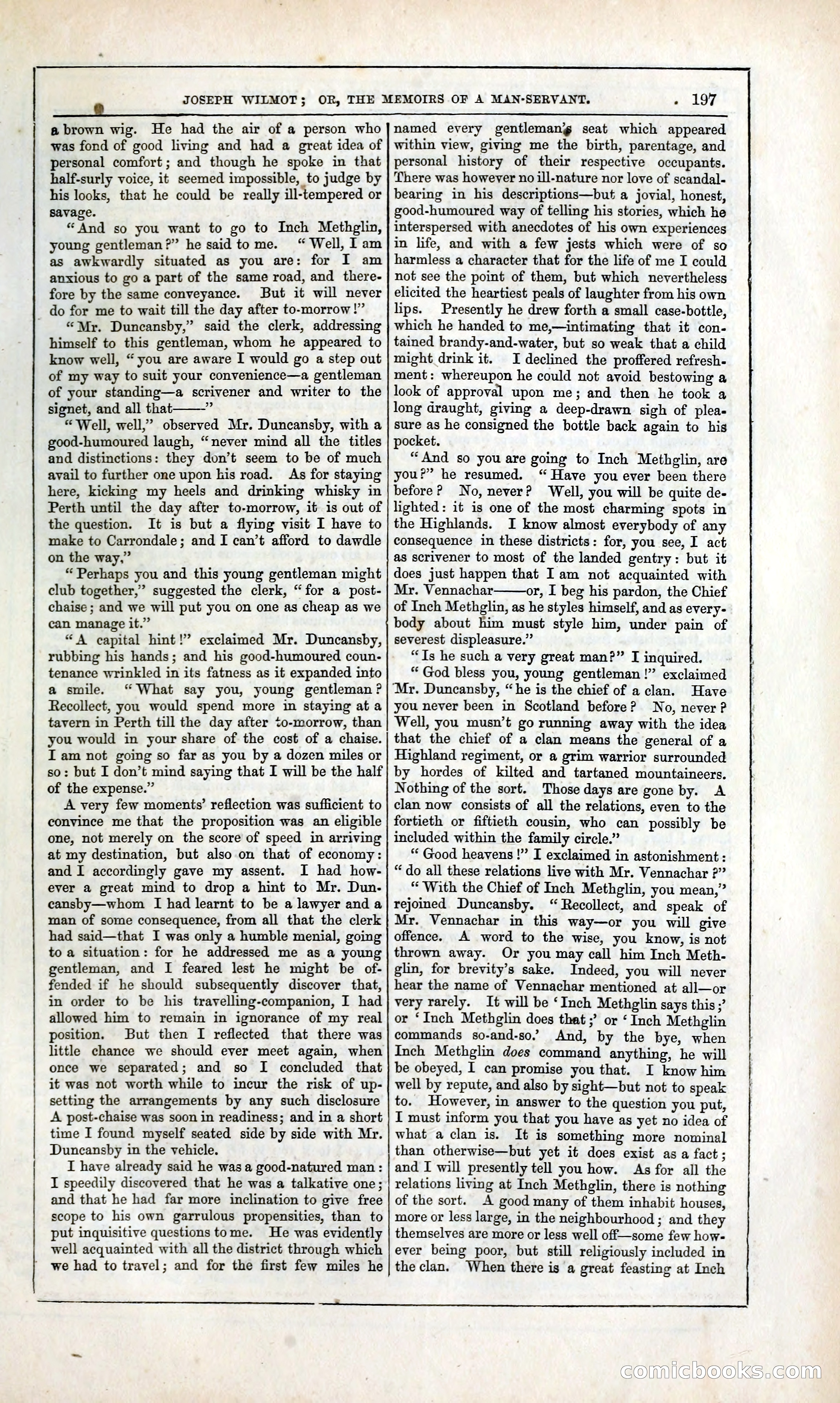
A restored page from Penny Dreadfuls, 1854. Page through the whole issue in the reader above.
📄 Transcribed text from this page (OCR, searchable)
Machine-transcribed from the original scan — historical spelling and the odd misread are preserved.
JOSEPH WILMOT ; a brown wig. He had the air of a person who was fond of good living and had a great idea of personal comfort; and though he spoke in that half-surly voice, it seemed impossible, to judge by his looks, that he could be really ill-tempered or savage. “And so you want to go to Inch Methglin, young gentleman?” he said tome. “ Well, lam as awkwardly situated as you are: for I am anxious to go a part of the same road, and there- fore by the same conveyance. But it will never do for me to wait till the day after to-morrow!” “Mr. Duncansby,” said the clerk, addressing himself to this gentleman, whom he appeared to know well, “you are aware I would go a step out of my way to suit your convenience—a gentleman of your standing—a scrivener and writer to the signet, and all that . “Well, well,” observed Mr. Duncansby, with a good-humoured laugh, “never mind all the titles and distinctions: they don’t seem to be of much avail to further one upon his road. As for staying here, kicking my heels and drinking whisky in Perth until the day after to-morrow, it is out of the question. It is but a flying visit I have to make to Carrondale; and I can’t afford to dawdle on the way,” “Perhaps you and this young gentleman might club together,” suggested the clerk, “for a post- chaise ; and we will put you on one as cheap as we can manage it.” “A capital hint!” exclaimed Mr. Duncansby, rubbing his hands; and his good-humoured coun- tenance wrinkled in its fatness as it expanded into a smile. “What say you, young gentleman? Recollect, you would spend more im staying ata tavern in Perth till the day after to-morrow, than you would in your share of the cost of a chaise. I am not going so far as you by a dozen miles or so: but I don’t mind saying that I will be the half of the expense.” A very few moments’ reflection was sufficient to convince me that the proposition was an eligible one, not merely on the score of speed in arriving at my destination, but also on that of economy: and I accordingly gave my assent. I had how- ever a great mind to drop a hint to Mr. Dun- cansby—whom I had learnt to be a lawyer and a man of some consequence, from all that the clerk had said—that I was only a humble menial, going to a situation: for he addressed me as a young gentleman, and I feared lest he might be of- fended if he should subsequently discover that, in order to be his trayelling-companion, I had allowed him to remain in ignorance of my real position. But then I reflected that there was little chance we should ever meet again, when once we separated; and so I concluded that it was not worth while to incur the risk of up- setting the arrangements by any such disclosure A post-chaise was soon in readiness; and in a short time I found myself seated side by side with Mr. Duncansby in the vehicle. I have already said he was a good-natured man: I speedily discovered that he was a talkative one; and that he had far more inclination to give free scope to his own garrulous propensities, than to put inquisitive questions tome. He was evidently well acquainted with all the district through which we had to travel; and for the first few miles he OR, THE MEMOIRS OF A MAN-SERVANT., 197 named every gentleman seat which appeared within view, giving me the birth, parentage, and personal history of their respective occupants. There was however no ill-nature nor love of scandal- bearing in his descriptions—but a jovial, honest, good-humoured way of telling his stories, which he interspersed with anecdotes of his own experiences in life, and with a few jests which were of so harmless a character that for the life of me I could not see the point of them, but which nevertheless elicited the heartiest peals of laughter from his own lips. Presently he drew forth a small case-bottle, which he handed to me,—intimating that it con- tained brandy-and-water, but so weak that a child might drink it. I declined the proffered refresh- ment: whereupon he could not avoid bestowing a look of approval upon me; and then he took a long draught, giving a deep-drawn sigh of plea- sure as he consigned the bottle back again to his pocket. “And so you are going to Inch Methglin, are you?” he resumed. ‘“ Have you ever been there before? No, never? Well, you will be quite de- lighted: it is one of the most charming spots in the Highlands. I know almost everybody of any consequence in these districts: for, you see, I act as scrivener to most of the landed gentry: but it does just happen that I am not acquainted with Mr. Vennachar or, I beg his pardon, the Chief of Inch Methglin, as he styles himself, and as every- body about him must style him, under pain of severest displeasure.” “Is he such a very great man?” I inquired. “ God bless you, young gentleman!” exclaimed ‘Mr. Duncansby, “he is the chief of a clan. Have you never been in Scotland before? No, never? Well, you musn’t go running away with the idea that the chief of a clan means the general of a Highland regiment, or a grim warrior surrounded by hordes of kilted and tartaned mountaineers. Nothing of the sort. Those days are gone by. A clan now consists of all the relations, even to the fortieth or fiftieth cousin, who can possibly be included within the family circle.” “‘ Good heavens !” I exclaimed in astonishment : “ do all these relations live with Mr. Vennachar ?” “ With the Chief of Inch Methglin, you mean,” rejommed Duncansby. “ Recollect, and speak of Mr. Vennachar in this way—or you will give offence. A word to the wise, you know, is not thrown away. Or you may call him Inch Meth- glin, for brevity’s sake. Indeed, you will never hear the name of Vennachar mentioned at all—or very rarely. It will be ‘Inch Methglin says this ;? or ‘Inch Methglin does that ;’ or ‘Inch Methglin commands so-and-so.’ And, by the bye, when Inch Methglin does command anything, he will be obeyed, I can promise you that. I know him well by repute, and also by sight—but not to speak to. However, in answer to the question you put, I must inform you that you have as yet no idea of what a clan is. It is something more nominal than otherwise—but yet it does exist as a fact; and I will presently tell you how. As for all the relations living at Inch Methglin, there is nothing of the sort. A good many of them inhabit houses, more or less large, in the neighbourhood ; and they themselves are more or less well off—some few how- ever being poor, but still religiously included in the clan. When there is a great feasting at Inch Glyoo S (CO) AA