
Penny Dreadfuls, 1854 · page 213 of 394
Joseph Wilmot, or, The Memoirs of a Man-Servant — page 213: what you’re looking at
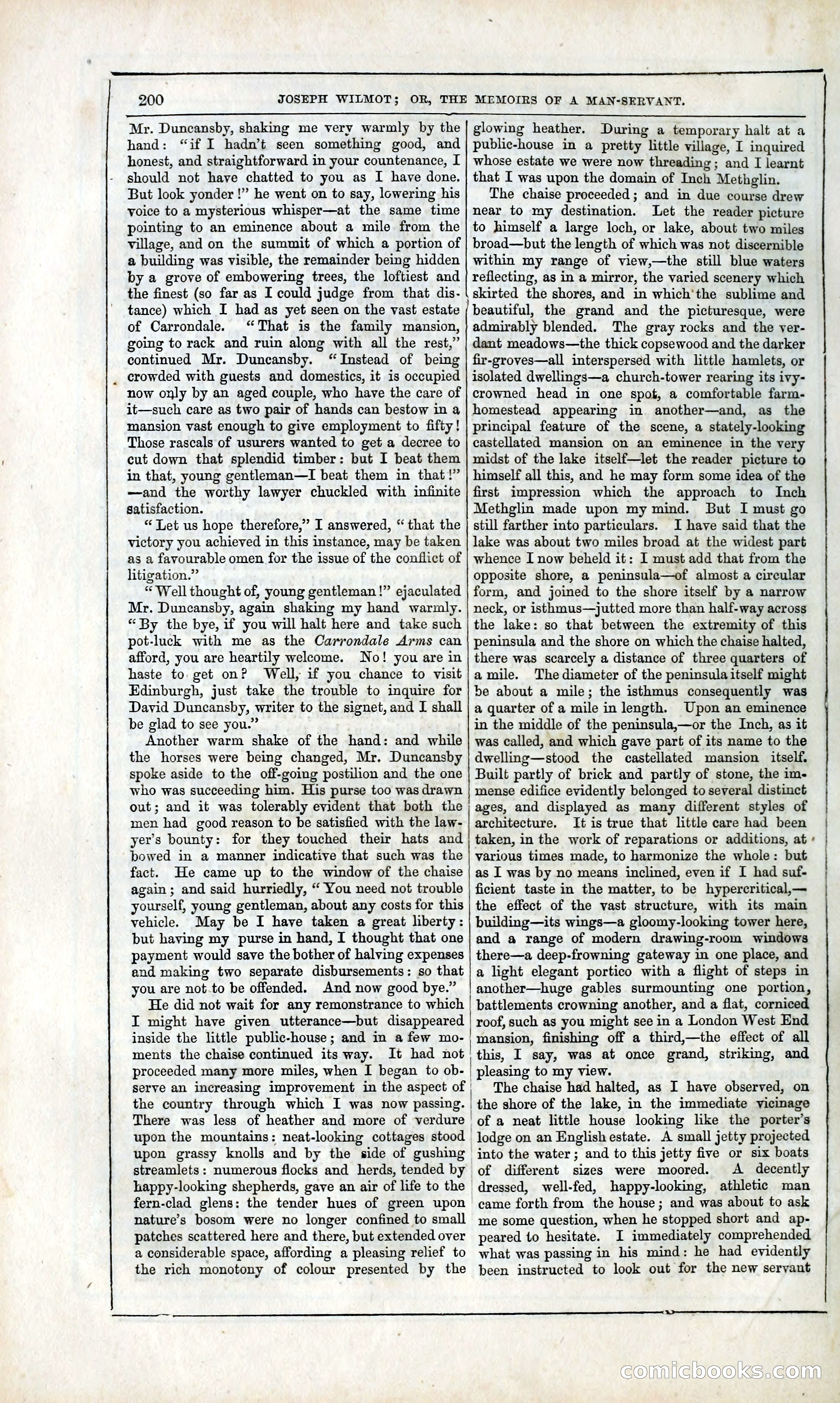
A restored page from Penny Dreadfuls, 1854. Page through the whole issue in the reader above.
📄 Transcribed text from this page (OCR, searchable)
Machine-transcribed from the original scan — historical spelling and the odd misread are preserved.
ee ee 200 JOSEPH WILMOT; OR, THE MEMOIRS OF A MAN-SERVANT. Mr. Duncansby, shaking me very warmly by the hand: “if I hadn’t seen something good, and honest, and straightforward in your countenance, I should not have chatted to you as I have done. But look yonder !” he went on to say, lowering his voice to a mysterious whisper—at the same time pointing to an eminence about a mile from the village, and on the summit of which a portion of a building was visible, the remainder being hidden by a grove of embowering trees, the loftiest and the finest (so far as I could judge from that dis- tance) which I had as yet seen on the vast estate of Carrondale. “That is the family mansion, going to rack and ruin along with all the rest,” continued Mr. Duncansby. “Instead of being _ crowded with guests and domestics, it is occupied now only by an aged couple, who have the care of it—such care as two pair of hands can bestow in a mansion vast enough to give employment to fifty! Those rascals of usurers wanted to get a decree to cut down that splendid timber: but I beat them in that, young gentleman—I beat them in that!” —and the worthy lawyer chuckled with infinite satisfaction. “Let us hope therefore,” I answered, “ that the victory you achieved in this instance, may be taken as a favourable omen for the issue of the conflict of litigation.” “ Well thought of, young gentleman!” ejaculated Mr. Duncansby, again shaking my hand warmly. “By the bye, if you will halt here and take such pot-luck with me as the Carrondale Arms can afford, you are heartily welcome. No! you are in haste to get on? Well, if you chance to visit Edinburgh, just take the trouble to inquire for David Duncansby, writer to the signet, and I shall be glad to see you.” Another warm shake of the hand: and while the horses were being changed, Mr. Duncansby spoke aside to the off-going postilion and the one who was succeeding him. His purse too was drawn out; and it was tolerably evident that both the men had good reason to be satisfied with the law- yer’s bounty: for they touched their hats and bowed in a manner indicative that such was the fact. He came up to the window of the chaise again ; and said hurriedly, “ You need not trouble yourself, young gentleman, about any costs for this vehicle. May be I have taken a great liberty: but having my purse in hand, I thought that one payment would save the bother of halving expenses and making two separate disbursements: so that you are not.to be offended. And now good bye.” He did not wait for any remonstrance to which I might have given utterance—but disappeared inside the little public-house; and in a few mo- ments the chaise continued its way. It had not proceeded many more miles, when I began to ob- serve an increasing improvement in the aspect of | the country through which I was now passing. There was less of heather and more of verdure | upon the mountains: neat-looking cottages stood upon grassy knolls and by the side of gushing streamlets: numerous flocks and herds, tended by happy-looking shepherds, gave an air of life to the fern-clad glens: the tender hues of green upon nature’s bosom were no longer confined to small patches scattered here and there, but extended over a considerable space, affording a pleasing relief to the rich monotony of colour presented by the glowing heather. During a temporary halt at a public-house in a pretty little village, I inquired whose estate we were now threading; and I learnt that I was upon the domain of Inch Methglin. The chaise proceeded; and in due course drew near to my destination. Let the reader picture to himself a large loch, or lake, about two miles broad—but the length of which was not discernible within my range of view,—the still blue waters reflecting, as in a mirror, the varied scenery which skirted the shores, and in which'the sublime and beautiful, the grand and the picturesque, were admirably blended. The gray rocks and the yer- dant meadows—the thick copsewood and the darker fir-groves—all interspersed with little hamlets, or isolated dwellings—a church-tower rearing its ivy- crowned head in one spot, a comfortable farm- homestead appearmg in another—and, as the principal feature of the scene, a stately-looking castellated mansion on an eminence in the very midst of the lake itself—let the reader picture to himself all this, and he may form some idea of the first impression which the approach to Inch Methglin made upon my mind. But I must go still farther into particulars. I have said that the lake was about two miles broad at the widest part whence I now beheld it: I must add that from the opposite shore, a peninsula—of almost a cireular form, and joined to the shore itself by a narrow neck, or isthmus—jutted more than half-way across the lake: so that between the extremity of this peninsula and the shore on which the chaise halted, there was scarcely a distance of three quarters of amile. The diameter of the peninsula itself might be about a mile; the isthmus consequently was a quarter of a mile in length. Upon an eminence in the middle of the peninsula,—or the Inch, as it was called, and which gave part of its name to the dwelling—stood the castellated mansion itself. Built partly of brick and partly of stone, the im- mense edifice evidently belonged to several distinct ages, and displayed as many different styles of architecture. It is true that little care had been taken, in the work of reparations or additions, at * various times made, to harmonize the whole: but as I was by no means inclined, even if I had suf- ficient taste in the matter, to be hypercritical,— the effect of the vast structure, with its main building—its wings—a gloomy-looking tower here, and a range of modern drawing-room windows there—a deep-frowning gateway in one place, and a light elegant portico with a flight of steps in another—huge gables surmounting one portion, battlements crowning another, and a flat, corniced roof, such as you might see in a London West End mansion, finishing off a third,—the effect of all this, I say, was at once grand, striking, and pleasing to my view. The chaise had halted, as I have observed, on the shore of the lake, in the immediate yicinage of a neat little house looking like the porter’s lodge on an English estate. A small jetty projected into the water; and to this jetty five or six boats of different sizes were moored. A decently dressed, well-fed, happy-looking, athletic man came forth from the house; and was about to ask me some question, when he stopped short and ap- peared to hesitate. I immediately comprehended what was passing in his mind: he had evidently been instructed to look out for the new servant OOO) <S) GOI