
Penny Dreadfuls, 1854 · page 221 of 394
Joseph Wilmot, or, The Memoirs of a Man-Servant — page 221: what you’re looking at
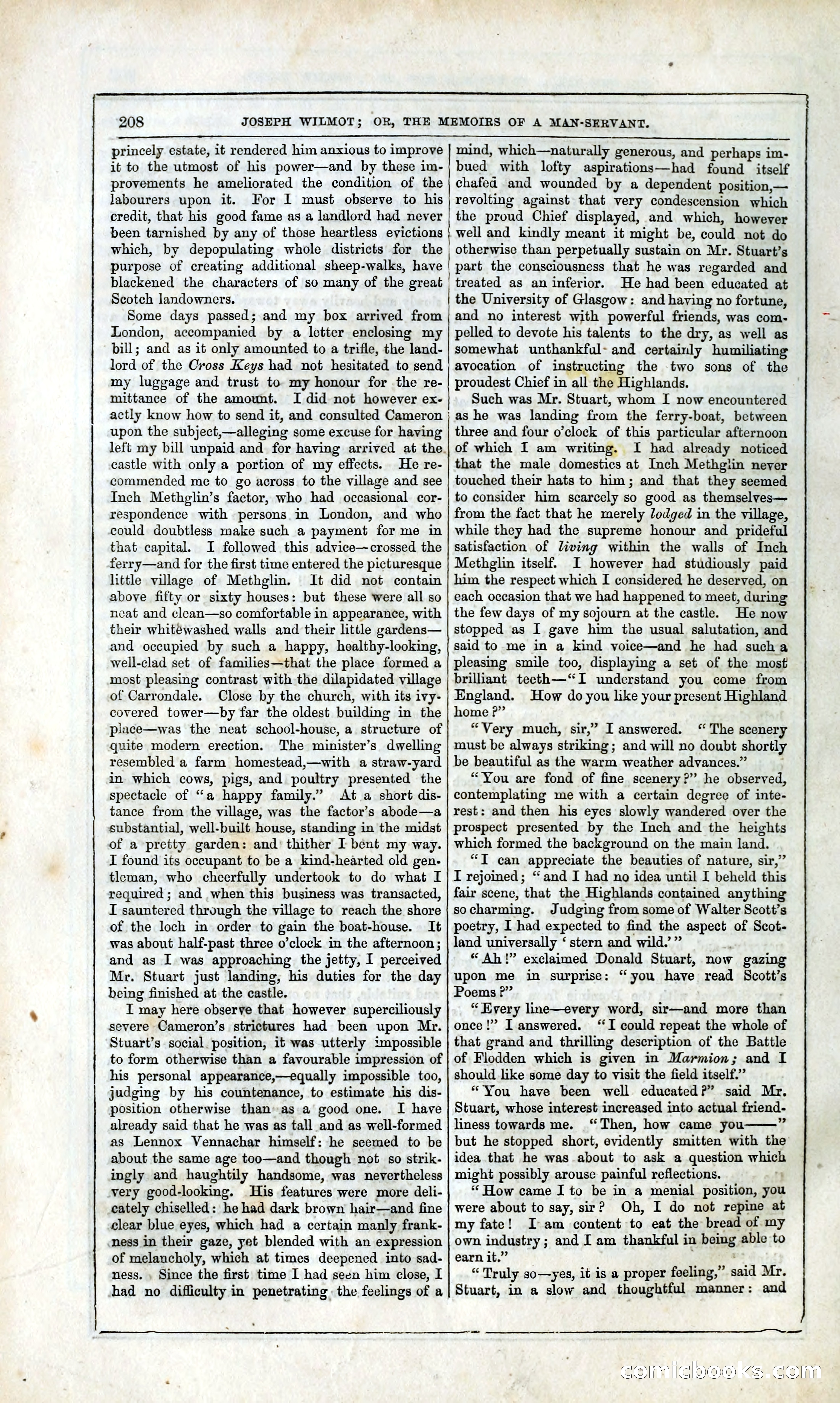
A restored page from Penny Dreadfuls, 1854. Page through the whole issue in the reader above.
📄 Transcribed text from this page (OCR, searchable)
Machine-transcribed from the original scan — historical spelling and the odd misread are preserved.
seine a ES SN STE SE Ns SRS 208 princely estate, it rendered him anxious to improve it to the utmost of his power—and by these im- provements he ameliorated the condition of the labourers upon it. For I must observe to his credit, that his good fame as a landlord had never been tarnished by any of those heartless evictions which, by depopulating whole districts for the purpose of creating additional sheep-walks, have blackened the characters of so many of the great Scotch landowners. Some days passed; and my box arrived from London, accompanied by a letter enclosing my bill; and as it only amounted to a trifle, the land- lord of the Cross Keys had not hesitated to send my luggage and trust to my honour for the re- mittance of the amount. I did not however ex- actly know how to send it, and consulted Cameron | upon the subject,—alleging some excuse for having left my bill unpaid and for having arrived at the. castle with only a portion of my effects. He re- commended me to go across to the village and see Inch Methglin’s factor, who had occasional cor- respondence with persons in London, and who could doubtless make such a payment for me in that capital. I followed this advice—crossed the ferry—and for the first time entered the picturesque little village of Methglin. It did not contain above fifty or sixty houses: but these were all so neat and clean—so comfortable in appearance, with their whitéwashed walls and their little gardens— and occupied by such a happy, healthy-looking, well-clad set of families—that the place formed a most pleasing contrast with the dilapidated village of Carrondale. Close by the church, with its ivy- covered tower—by far the oldest building in the place—was the neat school-house, a structure of quite modern erection. The minister’s dwelling resembled a farm homestead,—with a straw-yard in which cows, pigs, and poultry presented the spectacle of “a happy family.” At a short dis- tance from the village, was the factor’s abode—a substantial, well-built house, standing in the midst of a pretty garden: and’ thither I bent my way. I found its occupant to be a kind-hearted old gen- tleman, who cheerfully undertook to do what I required ; and when this business was transacted, I sauntered through the village to reach the shore of the loch in order to gain the boat-house. It was about half-past three o’clock in the afternoon; and as I was approaching the jetty, I perceived Mr. Stuart just landing, his duties for the day being finished at the castle. I may here observe that however superciliously severe Cameron’s strictures had been upon Mr. Stuart’s social. position, it was utterly xmpossible to form otherwise than a favourable impression of his personal appearance,—equally impossible too, judging by his countenance, to estimate his dis- position otherwise thanas a good one. I have already said that he was as tall and as well-formed as Lennox Vennachar himself: he seemed to be about the same age too—and though not so strik- ingly and haughtily handsome, was nevertheless very good-looking. His features were more deli- cately chiselled: he had dark brown hair—and fine clear blue eyes, which had a certain manly frank- ness in their gaze, yet blended with an expression of melancholy, which at times deepened into sad- ness. , Since the first time I had seen him close, I had no difliculty in penetrating : the feelings of a JOSEPH WILMOT; OR, THE MEMOIRS OF A MAN-SERVANT. mind, which—naturally generous, and perhaps im- bued with lofty aspirations—had found itself chafead and wounded by a dependent position,— revolting against that very condescension which the proud Chief displayed, and which, however well and kindly meant it might be, could not do otherwise than perpetually sustain on Mr. Stuart’s part the consciousness that he was regarded and treated as an inferior. He had been educated at the University of Glasgow: and haying no fortune, and no interest with powerful friends, was com- pelled to devote his talents to the dry, as well as somewhat unthankful- and certainly humiliating avocation of instructing the two sons of the proudest Chief in all the Highlands. Such was Mr. Stuart, whom I now encountered as he was landing from the ferry-boat, between three and four o’clock of this particular afternoon of which I am writing. I had already noticed that the male domestics at Inch Methglin never touched their hats to him; and that they seemed to consider him scarcely so good as themselves— from the fact that he merely lodged in the village, while they had the supreme honour and prideful satisfaction of living within the walls of Inch Methglin itself. I however had studiously paid him the respect which I considered he deserved, on each occasion that we had happened to meet, during the few days of my sojourn at the castle. He now stopped as I gave him the usual salutation, and said to me in a kind voice—and he had sucha pleasing smile too, displaying a set of the most brilliant teeth—“I understand you come from England. How do you lke your present Highland home ?” “Very much, sir,” I answered. “The scenery must be always striking ; and will no doubt shortly be beautiful as the warm weather advances.” | “You are fond of fine scenery?” he observed, contemplating me with a certain degree of inte- rest: and then his eyes slowly wandered over the prospect presented by the Inch and the heights which formed the background on the main land. “T can appreciate the beauties of nature, sir,” I rejoined; “and I had no idea until I beheld this fair scene, that the Highlands contained anything socharming. Judging from some of Walter Scott’s poetry, I had expected to find the aspect of Scot- land universally ‘ stern and wild.’ ” “Ah!” exclaimed Donald Stuart, now gazing upon me in surprise: “ you have read Scott’s Poems P?” “Every line—every word, sir—and more than once!” ITanswered. “I could repeat the whole of that grand and thrilling description of the Battle of Flodden which is given in Marmion; and I should like some day to visit the field itself.” “You have been well educated?” said Mr. Stuart, whose interest increased into actual friend- liness towards me. “Then, how came you 7 but he stopped short, evidently smitten with the idea that he was about to ask a question va might possibly arouse painful reflections. “ How came I to be in a menial position, you were about to say, sir? Oh, I do not repine at my fate! I am content to eat the bread of my own industry ; and I am thankful in being able to earn it.” “Truly so—yes, it is a proper feeling,” said Mr. Stuart, in a slow and thoughtful manner: and Gboo S (CO) —— im