
Penny Dreadfuls, 1854 · page 249 of 394
Joseph Wilmot, or, The Memoirs of a Man-Servant — page 249: what you’re looking at
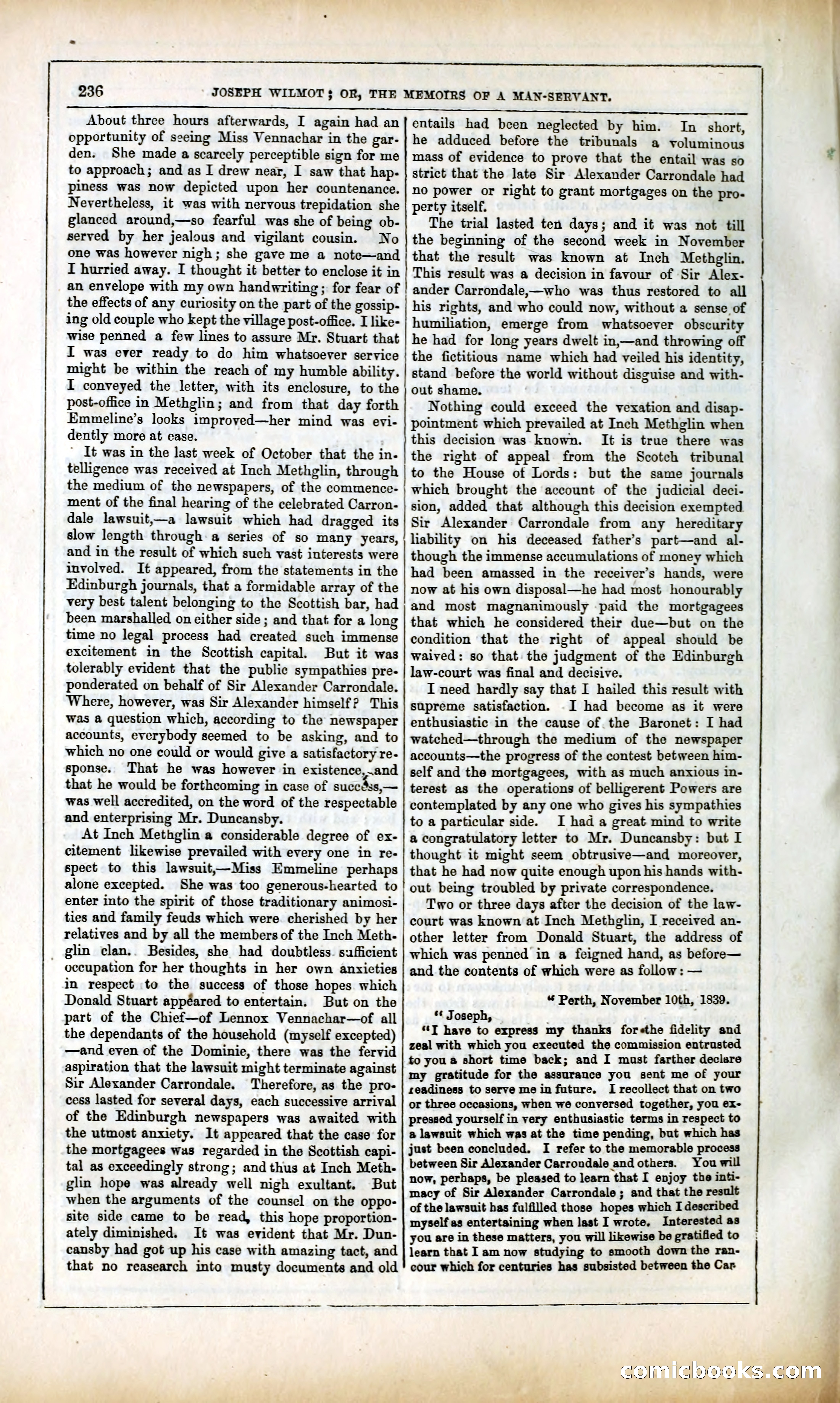
A restored page from Penny Dreadfuls, 1854. Page through the whole issue in the reader above.
📄 Transcribed text from this page (OCR, searchable)
Machine-transcribed from the original scan — historical spelling and the odd misread are preserved.
236 About three hours afterwards, I again had an opportunity of seeing Miss Vennachar in the gar- den. She made a scarcely perceptible sign for me to approach; and as I drew near, I saw that hap- piness was now depicted upon her countenance. Nevertheless, it was with nervous trepidation she glanced around,—so fearful was she of being ob- served by her jealous and vigilant cousin. No one was however nigh; she gave me a note~—and I hurried away. I thought it better to enclose it in an envelope with my own handwriting; for fear of the effects of any curiosity on the part of the gossip- ing old couple who kept the village post-office. I like- wise penned a few lines to assure Mr. Stuart that I was ever ready to do him whatsoever service might be within the reach of my humble ability. I conveyed the letter, with its enclosure, to the post-office in Methglin; and from that day forth Emmeline’s looks improved—her mind was evi- dently more at ease. It was in the last week of October that the in- telligence was received at Inch Methglin, through the medium of the newspapers, of the commence- ment of the final hearing of the celebrated Carron- dale lawsuit,—a lawsuit which had dragged its slow length through a@ series of so many years, and in the result of which such vast interests were involved. It appeared, from the statements in the Edinburgh journals, that a formidable array of the very best talent belonging to the Scottish bar, had been marshalled on either side ; and that for a long time no legal process had created such immense excitement in the Scottish capital. But it was tolerably evident that the public sympathies pre- ponderated on behalf of Sir Alexander Carrondale. Where, however, was Sir Alexander himself? This was a question which, according to the newspaper accounts, everybody seemed to be asking, and to which no one could or would give a satisfactory re- sponse. That he was however in existence,.and that he would be forthcoming in case of succéss,— was well accredited, on the word of the respectable and enterprising Mr. Duncansby. At Inch Methglin a considerable degree of ex- citement likewise prevailed with every one in re- spect to this lawsuit,~—Miss Emmeline perhaps alone excepted. She was too generous-hearted to enter into the spirit of those traditionary animosi- ties and family feuds which were cherished by her relatives and by all the members of the Inch Meth- _ glin clan.. Besides, she had doubtless. sufficient occupation for her thoughts in her own anxieties in respect to the success of those hopes which Donald Stuart appéared to entertain. But on the part of the Chief—of Lennox Vennachar—of all the dependants of the household (myself excepted) —and even of the Dominie, there was the fervid aspiration that the lawsuit might terminate against Sir Alexander Carrondale. Therefore, as the pro- cess lasted for several days, each successive arrival of the Edinburgh newspapers was awaited with the utmost anxiety. It appeared that the case for the mortgagees wus regarded in the Scottish capi- tal as exceedingly strong; and thus at Inch Meth- glin hope was already well nigh exultant. But when the arguments of the counsel on the oppo- site side came to be read, this hope proportion- ately diminished. It was evident that Mr. Dun- causby had got up his case with amazing tact, and that no reasearch into musty documents and old I JOSEPH WILMOT$ OR, THE MEMOIRS OF A MAN-SERVANT. entails had been neglected by him. In short, he adduced before the tribunals a voluminous mass of evidence to prove that the entail was so strict that the late Sir Alexander Carrondale had no power or right to grant mortgages on the pro- perty itself. The trial lasted ten days; and it was not till the beginning of the second week in November that the result was known at Inch Methglin. This result was a decision in favour of Sir Alex- ander Carrondale,—who was thus restored to all his rights, and who could now, without a sense of humiliation, emerge from whatsoever obscurity he had for long years dwelt in,—and throwing off the fictitious name which had veiled his identity, stand before the world without disguise and with- out shame. Nothing could exceed the vexation and disap- pointment which prevailed at Inch Methglin when this decision was known. It is true there was the right of appeal from the Scotch tribunal to the House ot Lords: but the same journals which brought the account of the judicial deci- sion, added that although this decision exempted Sir Alexander Carrondale from any hereditary liability on his deceased father’s part—and al- though the immense accumulations of money which had been amassed in the receiver’s hands, were now at his own disposal—he had most honourably and most magnanimously paid the mortgagees that which he considered their due—but on the condition that the right of appeal should be waived: so that the judgment of the Edinburgh law-court was final and decisive. I need hardly say that I hailed this result with supreme satisfaction. I had become as it were enthusiastic in the cause of the Baronet: I had watched—through the medium of the newspaper accounts—the progress of the contest between him- self and the mortgagees, with as much anxious in- terest as the operations of belligerent Powers are contemplated by any one who gives his sympathies to a particular side. I had a great mind to write a congratulatory letter to Mr. Duncansby: but I thought it might seem obtrusive—and moreover, that he had now quite enough upon his hands with- out being troubled by private correspondence. Two or three days after the decision of the law- court was known at Inch Methglin, I received an- other letter from Donald Stuart, the address of which was penned in a feigned hand, as before— and the contents of which were as follow: — “ Perth, November 10th, 1839. ** Joseph, “T have to express my thanks forethe fidelity and zeal with which you executed the commission entrusted to you 8 short time back; and I must farther declare my gratitude for the assurance you sent me of your readiness to serve mein future. I recollect that on two or three occasions, when we conversed together, you ex- pressed yourself in very enthusiastic terms in respect to a lawsuit which was at the time pending, but which has just been concluded. I refer to the memorable process between Sir Alexander Carrondale and others. You will now, perhaps, be pleased to learn that I enjoy the inti- macy of Sir Alexander Carrondale ; and that the result of the lawsuit has fulfilled those hopes which I described myself as entertaining when last I wrote. Interested as you are in these matters, you will likewise be gratified to learn that I am now studying to smooth down the ran- cour which for centuries has subsisted between the Car