
Penny Dreadfuls, 1854 · page 266 of 394
Joseph Wilmot, or, The Memoirs of a Man-Servant — page 266: what you’re looking at
A restored page from Penny Dreadfuls, 1854. Page through the whole issue in the reader above.
📄 Transcribed text from this page (OCR, searchable)
Machine-transcribed from the original scan — historical spelling and the odd misread are preserved.
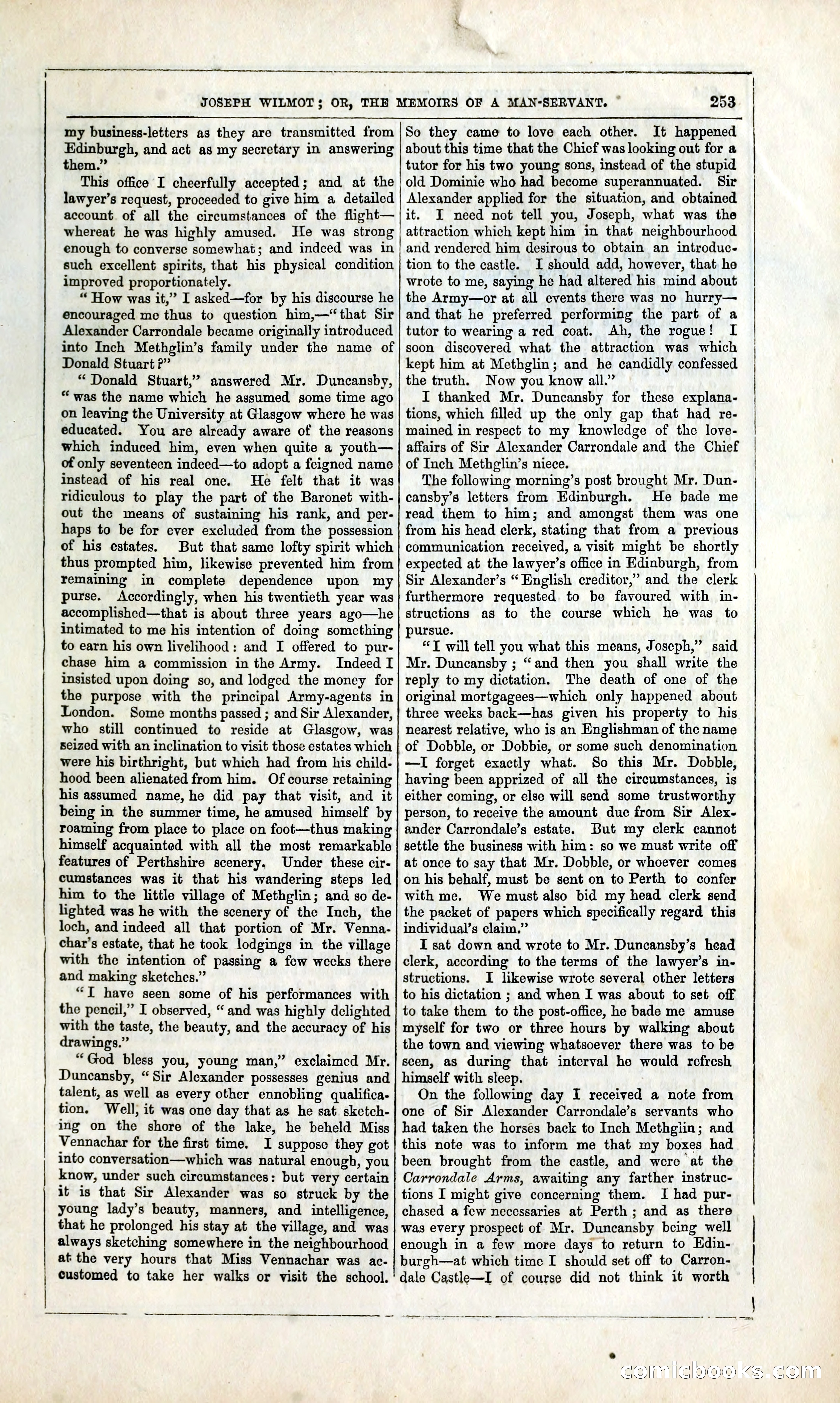
JOSEPH WILMOT; OR, THE MEMOIRS OF A MAN-SERVANT. — = — 253 my business-letters as they are transmitted from Edinburgh, and act as my secretary in answering them.” This office I cheerfully accepted; and at the lawyer’s request, proceeded to give him a detailed account of all the circumstances of the flight— whereat he was highly amused. He was strong enough to converse somewhat; and indeed was in such excellent spirits, that his physical condition improved proportionately. “ How was it,” I asked—for by his discourse he encouraged me thus to question him,—“that Sir Alexander Carrondale became originally introduced into Inch Methglin’s family under the name of Donald Stuart ?” “Donald Stuart,” answered Mr. Duncansby, ‘was the name which he assumed some time ago on leaving the University at Glasgow where he was educated. You are already aware of the reasons which induced him, even when quite a youth— of only seventeen indeed—to adopt a feigned name instead of his real one. He felt that it was ridiculous to play the part of the Baronet with- out the means of sustaining his rank, and per- haps to be for ever excluded from the possession of his estates. But that same lofty spirit which thus prompted him, likewise prevented him from remaining in complete dependence upon my purse. Accordingly, when his twentieth year was accomplished—that is about three years ago—he intimated to me his intention of doing something to earn his own livelihood: and I offered to pur- chase him a commission in the Army. Indeed I insisted upon doing so, and lodged the money for the purpose with the principal Army-agents in London. Some months passed ; and Sir Alexander, who still continued to reside at Glasgow, was seized with an inclination to visit those estates which were his birthright, but which had from his child- hood been alienated from him. Of course retaining his assumed name, he did pay that visit, and it being i in the summer time, he amused himself by roaming from place to place on foot—thus making himself acquainted with all the most remarkable features of Perthshire scenery, Under these cir- cumstances was it that his wandering steps led him to the little village of Methglin; and so de- lighted was he with the scenery of the Inch, the loch, and indeed all that portion of Mr. Venna- char’ s estate, that he took lodgings in the village with the intention of passing a few weeks there and making sketches.” “I have seen some of his performances with the pencil,” I observed, “ and was highly delighted with the taste, the beauty, and the accuracy of his drawings.” “God bless you, young man,” exclaimed Mr. Duncansby, “Sir Alexander possesses genius and talent, as well as every other ennobling qualifica- tion. Well; it was one day that as he sat sketch- ing on the shore of the lake, he beheld Miss Vennachar for the first time. I suppose they got into conversation—which was natural enough, you know, under such circumstances: but very certain it is that Sir Alexander was so struck by the young lady’s beauty, manners, and intelligence, that he prolonged his stay at the village, and was always sketching somewhere in the neighbourhood atthe very hours that Miss Vennachar was ac- customed to take her walks or visit the school. So they came to love each other. It happened about this time that the Chief was looking out for a tutor for his two young sons, instead of the stupid old Dominie who had become superannuated. Sir Alexander applied for the situation, and obtained it. I need not tell you, Joseph, what was the attraction which kept him in that neighbourhood and rendered him desirous to obtain an introduc- tion to the castle. I should add, however, that he wrote to me, saying he had altered his mind about the Army—or at all events there was no hurry— and that he preferred performing the part of a tutor to wearing a red coat. Ah, the rogue! I soon discovered what the attraction was which kept him at Methglin; and he candidly confessed the truth. Now you know all.” I thanked Mr. Duncansby for these explana- tions, which filled up the only gap that had re- mained in respect to my knowledge of the love- affairs of Sir Alexander Carrondale and the Chief of Inch Methglin’s niece. The following morning’s post brought Mr. Dun- cansby’s letters from Edinburgh. “He bade me read them to him; and amongst them was one from his head clerk, stating that from a previous communication received, a visit might be shortly expected at the lawyer’s office in Edinburgh, from Sir Alexander’s “ English creditor,” and the clerk furthermore requested to be favoured with in- structions as to the course which he was to ursue. “T will tell you what this means, Joseph,” said Mr. Duncansby ; “and then you shall write the reply to my dictation. The death of one of the original mortgagees—which only happened about three weeks back—has given his property to his nearest relative, who is an Englishman of the name of Dobble, or Dobbie, or some such denomination —I forget exactly what. So this Mr. Dobble, having been apprized of all the circumstances, is either coming, or else will send some trustworthy person, to receive the amount due from Sir Alex- ander Carrondale’s estate. But my clerk cannot settle the business with him: so we must write off at once to say that Mr. Dobble, or whoever comes on his behalf, must be sent on to Perth to confer with me. We must also bid my head clerk send the packet of papers which specifically regard this individual’s claim.” I sat down and wrote to Mr. Duncansby’s head clerk, according to the terms of the lawyer’s in- structions. I likewise wrote several other letters to his dictation ; and when I was about to set off to take them to the post-office, he bade me amuse myself for two or three hours by walking about the town and viewing whatsoever there was to be seen, as during that interval he would refresh himself with sleep. On the following day I received a note from one of Sir Alexander Carrondale’s servants who had taken the horses back to Inch Methgiin; and this note was to inform me that my boxes had been brought from the castle, and were “at the Carrondale Arms, awaiting any farther instruc- tions I might give concerning them. I had pur- chased a few necessaries at Perth; and as there was every prospect of Mr. Duncansby being well enough in a few more days to return to Kdin- burgh—at which time I should set off to Carron- dale Castle—I of course did not think it worth b Ghboo SS (CO) AA