
Penny Dreadfuls, 1854 · page 269 of 394
Joseph Wilmot, or, The Memoirs of a Man-Servant — page 269: what you’re looking at
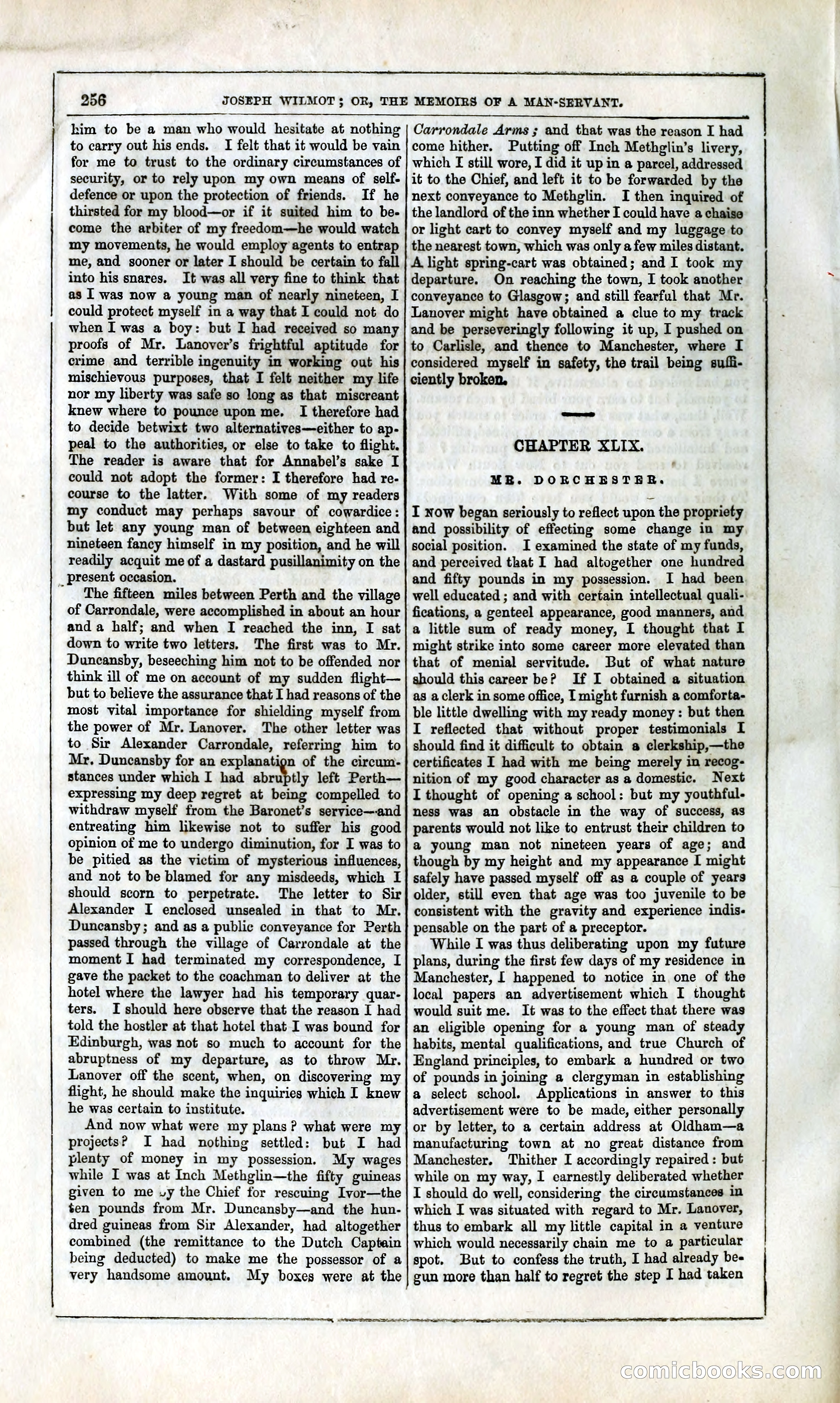
A restored page from Penny Dreadfuls, 1854. Page through the whole issue in the reader above.
📄 Transcribed text from this page (OCR, searchable)
Machine-transcribed from the original scan — historical spelling and the odd misread are preserved.
956 JOSEPH WILMOT; OR, THE MEMOIRS OF A MAN-SERVANT. him to be a man who would hesitate at nothing to carry out his ends. I felt that it would be vain for me to trust to the ordinary circumstances of security, or to rely upon my own means of self- defence or upon the protection of friends. If he thirsted for my blood—or if it suited him to be- come the arbiter of my freedom—he would watch my movements, he would employ agents to entrap me, and sooner or later I should be certain to fall into his snares. It was all very fine to think that as I was now a young man of nearly nineteen, I could protect myself in a way that I could not do when I was a boy: but I had received so many proofs of Mr. Lanover’s frightful aptitude for crime and terrible ingenuity in working out his mischievous purposes, that I felt neither my life nor my liberty was safe so long as that miscreant knew where to pounce upon me. I therefore had to decide betwixt two alternatives—either to ap- peal to the authorities, or else to take to flight. The reader is aware that for Annabel’s sake I could not adopt the former: I therefore had re- course to the latter. With some of my readers my conduct may perhaps savour of cowardice: but let any young man of between eighteen and nineteen fancy himself in my position, and he will readily acquit me of a dastard pusillanimity on the _present occasion. The fifteen miles between Perth and the village of Carrondale, were accomplished in about an hour and a half; and when I reached the inn, I sat down to write two letters. The first was to Mr. Duncansby, beseeching him not to be offended nor think ill of me on account of my sudden flight— but to believe the assurance that I had reasons of the most vital importance for shielding myself from the power of Mr. Lanover. The other letter was to Sir Alexander Carrondale, referring him to Mr. Duncansby for an explanation of the circum- stances under which I had abruptly left Perth— expressing my deep regret at being compelled to withdraw myself from the Baronet’s service—and entreating him likewise not to suffer his good opinion of me to undergo diminution, for I was to be pitied as the victim of mysterious influences, and not to be blamed for any misdeeds, which I should scorn to perpetrate. The letter to Sir Alexander I enclosed unsealed in that to Mr. Duncansby; and as a public conveyance for Perth passed through the village of Carrondale at the moment I had terminated my correspondence, I gave the packet to the coachman to deliver at the hotel where the lawyer had his temporary quar- ters. I should here observe that the reason I had told the hostler at that hotel that I was bound for Edinburgh, was not so much to account for the abruptness of my departure, as to throw Mr. Lanover off the scent, when, on discovering my flight, he should make the inquiries which I knew he was certain to institute. And now what were my plans? what were my projects? I had nothing settled: but I had plenty of money in my possession. My wages while I was at Inch Methglin—the fifty guineas given to me wy the Chief for rescuing Ivor—the ten pounds from Mr. Duncansby—and the hun- dred guineas from Sir Alexander, had altogether combined (the remittance to the Dutch Captain being deducted) to make me the possessor of a very handsome amount. My boxes were at the at Carrondale Arms ; and that was the reason I had come hither. Putting off Inch Methglin’s livery, which f still wore, I did it up in a parcel, addressed it to the Chief, and left it to be forwarded by the next conveyance to Methglin. I then inquired of the landlord of the inn whether I could have a chaise or light cart to convey myself and my luggage to the nearest town, which was only a few miles distant. A light spring-cart was obtained; and I took my departure. On reaching the town, I took another conveyance to Glasgow; and still fearful that Mr. Lanover might have obtained a clue to my track and be perseveringly following it up, I pushed on to Carlisle, and thence to Manchester, where I considered myself in safety, the trail being sufli- ciently broken. CHAPTER XLIX. ME. DORCHESTER. I now began seriously to reflect upon the propriety and possibility of effecting some change in my social position. I examined the state of my funds, and perceived that I had altogether one hundred and fifty pounds in my possession. I had been. well educated ; and with certain intellectual quali- fications, a genteel appearance, good manners, and a little sum of ready money, I thought that I might strike into some career more elevated than that of menial servitude. But of what nature should this career be? If I obtained a situation as a clerk in some office, I might furnish a comforta- ble little dwelling with my ready money: but then I reflected that without proper testimonials I should find it difficult to obtain a clerkship,—the certificates I had with me being merely in recog- nition of my good character as a domestic. Next I thought of opening a school: but my youthful- ness was an obstacle in the way of success, as parents would not like to entrust their children to @ young man not nineteen years of age; and though by my height and my appearance I might safely have passed myself off as a couple of years older, still even that age was too juvenile to be consistent with the gravity and experience indis- pensable on the part of a preceptor. While I was thus deliberating upon my future plans, during the first few days of my residence in Manchester, [ happened to notice in one of the local papers an advertisement which I thought would suit me. It was to the effect that there was an eligible opening for a young man of steady habits, mental qualifications, and true Church of England principles, to embark a hundred or two of pounds in joining a clergyman in establishing a select school. Applications in answer to this advertisement were to be made, either personally or by letter, to a certain address at Oldham—a manufacturing town at no great distance from Manchester. Thither I accordingly repaired: but while on my way, I earnestly deliberated whether I should do well, considering the circumstances im which I was situated with regard to Mr. Lanover, thus to embark all my little capital in a venture which would necessarily chain me to a particular spot. But to confess the truth, I had already bee gun more than half to regret the step I had taken ee — , ee a ee ee as pene 5 sain gai b seine iadelethsihnatiia sien CoOnniclooolks (CS) AA