
Penny Dreadfuls, 1854 · page 273 of 394
Joseph Wilmot, or, The Memoirs of a Man-Servant — page 273: what you’re looking at
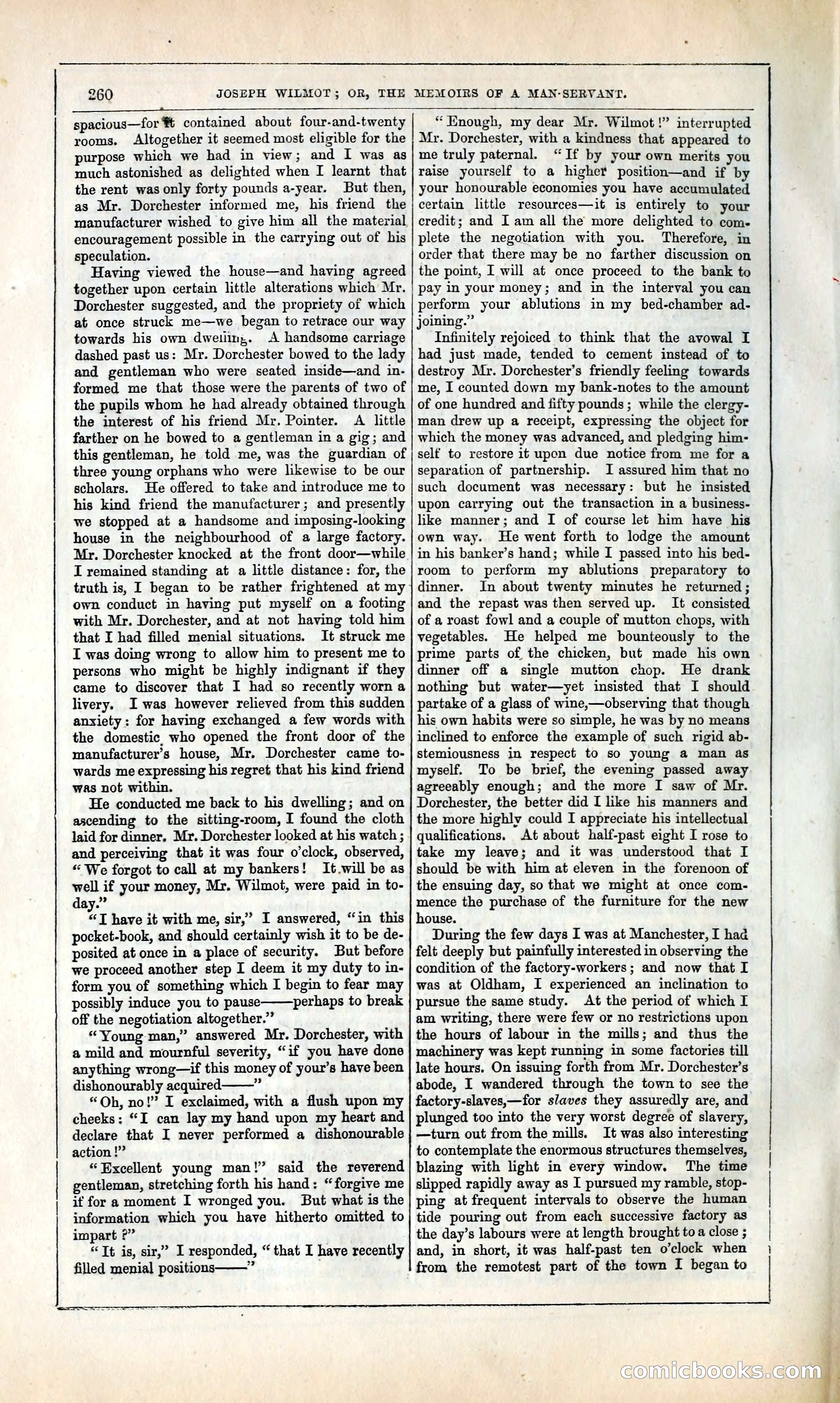
A restored page from Penny Dreadfuls, 1854. Page through the whole issue in the reader above.
📄 Transcribed text from this page (OCR, searchable)
Machine-transcribed from the original scan — historical spelling and the odd misread are preserved.
— 260 JOSEPH WILMOT; OR, THE MEMOIRS OF A MAN-SERVANT. spacious—for contained about four-and-twenty rooms. Altogether it seemed most eligible for the purpose which we had in view; and I was as much astonished as delighted when I learnt that the rent was only forty pounds a-year. But then, as Mr. Dorchester informed me, his friend the manufacturer wished to give him all the material encouragement possible in the carrying out of his speculation. Having viewed the house—and having agreed together upon certain little alterations which Mr. Dorchester suggested, and the propriety of which at once struck me—we began to retrace our way towards his own dwelling. A handsome carriage dashed past us: Mr. Dorchester bowed to the lady and gentleman who were seated inside—and in- formed me that those were the parents of two of the pupils whom he had already obtained through the interest of his friend Mr. Pointer. A little farther on he bowed to a gentleman in a gig; and this gentleman, he told me, was the guardian of three young orphans who were likewise to be our scholars. He offered to take and introduce me to his kind friend the manufacturer; and presently we stopped at a handsome and imposing-looking house in the neighbourhood of a large factory. Mr. Dorchester knocked at the front door—while I remained standing at a little distance: for, the truth is, I began to be rather frightened at my own conduct in having put myself on a footing with Mr. Dorchester, and at not having told him that I had filled menial situations. It struck me I was doing wrong to allow him to present me to persons who might be highly indignant if they came to discover that I had so recently worn a livery. Iwas however relieved from this sudden anxiety: for having exchanged a few words with the domestic. who opened the front door of the manufacturer’s house, Mr. Dorchester came to- wards me expressing his regret that his kind friend was not within. He conducted me back to his dwelling; and on ascending to the sitting-room, I found the cloth laid for dinner, Mr. Dorchester looked at his watch ; and perceiving that it was four o’clock, observed, ““We forgot to call at my bankers! It.will be as well if your money, Mr. Wilmot, were paid in to- day.” “T have it with me, sir,’ I answered, “in this pocket-book, and should certainly wish it to be de- posited at once in a place of security. But before we proceed another step I deem it my duty to in- form you of something which I begin to fear may possibly induce you to pause perhaps to break off the negotiation altogether.” “Young man,” answered Mr. Dorchester, with a mild and mournful severity, “if you have done anything wrong—if this money of your’s have been dishonourably acquired “ “Oh, no!” I exclaimed, with a flush upon my cheeks: “I can lay my hand upon my heart and declare that I never performed a dishonourable action !”” “Excellent young man!” said the reverend gentleman, stretching forth his hand: “forgive me if for a moment I wronged you. But what is the information which you have hitherto omitted to impart ?” “Tt is, sir,’ I responded, “ that I have recently filled menial positions bs “ Knough, my dear Mr. Wilmot!” interrupted Mr. Dorchester, with a kindness that appeared to me truly paternal. “If by your own merits you raise yourself to a higher position—and if by your honourable economies you have accumulated certain little resources—it is entirely to your credit; and I am all the more delighted to com- plete the negotiation with you. Therefore, in order that there may be no farther discussion on the point, I will at once proceed to the bank to pay in your money; and in the interval you can perform your ablutions in my bed-chamber ad- joining.” Infinitely rejoiced to think that the avowal I had just made, tended to cement instead of to destroy Mr. Dorchester’s friendly feeling towards me, I counted down my bank-notes to the amount of one hundred and fifty pounds; while the clergy- man drew up a receipt, expressing the object for which the money was advanced, and pledging him- self to restore it upon due notice from me for a separation of partnership. I assured him that no such document was necessary: but he insisted upon carrying out the transaction in a business- like manner; and I of course let him have his own way. He went forth to lodge the amount in his banker’s hand; while I passed into his bed- room to perform my ablutions preparatory to dinner. In about twenty minutes he returned; and the repast was then served up. It consisted of a roast fowl and a couple of mutton chops, with vegetables. He helped me bounteously to the prime parts of the chicken, but made his own dinner off a single mutton chop. He drank nothing but water—yet insisted that I should partake of a glass of wine,—observing that though his own habits were so simple, he was by no means inclined to enforce the example of such rigid ab- stemiousness in respect to so young a man 4s myself. To be brief, the evening passed away agreeably enough; and the more I saw of Mr. Dorchester, the better did I like his manners and the more highly could I appreciate his intellectual qualifications. At about half-past eight I rose to take my leave; and it was understood that I should be with him at eleven in the forenoon of the ensuing day, so that we might at once com- mence the purchase of the furniture for the new house. During the few days I was at Manchester, I had felt deeply but painfully interested in observing the condition of the factory-workers ; and now that I was at Oldham, I experienced an inclination to pursue the same study. At the period of which I am writing, there were few or no restrictions upon the hours of labour in the mills; and thus the machinery was kept running in some factories till late hours. On issuing forth from Mr. Dorchester’s abode, I wandered through the town to see the factory-slaves,—for slaves they assuredly are, and plunged too into the very worst degree of slavery, —turn out from the mills. It was also interesting to contemplate the enormous structures themselves, blazing with light in every window. The time slipped rapidly away as I pursued my ramble, stop- ping at frequent intervals to observe the human tide pouring out from each successive factory as the day’s labours were at length brought toa close ; and, in short, it was half-past ten o’clock when }from the remotest part of the town I began to : Conmmicaoolks (E(@)