
Penny Dreadfuls, 1854 · page 279 of 394
Joseph Wilmot, or, The Memoirs of a Man-Servant — page 279: what you’re looking at
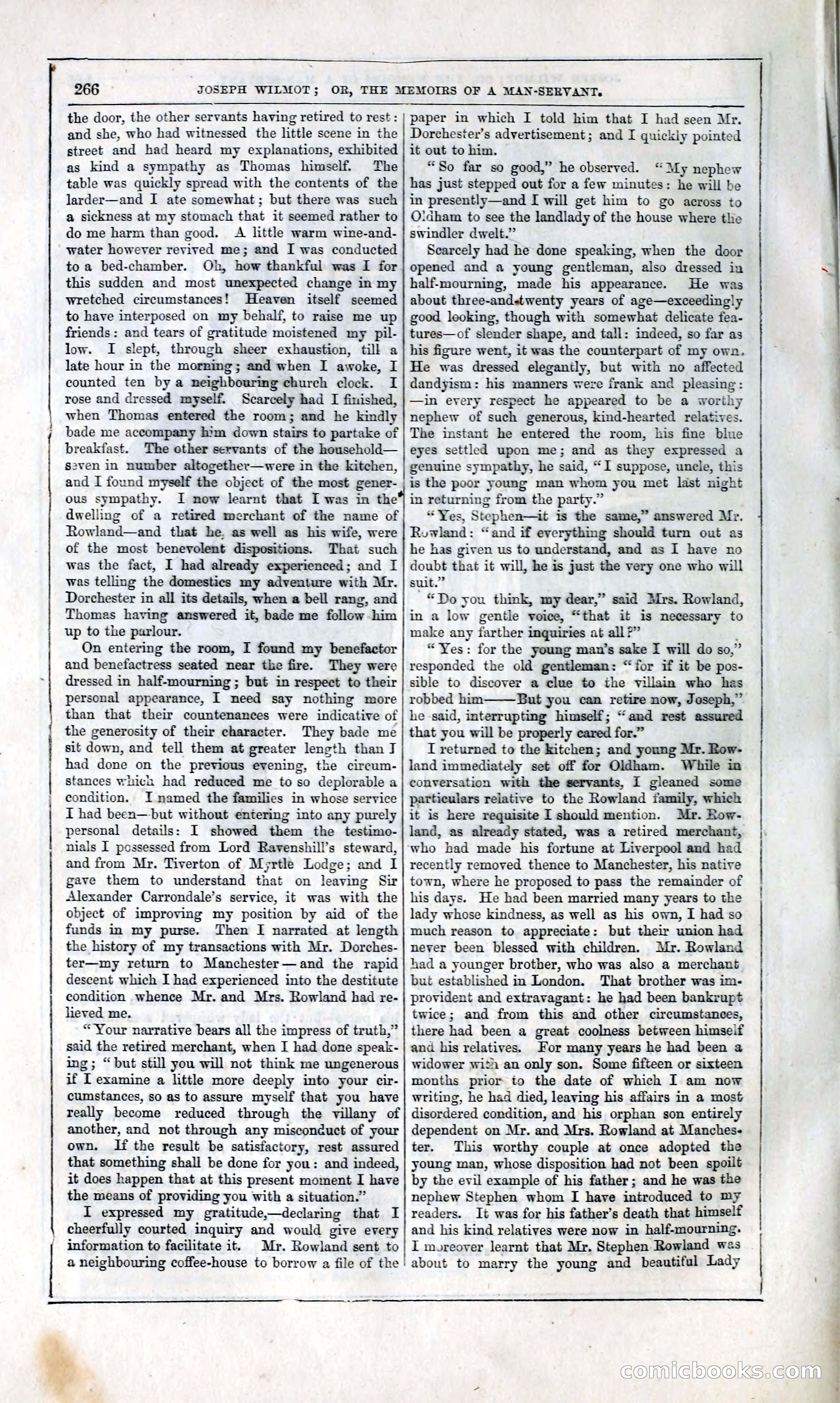
A restored page from Penny Dreadfuls, 1854. Page through the whole issue in the reader above.
📄 Transcribed text from this page (OCR, searchable)
Machine-transcribed from the original scan — historical spelling and the odd misread are preserved.
266 the door, the other servants having retired to rest: and she, who had witnessed the little scene in the street and had heard my explanations, exhibited as kind a sympathy as Thomas himself. The table was quickly spread with the contents of the larder—and I ate somewhat; but there was such a sickness at my stomach that it seemed rather to do me harm than good. A little warm wine-and- water however revived me; and I was conducted to a bed-chamber. Ob, how thankful was I for this sudden and most unexpected change in my wretched circumstances! Heaven itself seemed to have interposed on my behalf, to raise me up friends: and tears of gratitude moistened my pil- low. I slept, through sheer exhaustion, till a late hour in the morning; and when I awoke, I counted ten by a neighbouring church clock. I rose and dressed myself. Scarcely had I finished, when Thomas entered the room; and he kindly bade me accompany him down stairs to partake of breakfast. The other servants of the household— S2ven in number altogether—were in the kitchen, and I found myself the object of the most gener- ous sympathy. I now learnt that I was in the dwelling of a retired merchant of the name of Rowland—and that he. as well as his wife, were of the most benevolent dispositions. That such was the fact, I had already experienced; and I was telling the domestics my adventure with Mr. Dorchester in all its details, when a bell rang, and Thomas having answered it, bade me follow him up to the parlour. On entering the room, I found my benefactor and benefactress seated near the fire. They were dressed in half-mourning ; but in respect to their personal appearance, I need say nothing more than that their countemances were indicative of the generosity of their character. They bade me sit down, and tell them at greater length than J had done on the previous evening, the circum- stances which had reduced me to so deplorable a condition. I named the families in whose service I had been—-but without entering into any purely personal details: I showed them the testimo- nials 1 possessed from Lord Ravenshill’s steward, and from Mr. Tiverton of M;rtle Lodge; and I gave them to understand that on leaving Sir Alexander Carrondale’s service, it was with the object of improving my position by aid of the funds in my purse. Then [ narrated at length the history of my transactions with Mr. Dorches- ter—my return to Manchester—and the rapid descent which I had experienced into the destitute condition whence Mr. and Mrs. Rowland had re- heved me. “Your narrative bears all the impress of truth,” said the retired merchant, when I had done speak- ing; “but still you will not think me ungenerous if I examine a little more deeply into your cir- cumstances, so as to assure myself that you have really become reduced through the villany of another, and not through any misconcuct of your own. If the result be satisfactory, rest assured that something shall be done for you: and indeed, it does happen that at this present moment I have the means of providing you with a situation.” I expressed my gratitude,—declaring that I cheerfully courted inquiry and would give every information to facilitate it. Mr. Rowland sent to JOSEPH WILMOT; OR, THE MEMOIRS OF A MAN-SERVANT, paper in which I told him that I had seen Mr. Dorchester’s advertisement; and I quickly pointed it out to him. “So far so good,” he observed. “My nephew has just stepped out for a few minutes: he will be in presently—and I will get him to go across to O!aham to see the landlady of the house where tlie swindler dwelt.” Searcely had he done speaking, when the door opened and a young gentleman, also dressed in half-mourning, made his appearance. He was about three-andsetwenty years of age—exceedingly good leoking, though with somewhat delicate fea- tures—of slender shape, and tall: indeed, so far as his figure went, it was the counterpart of my own. He was dressed elegantly, but with no affected dandyism: his manners were frank and pleasing: —in every respect he appeared to be a worthy nephew of such generous, kind-hearted relatives. The instant he entered the room, his fine blue eyes settled upon me; and as they expressed a genuine sympathy, he said, “I suppose, uncle, this is the poor young man whom you met last night in returning from the party.” “Yes, Stephen—it is the same,” answered Mr. Rowland: “and if everything should turn out as he has given us to understand, and as I have no doubt that it will, he is just the very one who will sult.” ~©Do you think, my dear,” said Mrs. Rowland, in a low gentle voice, “that it is necessary to make any farther inquiries at all ?” “Yes: for the young man’s sake I will do so,” responded the old gentleman: “for if it be pos- sible to discover a clue to the villain who has robbed him But you can retire now, Joseph,” he said, interrupting himself; “and rest assured that you will be properly cared for.” I returned to the kitchen; and young Mr. Row- land immediately set off for Oldham. While in conversation with the servants, I gleaned some particulars relative to the Rowland family, which it is here requisite I should mention. Mr. Row- land, as already stated, was a retired merchant, ‘who had made his fortune at Liverpool and had recently removed thence to Manchester, his native town, where he proposed to pass the remainder of his days. He had been married many years to the lady whose kindness, as well as his own, I had so much reason to appreciate: but their union had never been blessed with children. Mr. Rowland had a younger brother, who was also a merchant but established in London. That brother was im- provident and extravagant: he had been bankrupt twice; and from this and other circumstances, there had been a great coolness between himseif and his relatives. For many years he had been a widower with an only son. Some fifteen or sixteen months prior to the date of which I am now writing, he had died, leaving his affairs in a most disordered condition, and his orphan son entirely dependent on Mr. and Mrs. Rowland at Manches- ter. This worthy couple at once adopted the young man, whose disposition had not been spoilt by the evil example of his father ; and he was the nephew Stephen whom I have introduced to my readers. It was for his father’s death that himself and his kind relatives were now in half-mourning. I moreover learnt that Mr. Stephen Rowland was a neighbouring coffee-house to borrow a file of the! about to marry the young and beautiful Lady rl Yr Or CORNIECLOO@