
Penny Dreadfuls, 1854 · page 295 of 394
Joseph Wilmot, or, The Memoirs of a Man-Servant — page 295: what you’re looking at
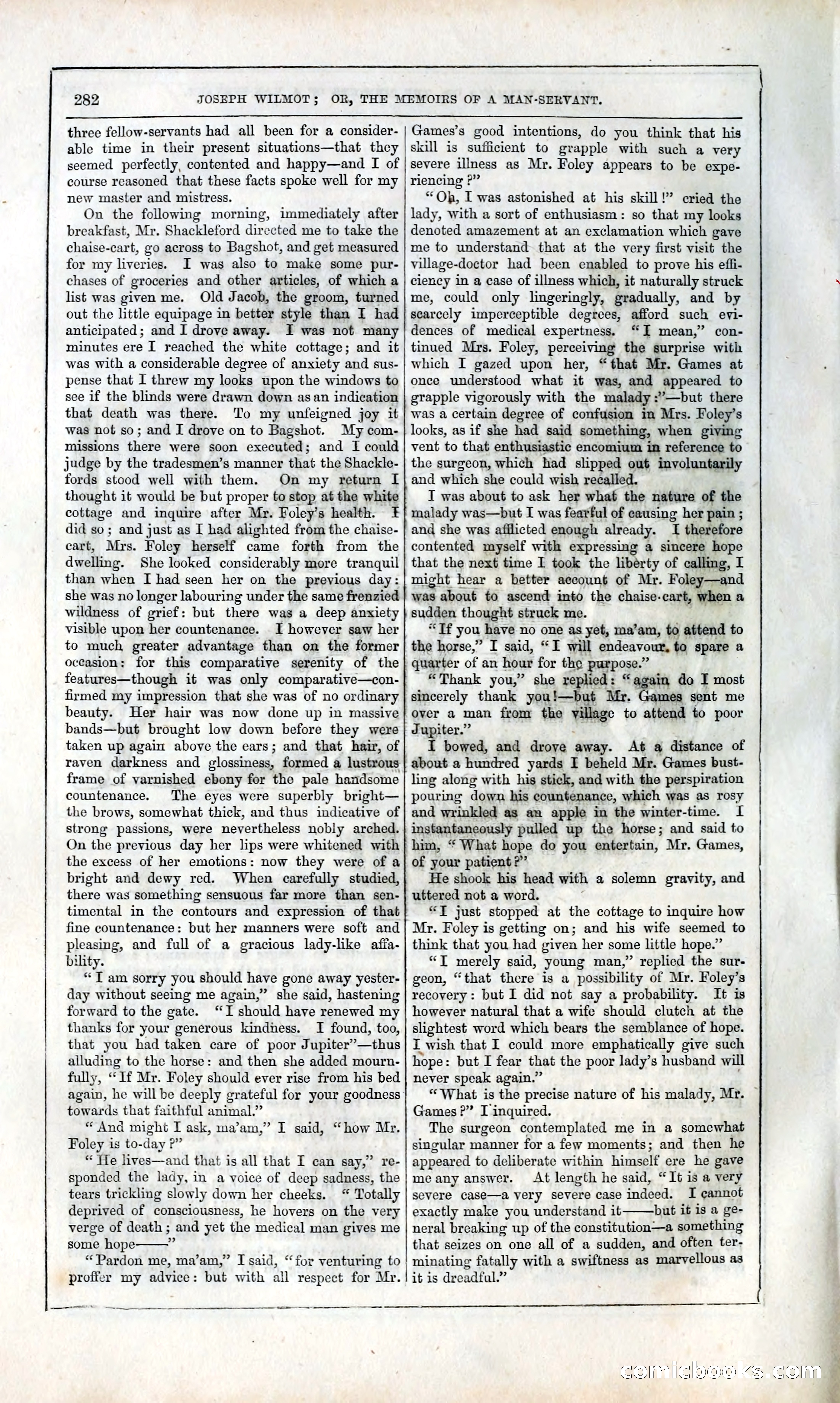
A restored page from Penny Dreadfuls, 1854. Page through the whole issue in the reader above.
📄 Transcribed text from this page (OCR, searchable)
Machine-transcribed from the original scan — historical spelling and the odd misread are preserved.
es 282 JOSEPH WILMOT ; OR, THE MEMOIRS OF A MAN-SERVANT. three fellow-servants had all been for a consider- able time in their present situations—that they seemed perfectly, contented and happy—and I of course reasoned that these facts spoke well for my new master and mistress. On the following morning, immediately after breakfast, Mr. Shackleford directed me to take the chaise-cart, go across to Bagshot, and get measured for my liveries. I was also to make some pur- chases of groceries and other articles, of which a list was given me. Old Jacob, the groom, turned out the little equipage in better style than I had anticipated; and I drove away. I was not many minutes ere I reached the white cottage; and it was with a considerable degree of anxiety and sus- pense that I threw my looks upon the windows to see if the blinds were drawn down as an indication that death was there. To my unfeigned joy it was not so; and I drove on to Bagshot. My com- missions there were soon executed; and I could judge by the tradesmen’s manner that the Shackle- fords stood well with them. On my return I thought it would be but proper to stop at the white cottage and inquire after Mr. Foley’s health. ft did so; and just as I had alighted from the chaise- cart, Mrs. Foley herself came forth from the dwelling. She looked considerably more tranquil than when I had seen her on the previous day: she was no longer labouring under the same frenzied wildness of grief: but there was a deep anxiety visible upon her countenance. I however saw her to much greater advantage than on the former occasion; for this comparative serenity of the features—though it was only comparative—con- firmed my impression that she was of no ordinary beauty. Her hair was now done up in massive bands—but brought low down before they were taken up again above the ears; and that hair, of raven darkness and glossiness, formed a lustrous frame of varnished ebony for the pale handsome countenance. The eyes were superbly bright— the brows, somewhat thick, and thus indicative of strong passions, were nevertheless nobly arched. On the previous day her lips were whitened with the excess of her emotions: now they were of a bright and dewy red. When carefully studied, there was something sensuous far more than sen- timental in the contours and expression of that fine countenance: but her manners were soft and pleasing, and full of a gracious lady-like afia- bility. “7 am sorry you should have gone away yester- day without seeing me again,” she said, hastening forward to the gate. “I should have renewed my thanks for your generous kindness. I found, too, that you had taken care of poor Jupiter’—thus alluding to the horse: and then she added mourn- fully, “If My. Foley should ever rise from his bed again, he will be deeply grateful for your goodness towards that faithful animal.” “And might I ask, ma’am,” I said, Foley is to-day ?” “ He lives—and that is all that I can say,” re- sponded the lady, in a voice of deep sadness, the tears trickling slowly down her cheeks. “ Totally deprived of consciousness, he hovers on the very verge of death ; and yet the medical man gives me some hope ye “Pardon me, ma’am,” I said, “for venturing to proffer my advice: but with all respect for Mr. “how Mr. et quarter of an hour for the i a ee, Games’s good intentions, do you think that his skill is sufficient to grapple with such a very severe illness as Mr. Foley appears to be expe- riencing ?” “Ob, I was astonished at his skill!” cried the lady, with a sort of enthusiasm: so that my looks denoted amazement at an exclamation which gave me to understand that at the very first visit the village-doctor had been enabled to prove his effi- ciency in a case of illness which, it naturally struck me, could only lingeringly, gradually, and by scarcely imperceptible degrees, afford such evi- dences of medical expertness. “IZ mean,” con- tinued Mrs. Foley, perceiving the surprise with which I gazed upon her, “that Mr. Games at once understood what it was, and appeared to grapple vigorously with the malady :’—but there was a certain degree of confusion in Mrs. Foley’s looks, as if she had said something, when giving vent to that enthusiastic encomium in reference to the surgeon, which had slipped out involuntarily and which she could wish recalled. T was about to ask her what the nature of the malady was—but I was fearful of causing her pain ; and she was afflicted enough already. I therefore contented myself with expressing a sincere Pope that the next time I took the libérty of calling, I might hear a better account of Mr. Foley—and was about to ascend into the chaise-cart, when a sudden thought struck me. “Tf you have no one as yet, ma’am, to attend to the horse,” I said, “I will endeavour, to spare a rpose.” “Thank you,” she replied : “again do I most sincerely thank you!—but Mr. Games sent me over a man from the yillage to attend to poor Jupiter.” I bowed, and drove ‘sie. At a distance of about a hundred yards I beheld Mr. Games bust- ling along with his stick, and with the perspiration pouring down his countenance, which was as rosy and wrinkled as an apple in the winter-time. I instantaneously pulled up the horse; and said to him, “ What hope do you entertain, Mr. Games, of your patient?” He shook his head with a solemn gravity, and uttered not a word. : “TY just stopped at the cottage to inquire how Mr. Foley is getting on; and his wife seemed to think that you had given her some little hope.” “T merely said, young man,” replied the sur- geon, “that there is a possibility of Mr. Foley’s recovery: but I did not say a probability. It is however natural that a wife should clutch at the slightest word which bears the semblance of hope. I wish that I could more emphatically give such hope: but I fear that the poor lady’s husband will never speak again.” “What is the precise nature of his malady, Mr. Games ?” I inquired. The surgeon contemplated me in a somewhat singular manner for a few moments; and then he appeared to deliberate within himself ere he gave me any answer. At length he said, “It is a very severe case—a very severe case indeed. I cannot exactly make you understand it but if is a ge- neral breaking up of the constitution—a something that seizes on one all of a sudden, and often ter- minating fatally with a swiftness as marvellous as it is dreadful.” ElOOO cS (C@)