
Penny Dreadfuls, 1854 · page 297 of 394
Joseph Wilmot, or, The Memoirs of a Man-Servant — page 297: what you’re looking at
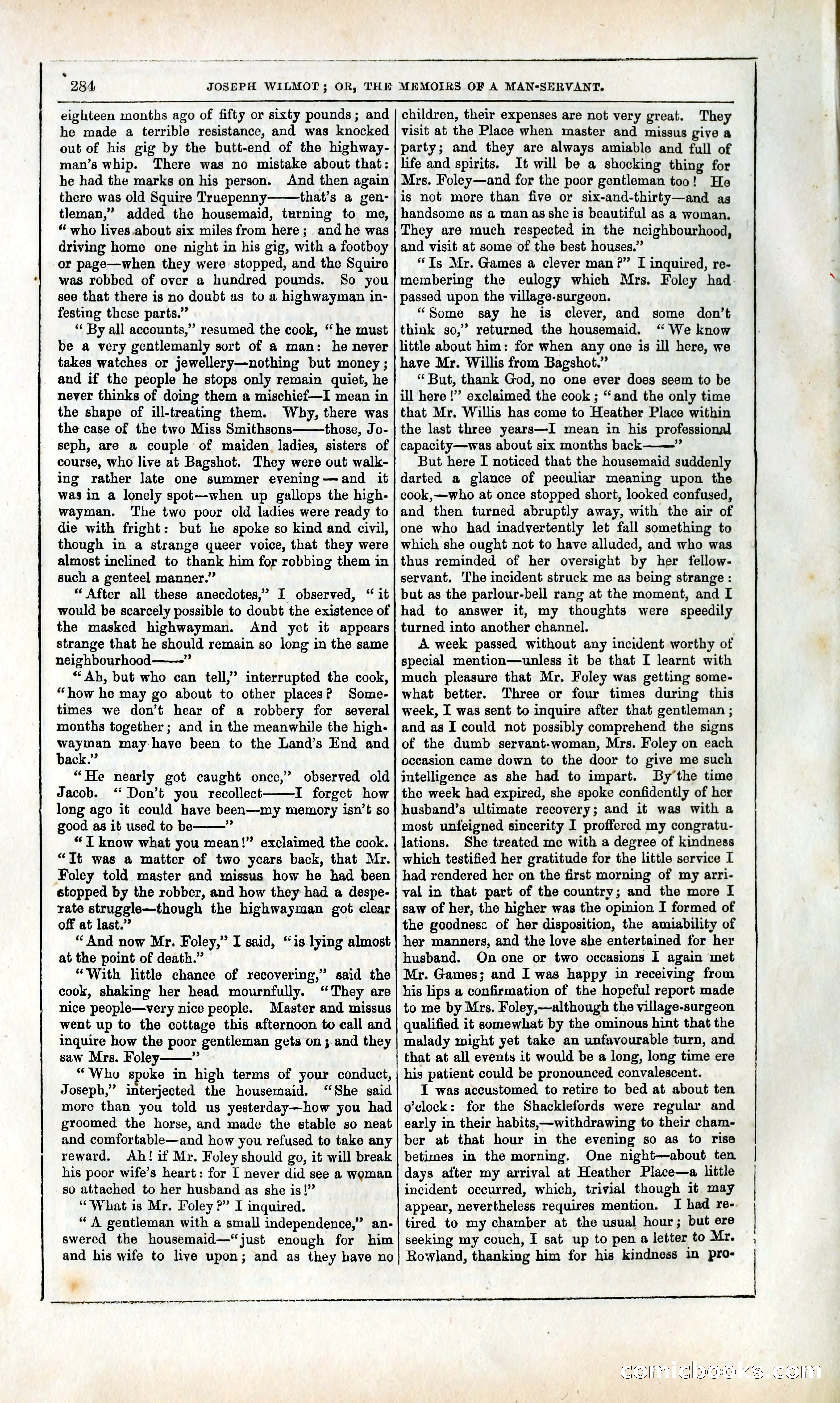
A restored page from Penny Dreadfuls, 1854. Page through the whole issue in the reader above.
📄 Transcribed text from this page (OCR, searchable)
Machine-transcribed from the original scan — historical spelling and the odd misread are preserved.
ry re ? eee ee ee "284 eighteen months ago of fifty or sixty pounds; and he made a terrible resistance, and was knocked out of his gig by the butt-end of the highway- man’s whip. There was no mistake about that: he had the marks on his person. And then again there was old Squire Truepenny that’s a gen- tleman,” added the housemaid, turning to me, “ who lives.about six miles from here; and he was driving home one night in his gig, with a footboy or page—when they were stopped, and the Squire was robbed of over a hundred pounds. So you see that there is no doubt as to a highwayman in- festing these parts.” ‘< By all accounts,” resumed the cook, “he must be a very gentlemanly sort of a man: he never takes watches or jewellery—nothing but money ; and if the people he stops only remain quiet, he never thinks of doing them a mischief—I mean in the shape of ill-treating them. Why, there was the case of the two Miss Smithsons those, Jo- seph, are a couple of maiden ladies, sisters of course, who live at Bagshot. They were out walk- ing rather late one summer evening —and it was in a lonely spot—when up gallops the high- wayman. The two poor old ladies were ready to die with fright: but he spoke so kind and civil, though in a strange queer voice, that they were almost inclined to thank him for robbing them in such a genteel manner.” “After all these anecdotes,’ I observed, “ it would be scarcely possible to doubt the existence of the masked highwayman. And yet it appears strange that he should remain so long in the same neighbourhood “ ** Ah, but who can tell,” interrupted the cook, “how he may go about to other places? Some- times we don’t hear of a robbery for several months together; and in the meanwhile the high- wayman may have been to the Land’s End and back.” “He nearly got caught once,” observed old Jacob. “ Don’t you recollect I forget how long ago it could have been—my memory isn’t so good as it used to be + “1 know what you mean!” exclaimed the cook. “It was a matter of two years back, that Mr. Foley told master and missus how he had been stopped by the robber, and how they had a despe- rate struggle—though the highwayman got clear off at last.” “And now Mr. Foley,” I said, “is lying almost at the point of death.” “With little chance of recoverimg,” said the cook, shaking her head mournfully. “They are nice people—very nice people. Master and missus went up to the cottage this afternoon to call and inquire how the poor gentleman gets on ;-and they saw Mrs. Foley * “Who spoke in high terms of your conduct, Joseph,” interjected the housemaid. “She said more than you told us yesterday—how you had groomed the horse, and made the stable so neat and comfortable—and how you refused to take any reward. Ah! if Mr. Foley should go, it will break his poor wife’s heart: for I never did see a woman so attached to her husband as she is!” “What is Mr. Foley ?” I inquired. “A gentleman with a small independence,” an- swered the housemaid—“just enough for him and his wife to live upon; and as they have no JOSEPH WILMOT; OR, THE MEMOIRS OF A MAN-SERVANT. children, their expenses are not very great. They visit at the Place when master and missus give a party; and they are always amiable and full of life and spirits. It will be a shocking thing for Mrs. Foley—and for the poor gentleman too! He is not more than five or six-and-thirty—and as handsome as a man as she 1s beautiful as a woman. They are much respected in the neighbourhood, and visit at some of the best houses.” “Is Mr. Games a clever man?” I inquired, re- membering the eulogy which Mrs. Foley had- passed upon the village-surgeon. “Some say he is clever, and some don’t think so,’ returned the housemaid. ‘ We know little about him: for when any one is ill here, we have Mr. Willis from Bagshot.” ‘“‘ But, thank God, no one ever does seem to be ill here !” exclaimed the cook ; “and the only time that Mr. Willis has come to Heather Place within the last three years—I mean in his professional capacity—was about six months back 4 But here I noticed that the housemaid suddenly darted a glance of peculiar meaning upon the cook,—who at once stopped short, looked confused, and then turned abruptly away, with the air of one who had inadvertently let fall something to which she ought not to have alluded, and who was thus reminded of her oversight by her fellow- servant. The incident struck me as being strange : but as the parlour-bell rang at the moment, and I had to answer it, my thoughts were speedily turned into another channel. A week passed without any incident worthy of special mention—unless it be that I learnt with much pleasure that Mr. Foley was getting some- what better. Three or four times during this week, I was sent to inquire after that gentleman ; and as I could not possibly comprehend the signs of the dumb servant-woman, Mrs. Foley on each occasion came down to the door to give me such intelligence as she had to impart. By’the time the week had expired, she spoke confidently of her husband’s ultimate recovery; and it was with a most unfeigned sincerity I proffered my congratu- lations. She treated me with a degree of kindness which testified her gratitude for the little service I had rendered her on the first morning of my arri- val in that part of the country; and the more I saw of her, the higher was the opinion I formed of the goodnesc of her disposition, the amiability of her manners, and the love she entertained for her husband. On one or two occasions I again met Mr. Games; and I was happy in receiving from his lips a confirmation of the hopeful report made to me by Mrs. Foley,—although the village-surgeon qualified it somewhat by the ominous hint that the malady might yet take an unfavourable turn, and that at all events it would be a long, long time ere his patient could be pronounced convalescent. I was accustomed to retire to bed at about ten o’clock: for the Shacklefords were regular and early in their habits,—withdrawing to their cham- ber at that hour in the evening so as to rise betimes in the morning. One night—about ten days after my arrival at Heather Place—a little incident occurred, which, trivial though it may appear, nevertheless requires mention. tired to my chamber at the usual hour; but ere seeking my couch, I sat up to pen a letter to Mr. Rowland, thanking him for his kindness in pro- I had re-. Gboo SS co AA