
Penny Dreadfuls, 1854 · page 311 of 394
Joseph Wilmot, or, The Memoirs of a Man-Servant — page 311: what you’re looking at
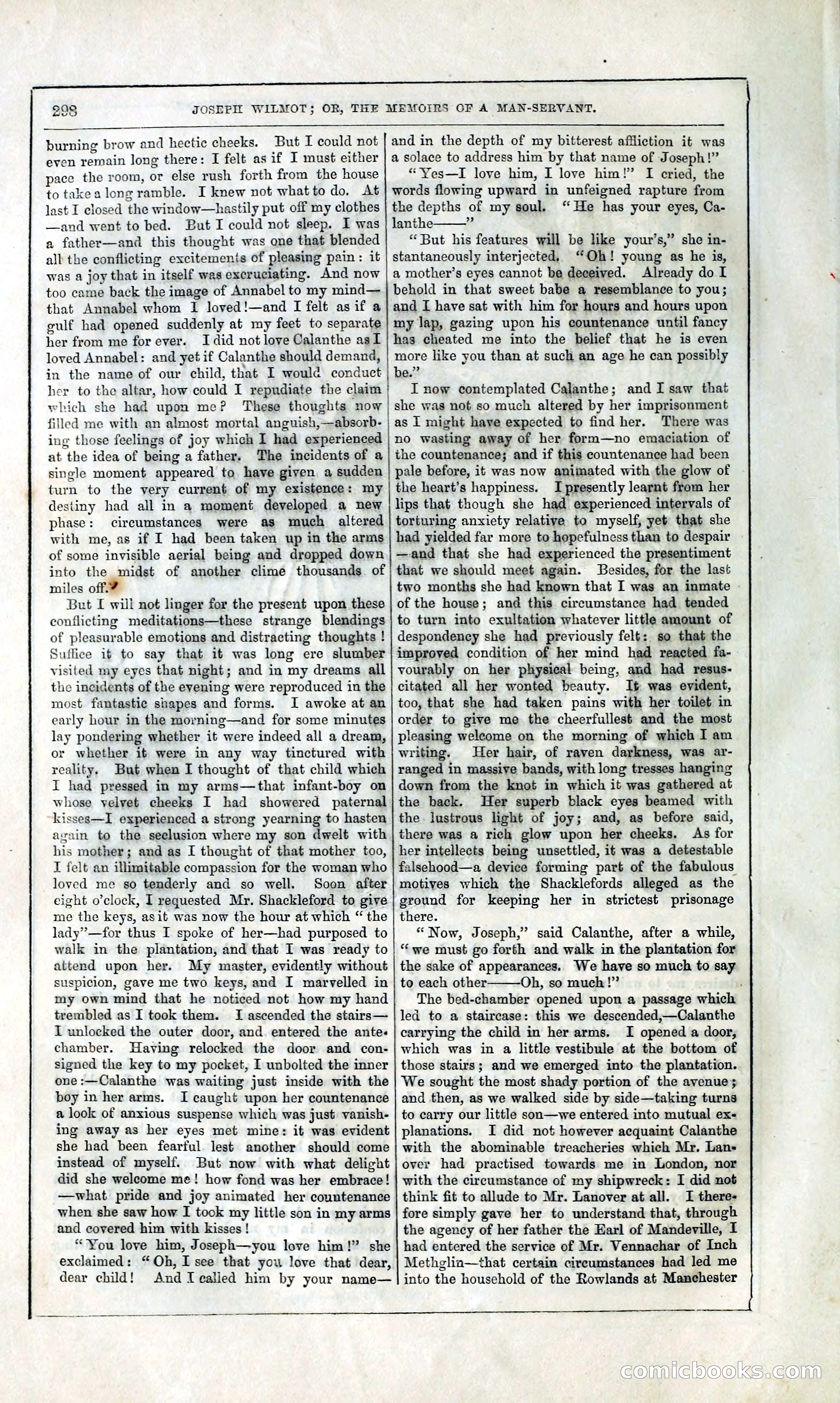
A restored page from Penny Dreadfuls, 1854. Page through the whole issue in the reader above.
📄 Transcribed text from this page (OCR, searchable)
Machine-transcribed from the original scan — historical spelling and the odd misread are preserved.
a a — 298 JOSEEFH WILMOT; OR, THE MEMOIRS OF A MAN-SERVANT. burning brow and hectic cheeks. But I could not even remain long there: I felt as if I must either pace the room, or else rush forth from the house to takea long ramble. I knew not whatto do. At last I closed the window—hastily put off my clothes —and went to bed. But I could not sleep. 1 was a father—and this thought was one that blended all the conflicting excitements of pleasing pain: it was a joy that in itself was excruciating. And now too came back the image of Annabel to my mind— that Annabel whom I loved!—and I felt asif a gulf had opened suddenly at my feet to separate her from me for ever. I did not love Calanthe asl loved Annabel: and yet if Calanthe should demand, in the name of our child, that I would conduct her to the altar, how could I repudiate the claim which she had upon me? These thoughts now filled me with an almost mortal anguish,—absorb- ing those feelings of joy which I had experienced at the idea of being a father. The incidents of a single moment appeared to have given a sudden turn to the very current of my existence: my destiny had all in a moment developed a new phase: circumstances were as much altered with me, as if I had been taken wp in the arms of some invisible aerial being and dropped down into the midst of another clime thousands. of miles off. But I wili not linger for the present upon these conflicting meditations—these strange blendings of pleasurable emotions and distracting thoughts ! Suffice if to say that it was long ere slumber visited my eyes that night; and in my dreams all the incidents of the evening were reproduced in the most fantastic shapes and forms. I awoke at an early hour in the morning—and for some minutes lay pondering whether it were indeed all a dream, or whether it were in any way tinctured with reality. But when I thought of that child which I had pressed in my arms—that infant-boy on whose velvet cheeks I had showered paternal kisses—I experienced a strong yearning to hasten avain to the seclusion where my son dwelt with his mother; and as I thought of that mother too, I felt an illimitable compassion for the woman who loved me so tenderly and so well. Soon after eight o’clock, I requested Mr. Shackleford to give me the keys, asit was now the hour at which “ the lady”—for thus I spoke of her—had purposed to walk in the plantation, and that I was ready to attend upon her. My master, evidently without suspicion, gave me two keys, and I marvelled in my own mind that he noticed not how my hand trembled as I took them. I ascended the stairs— I unlocked the outer door, and entered the ante. chamber. Having relocked the door and con- signed the key to my pocket, I unbolted the inner one :—Calanthe was waiting just inside with the boy in her arms. I caught upon her countenance a look of anxious suspense which was just vanish- ing away as her eyes met mine: it was evident she had been fearful lest another should come instead of myself. But now with what delight did she weleome me! how fond was her embrace! —what pride and joy animated her countenance when she saw how I took my little son in my arms and covered him with kisses ! “You love him, Joseph—you love him!” she exclaimed: “Oh, I see that you love that dear, dear child! And I ealied him by your name— —_—_———— and in the depth of my bitterest affliction it was a solace to address him by that name of Joseph!” “Yes—I love him, I love him!” I cried, the words flowing upward in unfeigned rapture from the depths of my soul. “He has your eyes, Ca- lanthe a “But his features will be like your’s,” she in- stantaneously interjected, “Oh! young as he is, a mother’s eyes cannot be deeeived. Already do I behold in that sweet babe a resemblance to you; and I have sat with him for hours and hours upon my lap, gazing upon his countenance until fancy has cheated me into the belief that he is even more like you than at such an age he can possibly be.” I now contemplated Calanthe; and I saw that she was not so much altered by her imprisonment as I might haye expected to find her. There was no wasting away of her form—no emaciation of the countenance; and if this countenance had been pale before, it was now animated with the glow of the heart’s happiness. Ipresently learnt from her lips that though she had experienced intervals of torturing anxiety relative to myself, yet that she had yielded far more to hopefulness than to despair —and that she had experienced the presentiment that we should meet again. Besides, for the last two months she had known that I was an inmate - of the house; and this circumstance had tended to turn into exultation whatever little amount of despondency she had previously felt: so that the improved condition of her mind had reacted fa- vourably on her physical being, and had resus- citated all her wonted beauty. It was evident, too, that she had taken pains with her toilet in order to give me the cheerfullest and the most pleasing welcome on the morning of which I am writing. Her hair, of raven darkness, was ar- ranged in massive bands, with long tresses hanging down from the knot in which it was gathered at the back. Her superb black eyes beamed with the. lustrous light of joy; and, as before said, there was a rich glow upon her cheeks. As for her intellects being unsettled, it was a detestable falsehood—a device forming part of the fabulous motives which the Shacklefords alleged as the ground for keeping her in strictest prisonage there. “Now, Joseph,” said Calanthe, after a while, “we must go forth and walk in the plantation for the sake of appearances. We have so much to say to each other Oh, so much!” The bed-chamber opened upon a passage which led to a staircase: this we descended,—Calanthe carrying the child in her arms. I opened a door, which was in a little vestibule at the bottom of those stairs; and we emerged into the plantation. We sought the most shady portion of the avenues and then, as we walked side by side—taking turns to carry our little son—we entered into mutual ex- planations. I did not however acquaint Calanthe with the abominable treacheries which Mr. Lan- over had practised towards me in London, nor with the circumstance of my shipwreck: I did not think fit to allude to Mr. Lanover at all. I there- fore simply gave her to understand that, through the agency of her father the Earl of Mandeville, I had entered the service of Mr. Vennachar of Inch Methglin—that certain circumstances had led me into the household of the Rowlands at Manchester - OOO) <S (C(O) im