
Penny Dreadfuls, 1854 · page 315 of 394
Joseph Wilmot, or, The Memoirs of a Man-Servant — page 315: what you’re looking at
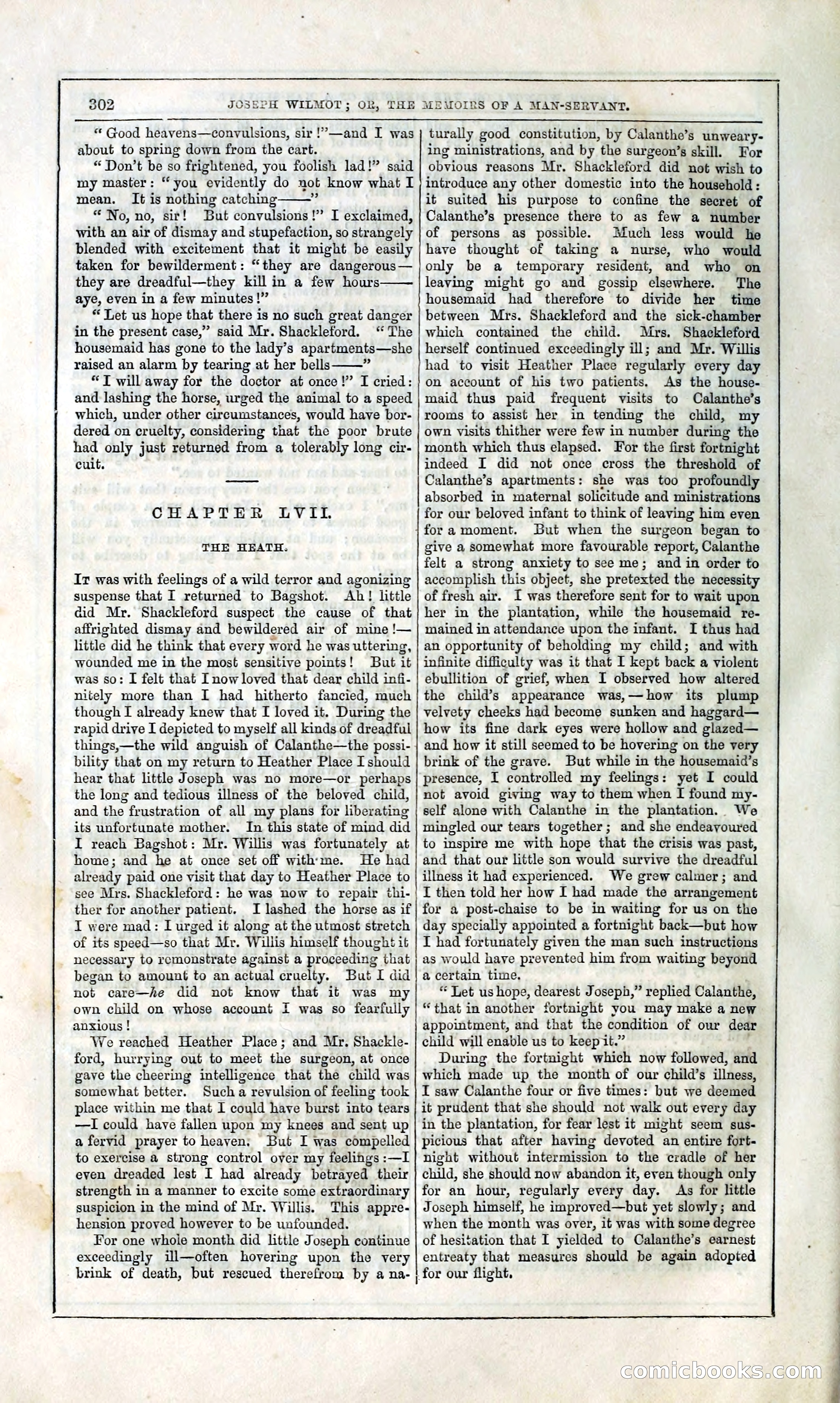
A restored page from Penny Dreadfuls, 1854. Page through the whole issue in the reader above.
📄 Transcribed text from this page (OCR, searchable)
Machine-transcribed from the original scan — historical spelling and the odd misread are preserved.
302 “ Good heavens—convulsions, sir !”—and I was about to spring down from the cart. “ Don’t be so frightened, you foolish lad!” said my master: “you evidently do not know what I mean. It is nothing catching , * No, no, sir! But convulsions!” I exclaimed, with an air of dismay and stupefaction, so strangely blended with excitement that it might be easily taken for bewilderment: “they are dangerous— they are dreadful—they kill in a few hours aye, even in a few minutes!” ** Let us hope that there is no such great danger in the present case,” said Mr. Shackleford. ‘The housemaid has gone to the lady’s apartments—she raised an alarm by tearing at her bells 4 “TT will away for the doctor at once!’ I cried: and lashing the horse, urged the animal to a speed which, under other circumstances, would have bor- dered on cruelty, considering that the poor brute had only just returned from a tolerably long cir- cuit. CHAPTER LVIL THE HEATH. Ir was with feelings of a wild terror and agonizing suspense that I returned to Bagshot. Ab! little aid Mr. Shackleford suspect the cause of that affrighted dismay and bewildered air of mine !— little did he think that every word he was uttering, wounded me in the most sensitive points! But it was so: I felt that I now loved that dear child infi- nitely more than I had hitherto fancied, much though I already knew that I loved it. During the rapid drive I depicted to myself all kinds of dreadful things,—the wild anguish of Calanthe—the possi- bility that on my return to Heather Place I should hear that little Joseph was no more—or perhaps the long and tedious illness of the beloved child, and the frustration of all my plans for liberating its unfortunate mother. In this state of mind did I reach Bagshot: Mr. Willis was fortunately at home; and he at once set off with:me. He had already paid one visit that day to Heather Place to see Mrs. Shackleford: he was now to repair thi- ther for another patient. I lashed the horse as if I were mad: L urged it along at the utmost stretch of its speed—so that Mr. Willis himself thought it necessary to rcmonstrate against a proceeding that began to amount to an actual cruelty. But I did not care—he did not know that it was my own child on whose account I was so fearfully anxious ! We reached Heather Place; and Mr. Shackle- ford, hurrying out to meet the surgeon, at once gaye the cheering intelligence that the child was somewhat better. Such a revulsion of feeling took place within me that I could have burst into tears —I could have fallen upon my knees and sent up a fervid prayer to heayen; But I was compelled to exercise a strong control over my feelings :—I even dreaded lest I had already betrayed their strength in a manner to excite some extraordinary suspicion in the mind of Mr. Willis. This appre- hension proved however to be unfounded. For one whole month did little Joseph continue exceedingly ill—often hovering upon the very brink of death, but rescued therefrom by a na- JOSEPH WILMOT; OR, THE MEMOIRS OF A MAN-SERVANT. turally good constitution, by Calanthe’s unweary- ing ministrations, and by the surgeon’s skill. For obvious reasons Mr. Shackleford did not wish to introduce any other domestic into the household: it suited his purpose to confine the secret of Calanthe’s presence there to as few a number of persons as possible. Much less would he have thought of taking a nurse, who would only be a temporary resident, and who on leaying might go and gossip elsewhere. The housemaid had therefore to divide her time between Mrs. Shackleford and the sick-chamber which contained the child. Mrs. Shackleford herself continued exceedingly ill; and Mr. Willis had to visit Heather Place regularly every day on account of his two patients. As the house- maid thus paid frequent visits to Calanthe’s rooms to assist her in tending the child, my own visits thither were few in number during the month which thus elapsed. For the first fortnight indeed I did not once cross the threshold of Calanthe’s apartments: she was too profoundly absorbed in maternal solicitude and ministrations for our beloved infant to think of leaving him even fora moment. But when the surgeon began to give a somewhat more favourable report, Calanthe felt a strong anxiety to see me; and in order to accomplish this object, she pretexted the necessity of fresh air. I was therefore sent for to wait upon her in the plantation, while the housemaid re- mained in attendance upon the infant. I thus had an opportunity of beholding my child; and with infinite difficulty was it that I kept back a violent ebullition of grief, when I observed how altered the child’s appearance was,—how its plump velvety cheeks had become sunken and haggard— how its fine dark eyes were hollow and glazed— and how it still seemed to be hovering on the very brink of the grave. But while in the housemaid’s presence, I controlled my feelings: yet I could not avoid giving way to them when I found my- self alone with Calanthe in the plantation. We mingled our tears together; and she endeayoured to inspire me with hope that the crisis was past, and that our little son would survive the dreadful illness it had experienced. We grew calmer; and I then told her how I had made the arrangement for a post-chaise to be in waiting for us on the day specially appointed a fortnight back—but how T had fortunately given the man such instructions as would have prevented him from waiting beyond a certain time, ** Let us hope, dearest Joseph,” replied Calanthe, “that in another fortnight you may make a new appointment, and that the condition of our dear child will enable us to keepit.” During the fortnight which now followed, and which made up the month of our child’s illness, I saw Calanthe four or five times: but we deemed it prudent that she should not walk out every day in the plantation, for fear lest it might seem sus- picious that after having devoted an entire fort- night without intermission to the cradle of her child, she should now abandon it, even though only for an hour, regularly every day. As for little Joseph himself, he improved—but yet slowly; and when the month was over, it was with some degree of hesitation that I yielded to Calanthe’s earnest entreaty that measures should be again adopted for our flight, cS OOO) (C©) im,