
Penny Dreadfuls, 1854 · page 320 of 394
Joseph Wilmot, or, The Memoirs of a Man-Servant — page 320: what you’re looking at
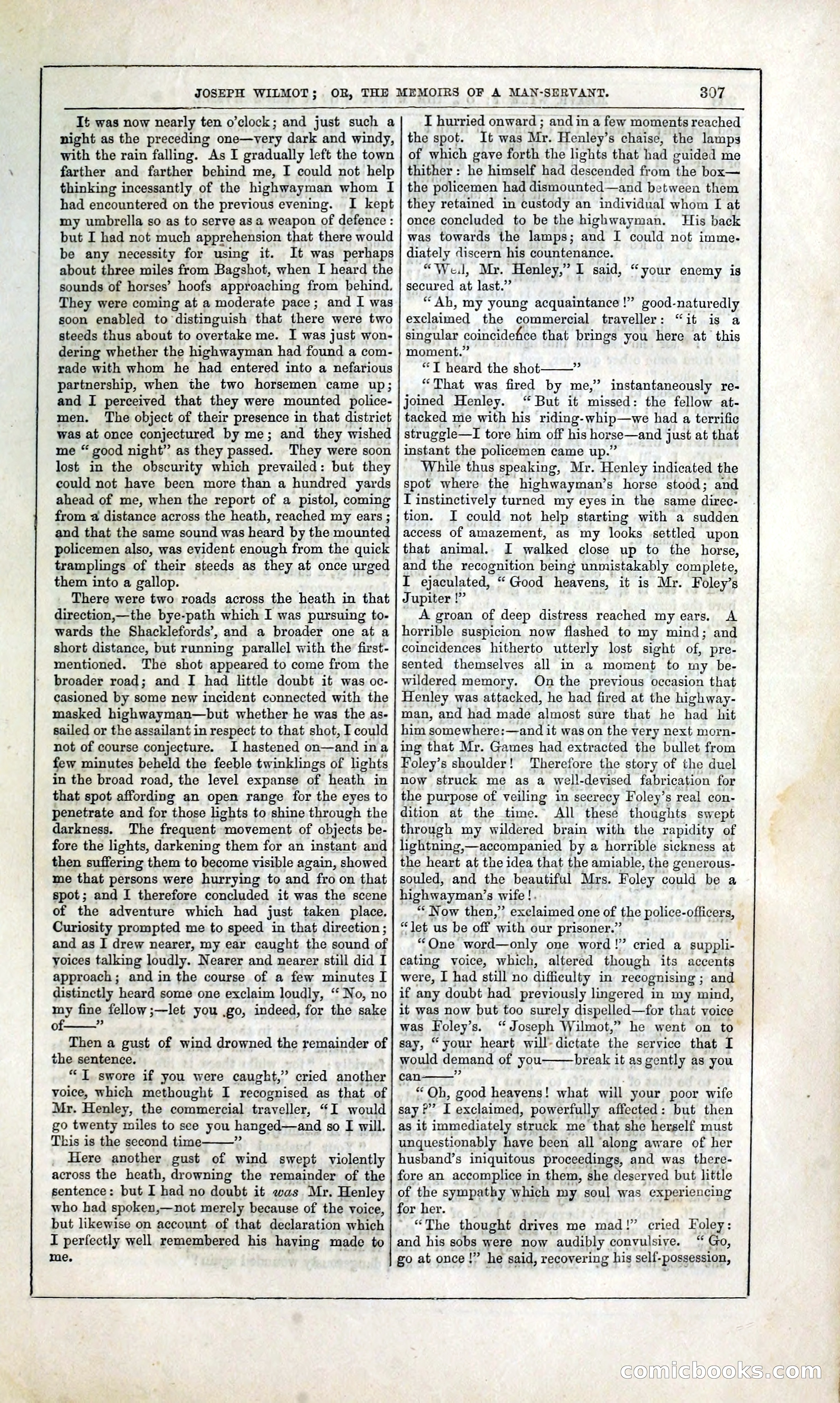
A restored page from Penny Dreadfuls, 1854. Page through the whole issue in the reader above.
📄 Transcribed text from this page (OCR, searchable)
Machine-transcribed from the original scan — historical spelling and the odd misread are preserved.
JOSEPH WILMOT; OR, THE MEMOIRS OF A MAN-SERVANT. 307 It was now nearly ten o’clock; and just such a night as the preceding one—very dark and windy, with the rain falling. As I gradually left the town farther and farther behind me, I could not help thinking incessantly of the highwayman whom I had encountered on the previous evening. I kept my umbrella so as to serve as a weapon of defence : but I had not much apprehension that there would be any necessity for using it. It was perhaps about three miles from Bagshot, when I heard the sounds of horses’ hoofs approaching from behind, They were coming at a moderate pace; and I was soon enabled to distinguish that there were two steeds thus about to overtake me. I was just won- dering whether the highwayman had found a com- rade with whom he had entered into a nefarious partnership, when the two horsemen came up; and I perceived that they were mounted police- men. The object of their presence in that district was at once conjectured by me; and they wished me “ good night” as they passed. They were soon lost in the obscurity which prevailed: but they could not have been more than a hundred yards ahead of me, when the report of a pistol, coming from a distance across the heath, reached my ears ; and that the same sound was heard by the aunten policemen also, was evident enough from the quick tramplings of their steeds as they at once urged them into a gallop. | There were two roads across the heath in that direction,—the bye-path which I was pursuing to- wards the Shacklefords’, and a broader one at a short distance, but running parallel with the first- mentioned. The shot appeared to come from the broader road; and I had little doubt it was oc- casioned by some new incident connected with the masked highwayman—but whether he was the as- sailed or the assailant in respect to that shot, I could not of course conjecture. I hastened on—and ina few minutes beheld the feeble twinklings of lights in the broad road, the level expanse of heath in that spot affording an open range for the eyes to penetrate and for those lights to shine through the darkness. The frequent “movement of objects be- fore the lights, darkening them for an instant and then suffering them to become visible again, showed me that persons were hurrying to and fro on that spot; and I therefore concluded it was the scene of the adventure which had just taken place. Curiosity prompted me to speed in that direction; and as I drew nearer, my ear caught the sound of yoices talking loudly. Nearer and nearer still did I approach; and in the course of a few minutes I distinctly heard some one exclaim loudly, “ No, no my fine fellow ;—let you .go, indeed, for the sake of Then a gust of wind drowned the remainder of the sentence. “I swore if you were caught,” cried another voice, which methought I recognised as that of | Mr. Henley, the commercial traveller, “I would go twenty miles to see you hanged—and so I will. This is the second time S _ Here another gust of wind swept violently across the heath, drowning the remainder of the sentence: but I had no doubt it was Mr. Henley who had spoken,—not merely because of the voice, but likewise on account of that declaration which I perfectly well remembered his haying made to me. IT hurried onward ; and in a few moments reached the spot. It was Mr. Henley’s chaise, the lamps of which gaye forth the lights that had euided me thither: he himself had descended from the box— the policemen had dismounted—and between them they retained in custody an individual whom [I at once concluded to be the highwayman. His back was towards the lamps; and I could not imme. diately discern his countenance. “Wel, Mx. Henley,’ I said, “your enemy is secured at last.” | “Ah, my young acquaintance !” good-naturedly exclaimed the commercial traveller: “it is a singular coincidefce that brings you here at this moment.” “T heard the shot “That was fired by me,” instantaneously re- joined Henley. “But it missed: the fellow at- tacked me with his riding-whip—we had a terrific struggle—I tore him off his hor se—and just at that instant the policemen came up.” While thus speaking, Mr. Henley indicated the spot where the highwayman’s horse stood; and I instinctively turned my eyes in the same direc- tion. I could not help starting with a sudden access of amazement, as my looks settled upon that animal. I walked close up to the horse, and the recognition being unmistakably complete, I ejaculated, “ Good heavens, it is Mr. Foley’s Jupiter |” A groan of deep distress reached my ears. A horrible suspicion now flashed to my mind; and coincidences hitherto utterly lost sight of, pre- sented themselves all in a moment to my be- wildered memory. On the previous occasion that Henley was attacked, he had fired at the highway- man, ard had made almost sure that he had hit him somewhere: :—and it was on the very next morn- ing that Mr. Games had extracted the bullet from Foley’s shoulder! Therefore the story of the duel now struck me as a well-devised fabrication for the purpose of veiling in secrecy Foley’s real con- dition at the time. All these thoughts swept through my wildered brain with the rapidity of lightning,—accompanied by a horrible sickness at the heart at the idea that the amiable, the generous- souled, and the beautiful Mrs. Foley could be a highwayman’s wife !. “< Now then,” exclaimed one of the police-officers, “let us be off ‘with our prisoner.” ) “One word—only one word!” cried a suppli- cating voice, which, altered though its accents were, I had still no difficulty in recognising ; and if any doubt had previously lingered in my mind, it was now but too surely dispelled—for that voice was Foley’s. “Joseph Wilmot,” he went on to say, “your heart will- dictate the service that I would demand of you break it as gently as you can ¥ * Oh, good heavens! what will your poor wife say P” I exclaimed, powerfully affected: but then as it immediately struck me ‘that she herself must unquestionably have been all ‘along aware of her husband’s iniquitous proceedings, and was there- fore an accomplice in them, she cleseryed but little of the sympathy which my soul was experiencing for her. ' “The thought drives me mad!” cried Foley: and his sobs were now audibly convulsive. “ Go, go at once!” he said, recovering his self-possession, ElOOO) cS (©) im