
Penny Dreadfuls, 1854 · page 322 of 394
Joseph Wilmot, or, The Memoirs of a Man-Servant — page 322: what you’re looking at
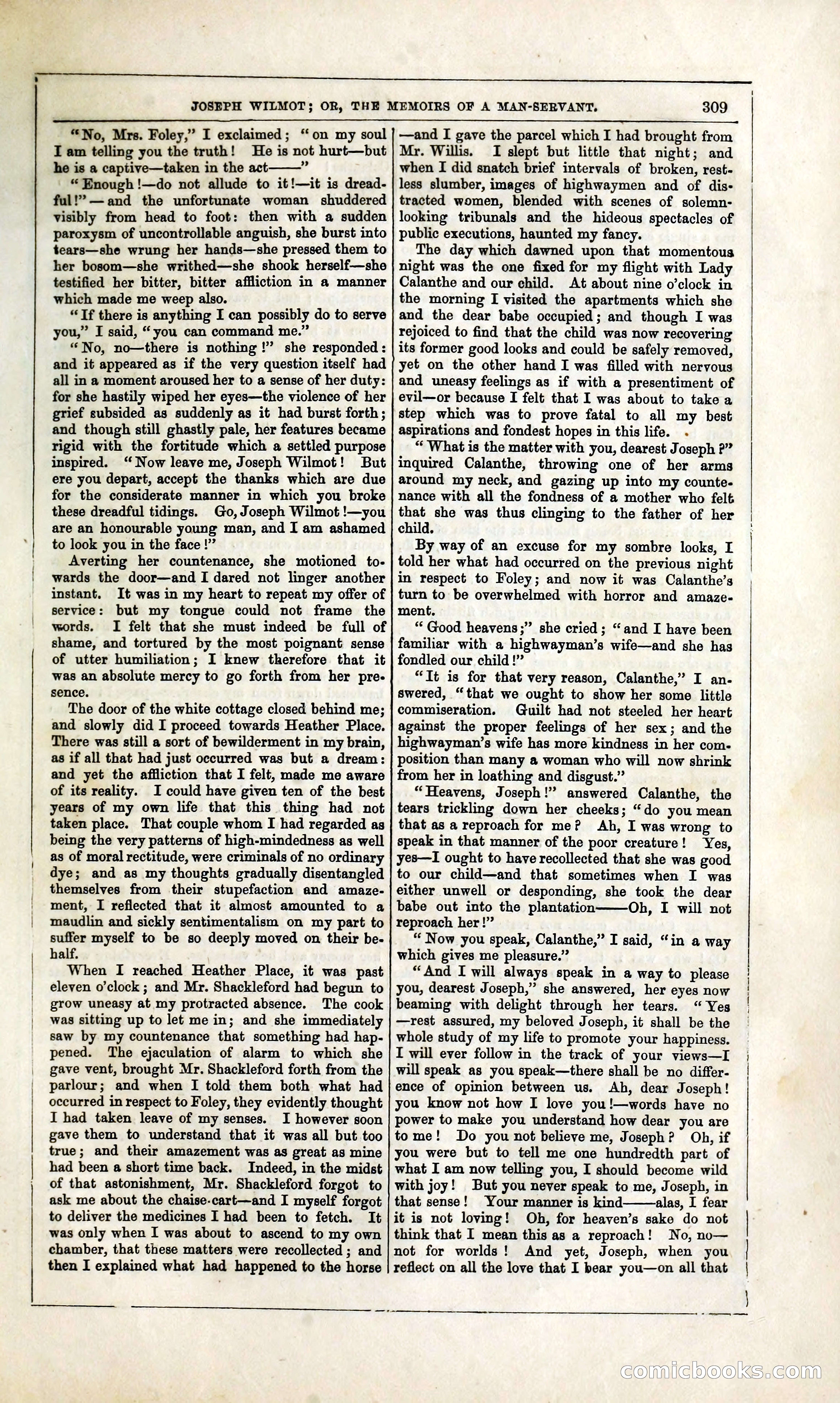
A restored page from Penny Dreadfuls, 1854. Page through the whole issue in the reader above.
📄 Transcribed text from this page (OCR, searchable)
Machine-transcribed from the original scan — historical spelling and the odd misread are preserved.
a nC See Se JOSEPH WILMOT; OR, THE MEMOIRS OF A MAN-SERVANT, 309 “No, Mrs. Foley,” I exclaimed; “on my soul I am telling you the truth! He is not hurt—but he is a captive—taken in the act sd “Enough !—do not allude to it!—it is dread- ful!’—and the unfortunate woman shuddered visibly from head to foot: then with a sudden paroxysm of uncontrollable anguish, she burst into tears—she wrung her hands—she pressed them to her bosom—she writhed—she shook herself—she testified her bitter, bitter affliction in a manner which made me weep also. “Tf there is anything I can possibly do to serve you,” I said, “you can command me.” “No, no—there is nothing!” she responded: and it appeared as if the very question itself had all in a moment aroused her to a sense of her duty: for she hastily wiped her eyes—the violence of her grief subsided as suddenly as it had burst forth; and though still ghastly pale, her features became rigid with the fortitude which a settled purpose inspired. ‘Now leave me, Joseph Wilmot! But ere you depart, accept the thanks which are due for the considerate manner in which you broke these dreadful tidings. Go, Joseph Wilmot !—you are an honourable young man, and I am ashamed to look you in the face !” Averting her countenance, she motioned to- wards the door—and I dared not linger another instant. It was in my heart to repeat my offer of service: but my tongue could not frame the words. I felt that she must indeed be full of shame, and tortured by the most poignant sense of utter humiliation; I knew therefore that it was an absolute mercy to go forth from her pre- sence. The door of the white cottage closed behind me; and slowly did I proceed towards Heather Place. There was still a sort of bewilderment in my brain, as if all that had just occurred was but a dream: and yet the affliction that I felt, made me aware of its reality. I could have given ten of the best years of my own life that this thing had not taken place. That couple whom I had regarded as being the very patterns of high-mindedness as well as of moral rectitude, were criminals of no ordinary dye; and as my thoughts gradually disentangled themselves from their stupefaction and amaze- ment, I reflected that it almost amounted to a maudlin and sickly sentimentalism on my part to suffer myself to be so deeply moved on their be- half. When I reached Heather Place, it was past eleven o’clock ; and Mr. Shackleford had begun to grow uneasy at my protracted absence. The cook was sitting up to let me in; and she immediately saw by my countenance that something had hap- pened. The ejaculation of alarm to which she gave vent, brought Mr. Shackleford forth from the parlour; and when I told them both what had occurred in respect to Foley, they evidently thought I had taken leave of my senses. I however soon gave them to understand that it was all but too true; and their amazement was as great as mine had been a short time back. Indeed, in the midst of that astonishment, Mr. Shackleford forgot to ask me about the chaise-cart—and I myself forgot to deliver the medicines I had been to fetch. It was only when I was about to ascend to my own chamber, that these matters were recollected; and then I explained what had happened to the horse —and I gave the parcel which I had brought from Mr. Willis. I slept but little that night; and when I did snatch brief intervals of broken, rest- less slumber, images of highwaymen and of dis- tracted women, blended with scenes of solemn- looking tribunals and the hideous spectacles of public executions, haunted my fancy. The day which dawned upon that momentous night was the one fixed for my flight with Lady Calanthe and our child. At about nine o’clock in the morning I visited the apartments which she and the dear babe occupied; and though I was rejoiced to find that the child was now recovering its former good looks and could be safely removed, yet on the other hand I was filled with nervous and uneasy feelings as if with a presentiment of evil—or because I felt that I was about to take a step which was to prove fatal to all my best aspirations and fondest hopes in this life. . “ What is the matter with you, dearest Joseph 2” inquired Calanthe, throwing one of her arms around my neck, and gazing up into my counte- nance with all the fondness of a mother who felt that she was thus clinging to the father of her child. By way of an excuse for my sombre looks, I told her what had occurred on the previous night in respect to Foley; and now it was Calanthe’s turn to be overwhelmed with horror and amaze- ment. ** Good heavens ;” she cried; “and I have been familiar with a highwayman’s wife—and she has fondled our child!” “Tt is for that very reason, Calanthe,”’ I an- swered, “that we ought to show her some little commiseration. Guilt had not steeled her heart against the proper feelings of her sex; and the highwayman’s wife has more kindness in her com- position than many a woman who will now shrink from her in loathing and disgust.” “Heavens, Joseph!” answered Calanthe, the tears trickling down her cheeks; “do you mean that as a reproach for me? Ah, I was wrong to speak in that manner of the poor creature! Yes, yes—I ought to have recollected that she was good to our child—and that sometimes when I was either unwell or desponding, she took the dear babe out into the plantation Oh, I will not reproach her!” “ Now you speak, Calanthe,” I said, “in a way which gives me pleasure.” “And I will always speak in a way to please you, dearest Joseph,”’ she answered, her eyes now beaming with delight through her tears. “ Yes —rest assured, my beloved Joseph, it shall be the whole study of my life to promote your happiness. I will ever follow in the track of your views—I | will speak as you speak—there shall be no differ- ence of opinion between us. Ah, dear Joseph! you know not how I love you!—words have no power to make you understand how dear you are tome! Do you not believe me, Joseph? Oh, if you were but to tell me one hundredth part of what I am now telling you, I should become wild with joy! But you never speak to me, Joseph, in that sense! Your manner is kind alas, L fear it is not loving! Oh, for heaven’s sake do not think that I mean this as a reproach! No, no— not for worlds! And yet, Joseph, when you reflect on all the love that I bear you—on all that —_—__ P22 ——————————— 6 wee eee ee (6) NOC) SS (CO)