
Penny Dreadfuls, 1854 · page 325 of 394
Joseph Wilmot, or, The Memoirs of a Man-Servant — page 325: what you’re looking at
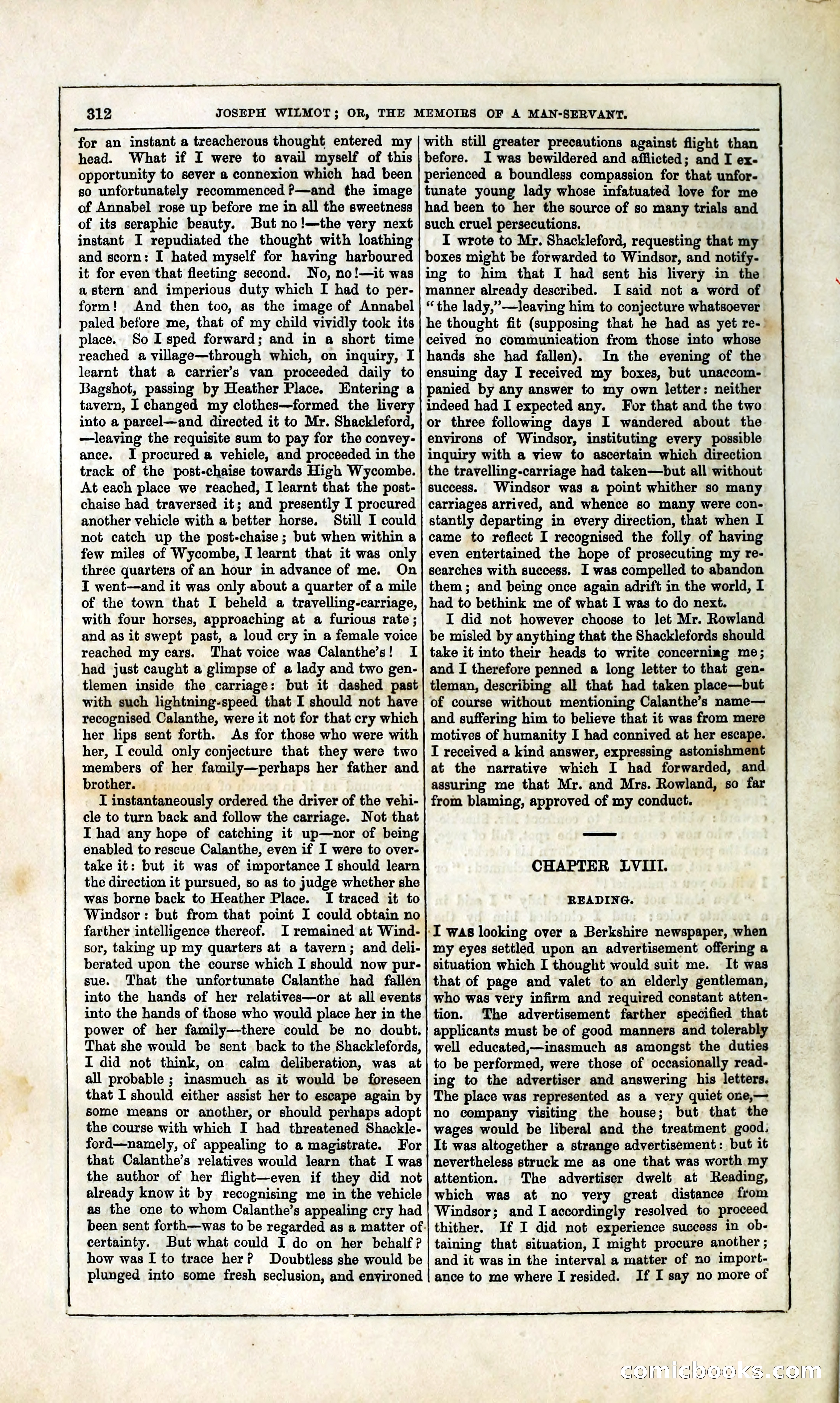
A restored page from Penny Dreadfuls, 1854. Page through the whole issue in the reader above.
📄 Transcribed text from this page (OCR, searchable)
Machine-transcribed from the original scan — historical spelling and the odd misread are preserved.
312 for an instant a treacherous thought entered my head. What if I were to avail myself of this opportunity to sever a connexion which had been so unfortunately recommenced P—and the image of Annabel rose up before me in all the sweetness of its seraphic beauty. But no!—the very next instant I repudiated the thought with loathing and scorn: I hated myself for having harboured it for even that fleeting second. No, no!—it was a stern and imperious duty which I had to per- form! And then too, as the image of Annabel paled before me, that of my child vividly took its place. So I sped forward; and in a short time reached a village—through which, on inquiry, I learnt that a carrier’s van proceeded daily to Bagshot, passing by Heather Place. Entering a tavern, I changed my clothes—formed the livery into a parcel—and directed it to Mr. Shackleford, —leaving the requisite sum to pay for the convey- ance. I procured a vehicle, and proceeded in the track of the post-chaise towards High Wycombe. At each place we reached, I learnt that the post- chaise had traversed it; and presently I procured another vehicle with a better horse. Still I could not catch up the post-chaise ; but when within a few miles of Wycombe, I learnt that it was only three quarters of an hour in advance of me. On I went—and it was only about a quarter of a mile of the town that I beheld a travelling-carriage, with four horses, approaching at a furious rate ; and as it swept past, a loud cry in a female voice reached my ears. ‘That voice was Calanthe’s! I had just caught a glimpse of a lady and two gen- tlemen inside the carriage: but it dashed past with such lightning-speed that I should not have recognised Calanthe, were it not for that cry which her lips sent forth. As for those who were with her, I could only conjecture that they were two members of her family—perhaps her father and brother. I instantaneously ordered the driver of the vehi- cle to turn back and follow the carriage. Not that I had any hope of catching it up—nor of being enabled to rescue Calanthe, even if I were to over- take it: but it was of importance I should learn the direction it pursued, so as to judge whether she was borne back to Heather Place. I traced it to Windsor: but from that point I could obtain no farther intelligence thereof. I remained at Wind- sor, taking up my quarters at a tavern; and deli- berated upon the course which I should now pur- sue. That the unfortunate Calanthe had fallen into the hands of her relatives—or at all events into the hands of those who would place her in the power of her family—-there could be no doubt. That she would be sent back to the Shacklefords, I did not think, on calm deliberation, was at all probable ; inasmuch as it would be foreseen that I should either assist her to escape again by some means or another, or should perhaps adopt the course with which I had threatened Shackle- ford—namely, of appealing to a magistrate. For that Calanthe’s relatives would learn that I was the author of her flight—even if they did not already know it by recognising me in the vehicle as the one to whom Calanthe’s appealing cry had been sent forth—was to be regarded as a matter of- certainty. But what could I do on her behalf? how was I to trace her? Doubtless she would be plunged into some fresh seclusion, and enyironed JOSEPH WILMOT; OR, THE MEMOIRS OF A MAN-SERVANT. with still greater precautions against flight than before. perienced a boundless compassion for that unfor- tunate young lady whose infatuated love for me had been to her the source of so many trials and such cruel persecutions. I was bewildered and afflicted; and I ex- I wrote to Mr. Shackleford, requesting that my boxes might be forwarded to Windsor, and notify- ing to him that I had sent his livery in the manner already described. I said not a word of “the lady,”—leaving him to conjecture whatsoever In the evening of the ensuing day I received my boxes, but unaccom- panied by any answer to my own letter: neither indeed had I expected any. For that and the two or three following days I wandered about the environs of Windsor, instituting every possible inquiry with a view to ascertain which direction the travelling-carriage had taken—but all without success. Windsor was a point whither so many carriages arrived, and whence so many were con- stantly departing in every direction, that when I came to reflect I recognised the folly of having even entertained the hope of prosecuting my re- searches with success. I was compelled to abandon them ; and being once again adrift in the world, I had to bethink me of what I was to do next. I did not however choose to let Mr. Rowland be misled by anything that the Shacklefords should take it into their heads to write concerniag me; and I therefore penned a long letter to that gen- tleman, describing all that had taken place—but of course without mentioning Calanthe’s name— and suffering him to believe that it was from mere motives of humanity I had connived at her cca I received a kind answer, expressing astonishmen at the narrative which I had forwarded, and assuring me that Mr. and Mrs. Rowland, so far from blaming, approved of my conduct. CHAPTER LVIII. READING. ‘I was looking over a Berkshire newspaper, when my eyes settled upon an advertisement offering a situation which I thought would suit me. It was that of page and valet to an elderly gentleman, who was very infirm and required constant atten- tion. The advertisement farther specified that applicants must be of good manners and tolerably well educated,—inasmuch as amongst the duties to be performed, were those of occasionally read- ing to the advertiser and answering his letters. The place was represented as a very quiet one,— no company visiting the house; but that the wages would be liberal and the treatment good. It was altogether a strange advertisement: but it nevertheless struck me as one that was worth my attention. The advertiser dwelt at Reading, which was at mo very great distance from Windsor; and I accordingly resolved to proceed thither. If I did not experience success in ob- taining that situation, I might procure another ; and it was in the interval a matter of no import- ance to me where I resided. If I say no more of he thought fit (supposing that he had as yet re- ceived no communication from those into whose hands she had fallen). — ee (C 6)(6)(6) (COUN cS (f()