
Penny Dreadfuls, 1854 · page 327 of 394
Joseph Wilmot, or, The Memoirs of a Man-Servant — page 327: what you’re looking at
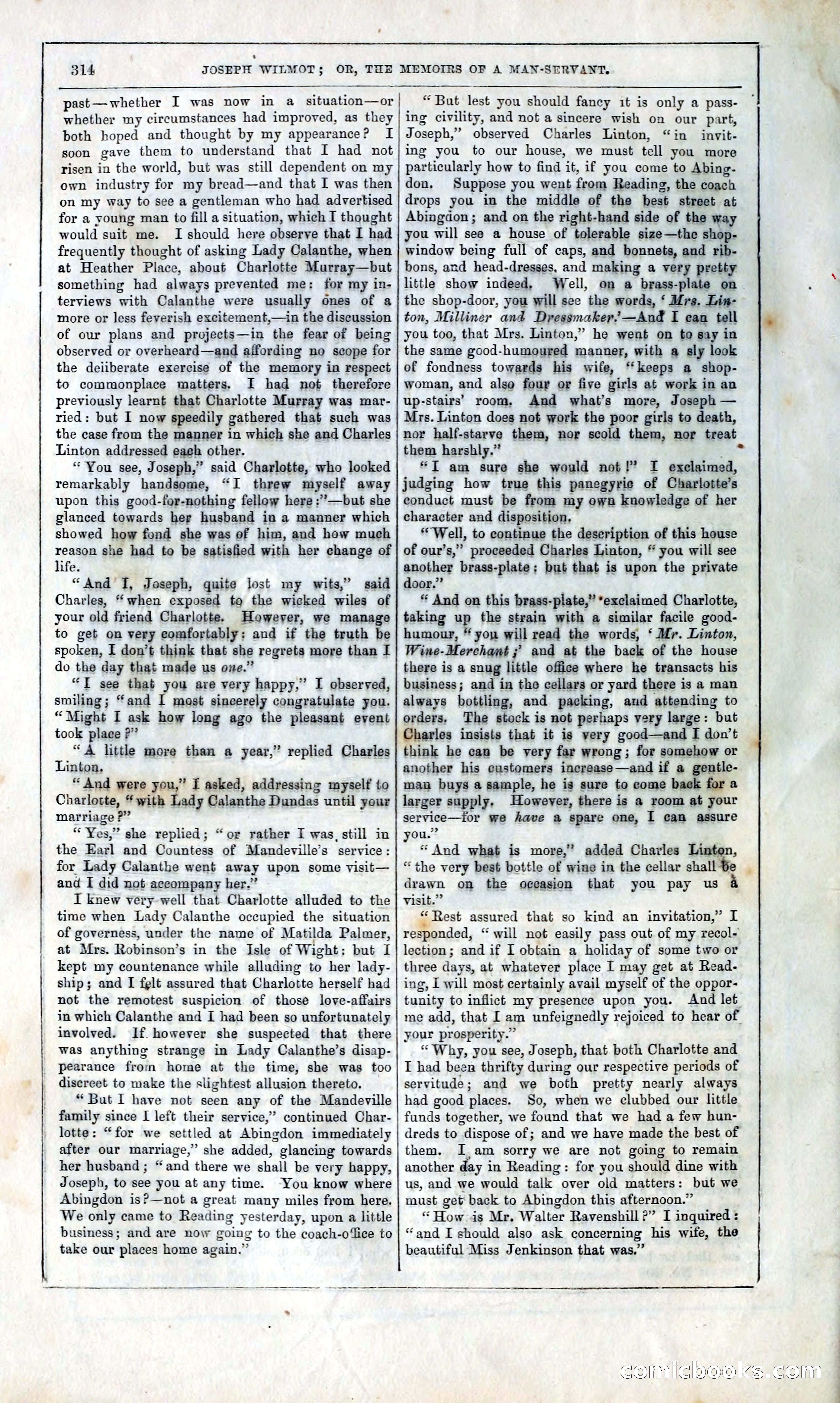
A restored page from Penny Dreadfuls, 1854. Page through the whole issue in the reader above.
📄 Transcribed text from this page (OCR, searchable)
Machine-transcribed from the original scan — historical spelling and the odd misread are preserved.
‘ 314 JOSEPH WILMOT; OR, THE MEMOTRS OF A MAN-SERVANT. past—whether I was now in a situation—or whether my circumstances had improved, as they both hoped and thought by my appearance? I soon gave them to understand that I had not risen in the world, but was still dependent on my own industry for my bread—and that I was then on my way to see a gentleman who had advertised for a young man to fill a situation, which I thought would suit me. I should here obserye that I had frequently thought of asking Lady Calanthe, when at Heather Place, about Charlotte Murray—but something had always prevented me: for my in- terviews with Calanthe were usually ones of a more or less feyerish excitement,—in the discussion of our plans and projects—in the fear of being observed or overheard—and affording no scope for the deiiberate exercise of the memory in respect to commonplace matters. [I had not therefore previously learnt that Charlotte Murray was mar- ried: but I now speedily gathered that such was the case from the manner in which she and Charles Linton addressed eaeh other. “You see, Joseph,” said Charlotte, who looked remarkably handsome, “I threw myself away upon this good-for-nothing fellow here :’’—but she glanced towards her husband in a manner which showed how fond she was of him, and how much reason she had to be satisfied with her change of life. “And I, Joseph, quite lost my wits,” said Charles, “when exposed to the wicked wiles of your old friend Charlotte. However, we manage to get on very comfortably: and if the truth be spoken, I don’t think that she regrets more than I do the day that made us one.” “T see that you are very happy,” I observed, smiling; “and I most sineerely congratulate you. “Might I ask how long ago the pleasant event took place ?” “A littke more than a year,” replied Charles Linton. “And were you,” I asked, addressing myself to Charlotte, * with Lady Calanthe Dundas until your marriage ?” “Yes,” she replied; “or rather I was, still in the Earl and Countess of Mandeville’s service: for Lady Calanthe went away upon some visit— and I did not aceompany her.” I knew very well that Charlotte alluded to the time when Lady Calanthe occupied the situation of governess, under the name of Matilda Palmer, at Mrs. Robinson’s in the Isle of Wight: but I kept my countenance while alluding to her lady- ship; and I felt assured that Charlotte herself had not the remotest suspicion of those love-affairs in which Calanthe and I had been so unfortunately involved. If however she suspected that there was anything strange in Lady Calanthe’s disap- pearance from home at the time, she was too disereet to make the slightest allusion thereto. * But I have not seen any of the Mandeville family since I left their service,’ continued Char- lotte: “for we settled at Abingdon immediately after our marriage,” she added, glancing towards her husband ; “and there we shall be very happy, Joseph, to see you at any time. “You know where Abingdon is?—not a great many miles from here. We only came to Reading yesterday, upon a little business; and are now going to the coach-o‘fice to take our places home again.” ee a —_-- -—— “ But lest you should fancy it is only a pass- ing civility, and not a sincere wish on our part, Joseph,” observed Charles Linton, “in inyit- ing you to our house, we must tell you more particularly how to find it, if you come to Abing- don, Suppose you went from Reading, the coach drops you in the middle of the best street at Abingdon; and on the right-hand side of the way you will see a house of tolerable size—the shop- window being full of caps, and bonnets, and rib- bons, and head-dresses, and making a very pretty little show indeed, Well, on a brass-plate on the shop-door, you will see the words, ‘ Mrs. Lin- ton, Milliner and Dressmaker.—And I ean tell you too, that Mrs. Linton,” he went on to say in the same good-humoured manner, with a sly look of fondness towards his wife, “keeps a shop- woman, and also four or five girls at work in an up-stairs’ room. And what's more, Joseph — Mrs. Linton does not work the poor girls to death, nor half-starve them, nor scold them, nor treat them harshly.” | | “T am sure she would not!” I exclaimed, judging how true this panegyric of Charlotte’s eonduct must be from my own knowledge of her character and disposition, “Well, to continue the description of this house of our’s,” proceeded Charles Linton, “ you will see another brass-plate: but that is upon the private door.” * And on this brass-plate,” *exclaimed Charlotte, taking up the strain with a similar facile good- humour, * you will read the words, ‘ Mr. Linton, Wine-Merchant ;? and at the back of the house there is a snug little office where he transacts his business; and in the cellars or yard there is a man always bottling, and packing, and attending to orders. The stock is not perhaps very large: but Charles insists that it is very good—and I don’t another his customers increase—and if a gentle- man buys a sample, he is sure to come back for a larger supply, However, there is a room at your service—ior we have a spare one, I can assure you.” * And what is more,” added Charles Linton, “ the very best bottle of wine in the cellar shall B drawn on the ogeasion that you pay us visit.” * Rest assured that so kind an invitation,” I responded, “will not easily pass out of my recol- lection; and if I obtain a holiday of some two or three days, at whatever place I may get at Read- ing, I will most certainly avail myself of the oppor- tunity to inflict my presence upon you. And let me add, that [ am unfeignedly rejoiced to hear of your prosperity.” “Why, you see, Joseph, that both Charlotte and I had been thrifty during our respective periods of servitude; and we both pretty nearly always had good places. So, when we clubbed our little funds together, we found that we had a few hun- dreds to dispose of; and we have made the best of them. J am sorry we are not going to remain another day in Reading: for you should dine with us, and we would talk over old matters: but we must get back to Abingdon this afternoon.” “How is Mr. Walter Ravenshill ?” I inquired : “and I should also ask concerning his wife, the beautiful Miss Jenkinson that was.” a el OO) cS Cc (0)