
Penny Dreadfuls, 1854 · page 332 of 394
Joseph Wilmot, or, The Memoirs of a Man-Servant — page 332: what you’re looking at
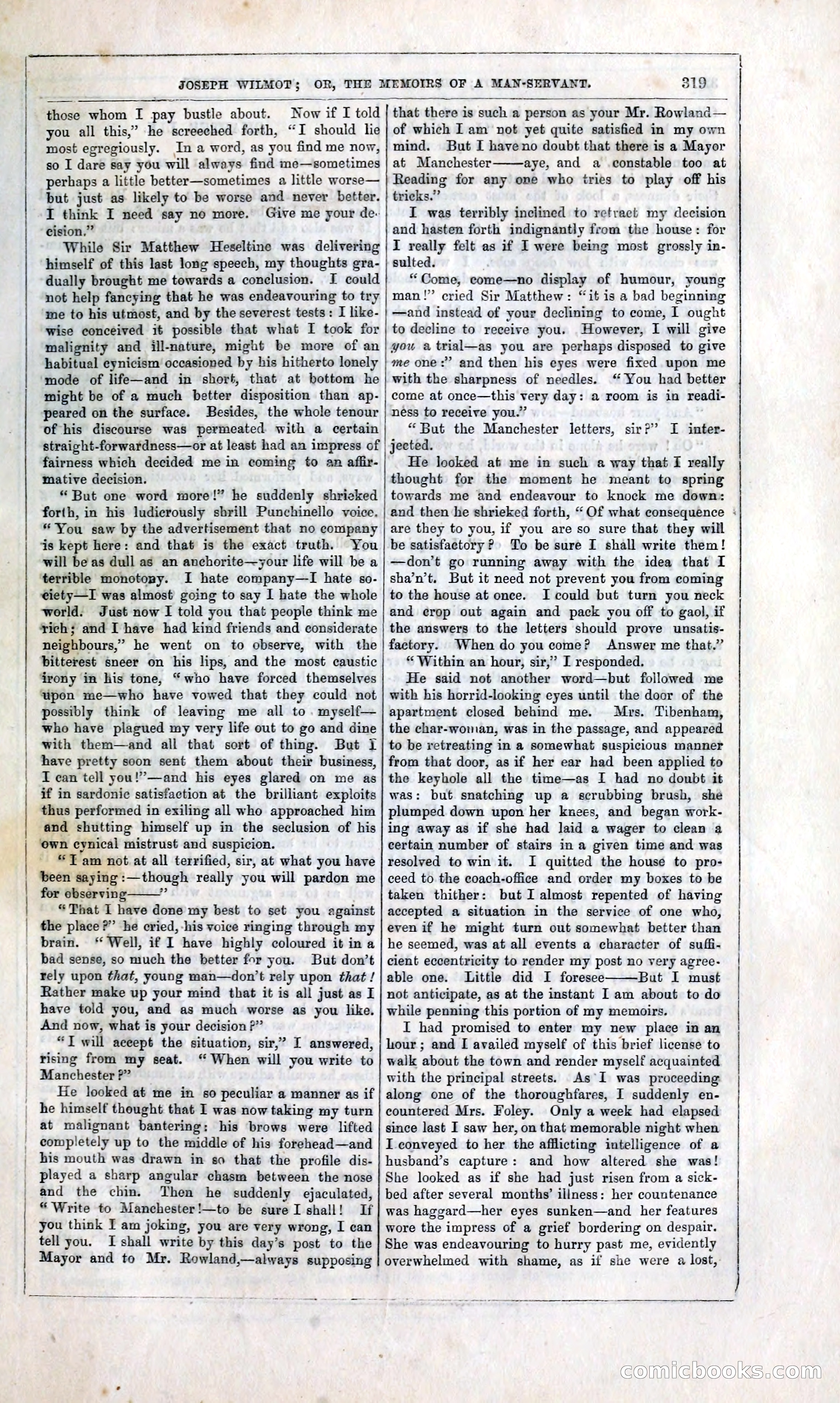
A restored page from Penny Dreadfuls, 1854. Page through the whole issue in the reader above.
📄 Transcribed text from this page (OCR, searchable)
Machine-transcribed from the original scan — historical spelling and the odd misread are preserved.
hg a ee ee Oe So heme — JOSEPH WILMOT ; those whom I pay bustle about. Now if I told you all this,” he screeched forth, “I should lie most egregiously. In a word, as you find me now, so I dare say you will always find me—sometimes perhaps a little better—sometimes a little worse— but just as likely to be worse and never better. I think I need say no more. Give me your de- cision.’ While Sir Matthew Heseltine was delivering himself of this last long speech, my thoughts gra- dually brought me towards a conclusion. I could not help fancying that he was endeavouring to try me to his utmost, and by the severest tests: I like- wise conceived it possible that what I took for malignity and ill-nature, might be more of an habitual eynicism occasioned by his hitherto lonely mode of life—and in short, that at bottom he might be of a much better disposition than ap- peared on the surface. Besides, the whole tenour of his discourse was permeated with a certain straight-forwardness—or at least had an impress of fairness which decided me in coming to an aflir- mative decision. * But one word more!” he suddenly shrieked forth, in his ludicrously shrill Punchinello voice. “You saw by the advertisement that no company is kept here: and that is the exact truth. You will be as dull as an anchorite—your life will be a terrible monotony. I hate ecompany—I hate so- eiety—I was almost going to say I hate the whole world. Just now I told you that people think me rich; and I have had kind friends and considerate neighbours,” he went on to observe, with the bitterest sneer on his lips, and the most caustic dvony in his tone, “who have forced themselves ‘pon me—who have vowed that they could not possibly think of leaving me all to. myself— who have plagued my very life out to go and dine with them—and all that sort of thing. But I have pretty soon sent them about their business, I can tell you!”—and his eyes glared on me as if in sardonic satisfaction at the brilliant exploits thus performed in exiling all who approached him and shutting himself up in the seclusion of his ‘own cynical mistrust and suspicion. - “Tam not at all terrified, sir, at what you have been saying :—though really you will pardon me for observing be “That 1 have done my best to set you against the place ?” he cried, -his voice ringing through my brain. ‘ Well, if I have highly coloured it in a bad sense, so siuch the better for you. But don’t rely upon that, young man—don’t rely upon that ! Rather make up your mind that it is all just as I have told you, and as much worse as you like. And now, what is your decision ?” “J will aceept the situation, sir,” I answered, rising from my seat. “ When will you write to Manchester ?” He looked at me in so peculiar a manner as if he himself thought that I was now taking my turn at malignant bantering: his brows were lifted completely up to the middle of his forehead—and his mouth was drawn in so that the profile dis- played a sharp angular chasm between the nose and the chin. Then he suddenly ejaculated, “ Write to Manchester!—to be sure I shall! If you think I am joking, you are very wrong, I can tell you. Ishall write by this day’s post to the Mayor and to Mr. Rowland,—always supposing OR, THE MEMOIRS OF A MAN-SERVANT. o19 that there is such a person as your Mr. Rowland of which I am not yet quite satisfied in my own mind. But I haveno doubt that there is a Mayor at Manchester aye, and a constable too at Reading for any one who tries to play off his trieks.” I was terribly inciined to retract my decision and hasten forth indignantly from the house: for I really felt as if I were being most grossly in- sulted. | “Come, ecome—no display of humour, young man!” cried Sir Matthew: “it is a bad beginning —and instead of your declining to come, I ought to decline to receive you. However, I will give you a trial—as you are perhaps disposed to give me one: and then his eyes were fixed upon me with the sharpness of needles. “ You had better come at once—this very day: a room is in readi- ness to receive you.” “But the Manchester letters, sir?’ I inter- jeeted. He looked at me in such a way that i really thought for the moment he meant to spring towards me and endeavour to knock me down: and then he shrieked forth, “ Of what consequence are they to you, if you are so sure that they will be satisfactory? To be sure I shall write them! —don’t go running away with the idea that I sha’n’t. But it need not prevent you from coming to the house at once. I could but turn you neck and erop out again and pack you off to gaol, if the answers to the letters should prove unsatis- factory. When do youcome? Answer me that.” * Within an hour, sir,” I responded. He said not another word—but followed me with his horrid-looking eyes until the door of the apartment closed behind me. Mrs. Tibenham, the char-woian, was in the passage, and appeared to be retreating in a somewhat suspicious manner from that door, as if her ear had been applied to the keyhole all the time—as I had no donbt it was: but snatching up a scrubbing brush, she plumped down upon her knees, and began work- ing away as if she had laid a wager to clean a certain number of stairs in a given time and was resolyed to win it. I quitted the house to pro- ceed to the coach-office and order my boxes to be taken thither: but I almost repented of having accepted a situation in the service of one who, even if he might turn out somewhat better than he seemed, was at all events a character of suffi- cient eccentricity to render my post no very agree- able one. Little did I foresee But I must not anticipate, as at the instant I am about to do while penning this portion of my memoirs. I had promised to enter my new place in an hour ; and I availed myself of this brief license to walk about the town and render myself acquainted with the principal streets. As I was proceeding along one of the thoroughfares, I suddenly en- countered Mrs. Foley. Only a week had elapsed since last I saw her, on that memorable night when I conveyed to her the afflicting intelligence of a husband’s capture: and how altered she was! She looked as if she had just risen from a sick- bed after several months’ illness: her countenance was haggard—her eyes sunken—and her features wore the impress of a grief bordering on despair. She was endeavouring to hurry past me, evidently overwhelmed with shame, as if she were a lost, ee == CORNICGLO@ cS (@ ©)