
Penny Dreadfuls, 1854 · page 337 of 394
Joseph Wilmot, or, The Memoirs of a Man-Servant — page 337: what you’re looking at
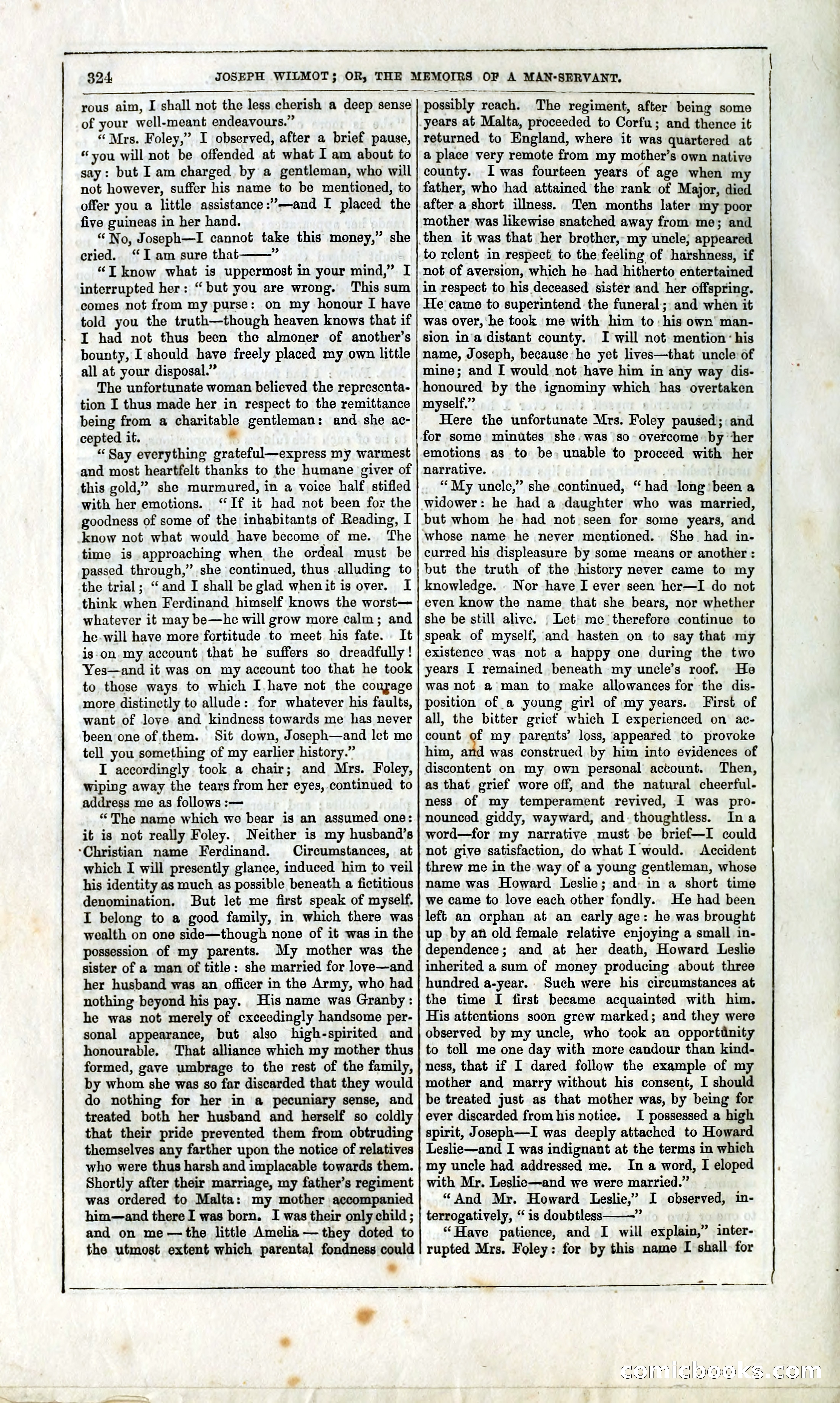
A restored page from Penny Dreadfuls, 1854. Page through the whole issue in the reader above.
📄 Transcribed text from this page (OCR, searchable)
Machine-transcribed from the original scan — historical spelling and the odd misread are preserved.
324 rous aim, I shall not the less cherish a deep sense of your well-meant endeavours.” “ Mrs. Foley,” I observed, after a brief pause, “you will not be offended at what I am about to say: but Iam charged by a gentleman, who will not however, suffer his name to be mentioned, to offer you a little assistance :”’-—and I placed the five guineas in her hand. “ No, Joseph—I cannot take this money,” she cried. “Iam sure that ‘“T know what is uppermost in your mind,” I interrupted her: “but you are wrong. This sum comes not from my purse: on my honour I have told you the truth—though heaven knows that if I had not thus been the almoner of another’s bounty, I should have freely placed my own little all at your disposal.” | The unfortunate woman believed the representa- tion I thus made her in respect to the remittance being from a charitable gentleman: and she ac- cepted it. e “Say everything grateful—express my warmest and most heartfelt thanks to the humane giver of this gold,” she murmured, in a voice half stifled with her emotions. “If it had not been for the goodness of some of the inhabitants of Reading, I know not what would have become of me. ‘The time is approaching when the ordeal must be passed through,” she continued, thus alluding to the trial; ‘and I shall be glad whenit is over. I think when Ferdinand himself knows the worst— whatever it may be—he will grow more calm; and he-will have more fortitude to meet his fate. It ison my account that he suffers so dreadfully! Yes—and it was on my account too that he took to those ways to which I.have not the courage more distinctly to allude: for whatever his faults, want of loye and kindness towards me has never been one of them. Sit down, Joseph—and let me tell you something of my earlier history.” I accordingly took a chair; and Mrs. Foley, wiping away the tears from her eyes, continued to address me as follows :— ‘The name which we bear is an assumed one: it is not really Foley. Neither is my husband’s ‘Christian name Ferdinand. Circumstances, at which I will presently glance, induced him to veil his identity as much as possible beneath a fictitious denomination. But let me first speak of myself. I belong to a good family, in which there was wealth on one side—though none of it was in the possession of my parents. My mother was the sister of a man of title: she married for love—and her husband was an officer in the Army, who had nothing beyond his pay. His name was Granby : he was not merely of exceedingly handsome per- sonal appearance, but also high-spirited and honourable. That alliance which my mother thus formed, gave umbrage to the rest of the family, by whom she was so far discarded that they would do nothing for her in a pecuniary sense, and treated both her husband and herself so coldly that their pride prevented them from obtruding themselves any farther upon the notice of relatives who were thus harsh and implacable towards them. Shortly after their marriage, my father’s regiment was ordered to Malta: my mother accompanied him—and there I was born. I was their only child ; and on me —the little Amelia — they doted to the utmost extent which parental fondness could . a JOSEPH WILMOT; OR, THE MEMOIRS OF A MAN-SERVANT. possibly reach. The regiment, after being some -years at Malta, proceeded to Corfu; and thence it returned to England, where it was quartered at a place very remote from my mother’s own native county. Iwas fourteen years of age when my father, who had attained the rank of Major, died after a short illness. Ten months later my poor | mother was likewise snatched away from me; and then it was that her brother,-my uncle; appeared to relent in respect to the feeling of harshness, if not of aversion, which he had hitherto entertained in respect to his deceased sister and her offspring. He came to superintend the funeral; and when it was over, he took me with him to: his own man- sion ina distant county. I will not mention his name, Joseph, because he yet lives—that uncle of mine; and I would not have him in any way dis- honoured by the ignominy which has overtaken myself.” | Here the unfortunate Mrs. Foley paused; and for some minutes she. was so overcome by ‘her emotions as to be. unable to proceed with her narrative. tl “My uncle,” she continued, “had long’been a widower: he had a daughter who was married, but whom he had not seen for some years, and whose name he never mentioned. She had in- curred his displeasure by some means or another : but the truth of the history never came to my knowledge. Nor have I ever seen her—I do not even know the name that she bears, nor whether she be still alive. _ Let me therefore continue to speak of myself, and hasten on to say that my existence was not a happy one during the two years I remained beneath my uncle’s roof. He was not a man to make allowances for the dis- position of a young girl of my years. First of all, the bitter grief which I experienced on ac- count of my parents’ loss, appeared to provoke him, and was construed by him into evidences of discontent on my own personal account. Then, as that grief wore off, and the natural cheerful- ness of my temperament revived, I was pro- nounced giddy, wayward, and. thoughtless. Ina word—for my narrative must be brief—I could not give satisfaction, do what I would. Accident threw me in the way of a young gentleman, whose name was Howard Leslie; and in a short time we came to love each other fondly. He had been left an orphan at an early age: he was brought up by ati old female relative enjoying a small in- dependence; and at her death, Howard Leslie inherited a sum of money producing about three hundred a-year. Such were his circumstances at the time I first became acquainted with him. His attentions soon grew marked; and they were observed by my uncle, who took an opportinity to tell me one day with more candour than kind- ness, that if I dared follow the example of my mother and marry without his consent, I should be treated just as that mother was, by being for ever discarded from his notice. I possessed a high spirit, Joseph—I was deeply attached to Howard Leslie—and I was indignant at the terms in which my uncle had addressed me. In a word, I eloped with Mr. Leslie—and we were married.” “And Mr. Howard Leslie,” I observed, in- terrogatively, “is doubtless 4: , “Have patience, and I will explain,” inter- rupted Mrs, Foley: for by this name I shall for - ——— SS Ghboo SS (C(O) A