
Penny Dreadfuls, 1854 · page 35 of 394
Joseph Wilmot, or, The Memoirs of a Man-Servant — page 35: what you’re looking at
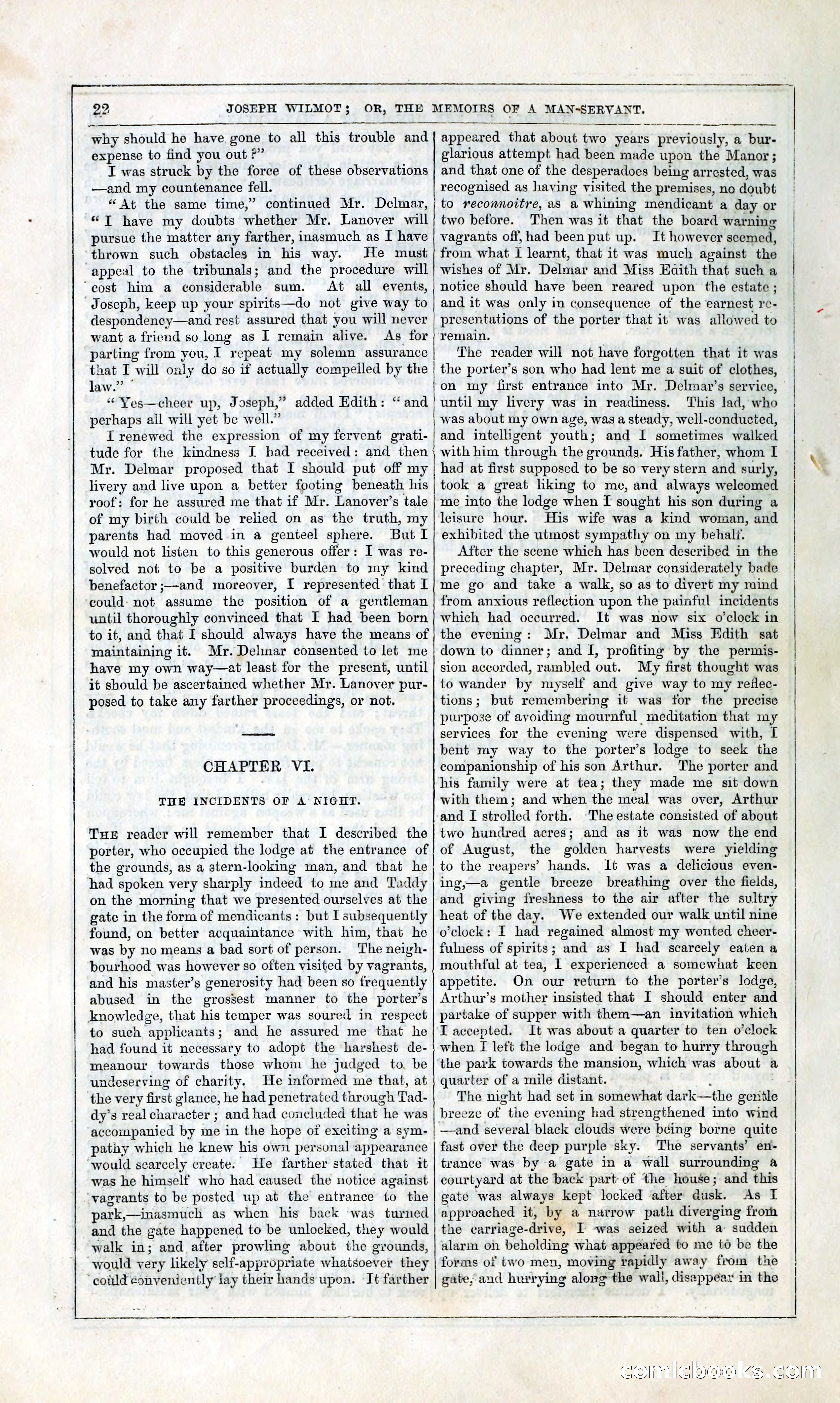
A restored page from Penny Dreadfuls, 1854. Page through the whole issue in the reader above.
📄 Transcribed text from this page (OCR, searchable)
Machine-transcribed from the original scan — historical spelling and the odd misread are preserved.
22 JOSEPH WILMOT; OR, THE MEMOIRS OF A MAN-SERVANT. why should he have gone to all this trouble and expense to find you out ?” I was struck by the force of these observations —and my countenance fell. “At the same time,” continued Mr. Delmar, “T have my doubts whether Mr. Lanover will pursue the matter any farther, inasmuch as I have thrown such obstacles in his way. He must appeal to the tribunals; and the procedure will ‘eost him a considerable sum. At all events, Joseph, keep up your spirits—do not give way to despondency—and rest assured that you will never want a friend so long as I remain alive. As for parting from you, I repeat my solemn assurance that I will only do so if actually compelled by the law.” “Yes—cheer up, Joseph,” added Edith: “ and perhaps all will yet be well.” I renewed the expression of my fervent grati- tude for the kindness I had received: and then Mr. Delmar proposed that I should put off my livery and live upon a better footing beneath his roof: for he assured me that if Mr. Lanover’s tale of my birth could be relied on as the truth, my parents had moved in a genteel sphere. But I would not listen to this generous offer: I was re- solved not to be a positive burden to my kind benefactor ;—and moreover, I represented that I could: not assume the position of a gentleman until thoroughly convinced that I had been born to it, and that I should always have the means of maintaining it. Mr. Delmar consented to let me have my own way—at least for the present, until it should be ascertained whether Mr. Lanover pur- posed to take any farther proceedings, or not. CHAPTER VI. THE INCIDENTS OF A NIGHT. Tue reader will remember that I described the porter, who occupied the lodge at the entrance of the grounds, as a stern-looking man, and that he had spoken very sharply indeed to me and Taddy on the morning that we presented ourselves at the gate in the form of mendicants: but I subsequently found, on better acquaintance with him, that he was by no means a bad sort of person. The neigh- bourhood was however so often visited by vagrants, and his master’s generosity had been so frequently abused in the grossest manner to the porter’s knowledge, that his temper was soured in respect to such applicants; and he assured me that he had found it necessary to adopt the harshest de- meanour towards those whom he judged to, be undeserving of charity. He informed me that, at the very first glance, he had penetrated through Tad- dy’s real character ; and had concluded that he was accompanied by me in the hope of exciting a sym- pathy which he knew his own personal appearance would searcely create: He farther stated that it was he himself who had caused the notice against ‘vagrants to be posted up at the entrance to the park, —inasmuch as when his back was turned and the gate happened to be unlocked, they would walk in; and after prowling about the grounds, would very likely self-appropriate whatsoever they ‘could conveniently lay their hands upon. It farther appeared that about two years previously, a bur- glarious attempt had been made upon the Manor; and that one of the desperadoes being arrested, was recognised as having visited the pr emises , no doubt to reconnoitre, as a whining mendicant a day or two before. Then was it that the board warning | vagrants off, had been put up. It however seemed, | from what 1 learnt, that it was much against the wishes of Mr. Delmar and Miss Eaith that such a notice should have been reared upon the estate ; | and it was only in consequence of the earnest re- | presentations of the porter that it was allowed to remain. The reader will not have forgotten that it was the porter’s son who had lent me a suit of clothes, | on my first entrance into Mr. Delmar’s service, | until my livery was in readiness. This lad, who was about my own age, was a steady, well-conducted, | and intelligent youth; and I sometimes walked with him through the grounds. His father, whom I had at first supposed to be so very stern and surly, took a great hking to me, and always welcomed me into the lodge when I sought his son during a | leisure hour. His wife was a kind woman, and exhibited the utmost sympathy on my behali. | After the scene which has been described in the | preceding chapter, Mr. Delmar considerately bade | me go and take a walk, so as to divert my mind from anxious reflection upon the painful incidents which had occurred. It was now six o’clock in the evening: Mr. Delmar and Miss Edith sat down to dinner; and I, profiting by the permis- sion accorded, rambled out. My first thought was | to wander by myself and give way to my reflec- | | | } | ! tions; but remembering it was for the precise purpose of avoiding mournful meditation that my services for the evening were dispensed with, L bent my way to the porter’s lodge to seek the companionship of his son Arthur. ‘The porter and his family were at tea; they made me sit down with them; and when the meal was over, Arthur and I strolled forth. ‘The estate consisted of about two hundred acres; and as it was now the end of August, the golden harvests were yielding to the reapers’ hands. It was a delicious even- ing;—a gentle breeze breathing over the fields, and giving freshness to the air after the sultry heat of the day. We extended our walk until nine o'clock: I had regained almost my wonted cheer- fulness of spirits; and as I had scarcely eaten a mouthful at tea, I experienced a somewhat keen appetite. On our return to the porter’s lodge, Arthur’s mother insisted that I should enter and partake of supper with them—an invitation which T accepted. It was about a quarter to ten o’clock when I left the lodge and began to hurry through the park towards the mansion, which was about a quarter of a mile distant. The night had set in somewhat dark—the gentle breeze of the evening had strengthened into wind —and several black clouds were being borne quite fast over the deep purple sky. The servants’ en- trance was by a gate in a wall surrounding a courtyard at the back part: of the house; and this gate was always kept locked after dusk. As 1 approached it, by a narrow path diverging froth the éartiage- drive, I -was seized with a sudden alarm on beholding what appeared to me to be the forms of two men, moving rapidly away from the gate; and hurrying along the wall, disappear in the im ECORMNICOOOKSseE®