
Penny Dreadfuls, 1854 · page 365 of 394
Joseph Wilmot, or, The Memoirs of a Man-Servant — page 365: what you’re looking at
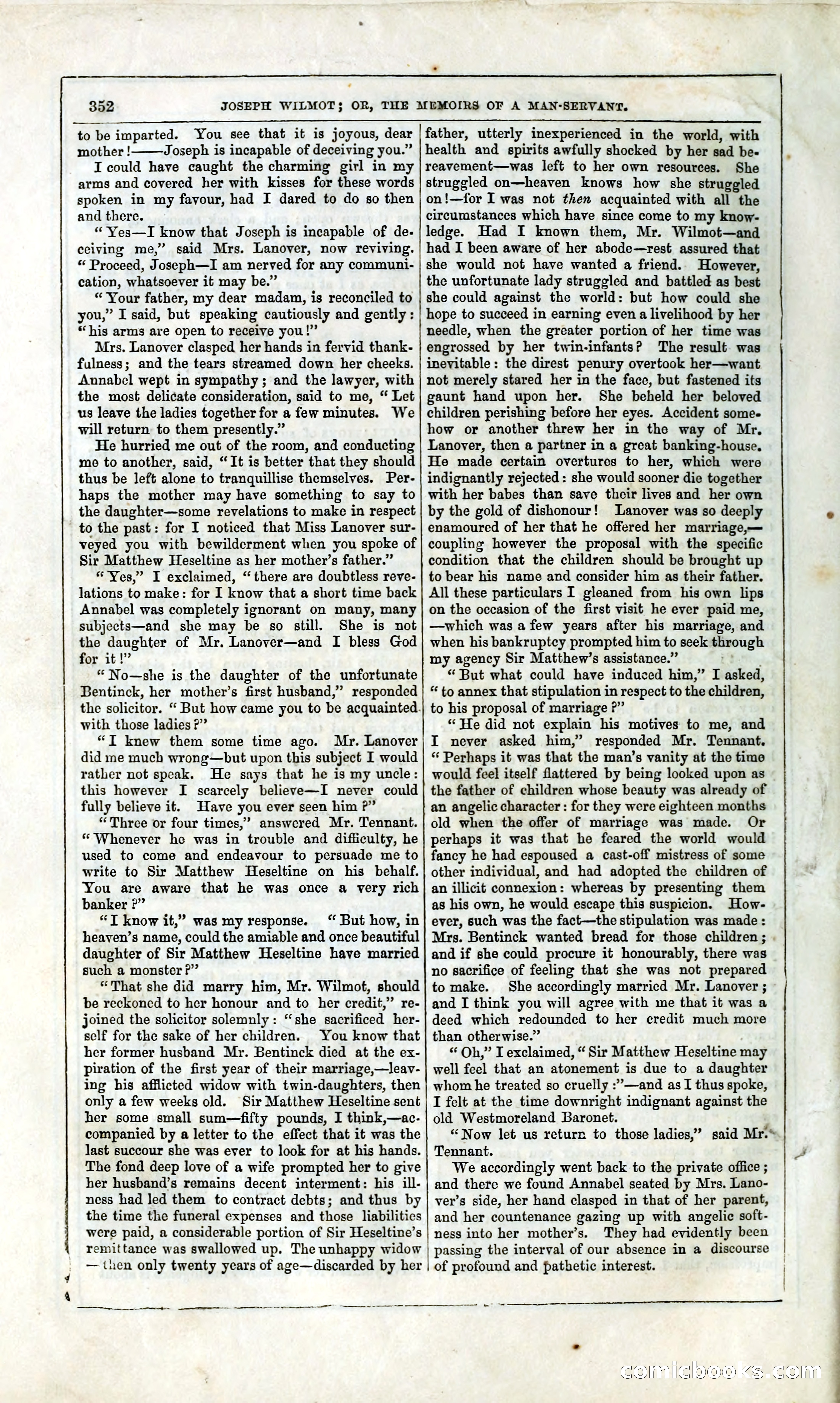
A restored page from Penny Dreadfuls, 1854. Page through the whole issue in the reader above.
📄 Transcribed text from this page (OCR, searchable)
Machine-transcribed from the original scan — historical spelling and the odd misread are preserved.
ee 352 to be imparted. You see that it is joyous, dear mother! Joseph is incapable of deceiving you.” I could have caught the charming girl in my arms and covered her with kisses for these words spoken in my favour, had I dared to do so then | and there. “ Yes—I know that Joseph is incapable of de- ceiving me,” said Mrs. Lanovyer, now reviving. ** Proceed, Joseph—I am nerved for any communi- cation, whatsoever it may be.” “ Your father, my dear madam, is reconciled to you,” I said, but speaking cautiously and gently: “his arms are open to receive you!” Mrs. Lanover clasped her hands in fervid thank- fulness; and the tears streamed down her cheeks. Annabel wept in sympathy; and the lawyer, with the most delicate consideration, said to me, “ Let us leave the ladies together for a few minutes. We will return to them presently.” He hurried me out of the room, and conducting me to another, said, “It is better that they should thus be left alone to tranquillise themselves. Per- haps the mother may have something to say to the daughter—some revelations to make in respect to the past: for I noticed that Miss Lanover sur- veyed you with bewilderment when you spoke of Sir Matthew Heseltine as her mother’s father.” “Yes,” I exclaimed, “there are doubtless reve- lations to make: for I know that a short time back Annabel was completely ignorant on many, many subjects—and she may be so still. She is not the daughter of Mr. Lanover—and I bless God for it!” “ No—she is the daughter of the unfortunate Bentinck, her mother’s first husband,” responded the solicitor. “ But how came you to be acquainted. with those ladies ?” “1 knew them some time ago. Mr. Lanover did me much wrong—but upon this subject I would rather not speak. He says that he is my uncle: this however I scarcely believe—I never could fully believe it. Have you ever seen him ?” “Three or four times,” answered Mr. Tennant. “Whenever he was in trouble and difficulty, he used to come and endeavour to persuade me to write to Sir Matthew Heseltine on his behalf. You are aware that he was once a very rich banker ?” “T know it,” was my response. “ But how, in heaven’s name, could the amiable and once beautiful daughter of Sir Matthew Heseltine have married such a monster?” “That she did marry him, Mr. Wilmot, should be reckoned to her honour and to her credit,” re- joined the solicitor solemnly: “she sacrificed her- self for the sake of her children. You know that her former husband Mr. Bentinck died at the ex- piration of the first year of their marriage,—leav- ing his afflicted widow with twin-daughters, then only a few weeks old. Sir Matthew Heseltine sent her some small sum—fifty pounds, I think,—ac- companied by a letter to the effect that it was the last succour she was ever to look for at his hands. The fond deep love of a wife prompted her to give her husband’s remains decent interment: his ill- ness had led them to contract debts; and thus by the time the funeral expenses and those liabilities were paid, a considerable portion of Sir Heseltine’s remittance was swallowed up. The unhappy widow — then only twenty years of age—discarded by her ——— el en eed —_—_—- - - JOSEPH WILMOT}; OR, THE MEMOIRS OF A MAN-SERVANT. father, utterly inexperienced in the world, with health and spirits awfully shocked by her sad be- reavement—was left to her own resources. She struggled on—heaven knows how she struggled on!—for I was not then acquainted with all the circumstances which have since come to my know- ledge. Had I known them, Mr. Wilmot—and had I been aware of her abode—rest assured that she would not have wanted a friend. However, the unfortunate lady struggled and battled as best she could against the world: but how could she hope to succeed in earning even a livelihood by her needle, when the greater portion of her time was engrossed by her twin-infants? The result. was inevitable: the direst penury overtook her—want not merely stared her in the face, but fastened its gaunt hand upon her. She beheld her beloved children perishing before her eyes. Accident some- how or another threw her in the way of Mr, Lanover, then a partner in a great banking-house, He made certain overtures to her, which were indignantly rejected : she would sooner die together with her babes than save their lives and her own by the gold of dishonour! lLanover was so deeply enamoured of her that he offered her marriage,— coupling however the proposal with the specific condition that the children should be brought up to bear his name and consider him as their father. All these particulars I gleaned from his own lips on the occasion of the first visit he ever paid me, —which was afew years after his marriage, and when his bankruptcy prompted him to seek sirough my agency Sir Matthew’s assistance.” “ But what could have induced him,” I asked, “ to annex that stipulation in respect to the children, to his proposal of marriage ?” “ He did not explain his motives to me, and I never asked him,” responded Mr. Tennant. *“‘ Perhaps it was that the man’s vanity at the time would feel itself flattered by being looked upon as the father of children whose beauty was already of an angelic character: for they were eighteen months old when the offer of marriage was made. Or perhaps it was that he feared the world would fancy he had espoused a cast-off mistress of some other individual, and had adopted the children of an illicit connexion: whereas by presenting them as his own, he would escape this suspicion. How- ever, such was the fact—the stipulation was made: Mrs. Bentinck wanted bread for those children; . and if she could procure it honourably, there was no sacrifice of feeling that she was not prepared to make. She accordingly married Mr. Lanover ; and I think you will agree with me that it was a deed which redounded to her credit much more than otherwise.” “ Oh,” I exclaimed, “ Sir Matthew Heseltine may well feel that an atonement is due to a daughter whom he treated so cruelly :’—and as I thus spoke, I felt at the time downright indignant against the old Westmoreland Baronet. “Now let us return to those ladies,” said Mr.* Tennant. We accordingly went back to the private office ; and there we found Annabel seated by Mrs. Lano- ver’s side, her hand clasped in that of her parent, and her countenance gazing up with angelic soft- ness into her mother’s. They had evidently been passing the interval of our absence in a discourse of profound and pathetic interest. ElOOO S (Cc) im