
Penny Dreadfuls, 1854 · page 367 of 394
Joseph Wilmot, or, The Memoirs of a Man-Servant — page 367: what you’re looking at
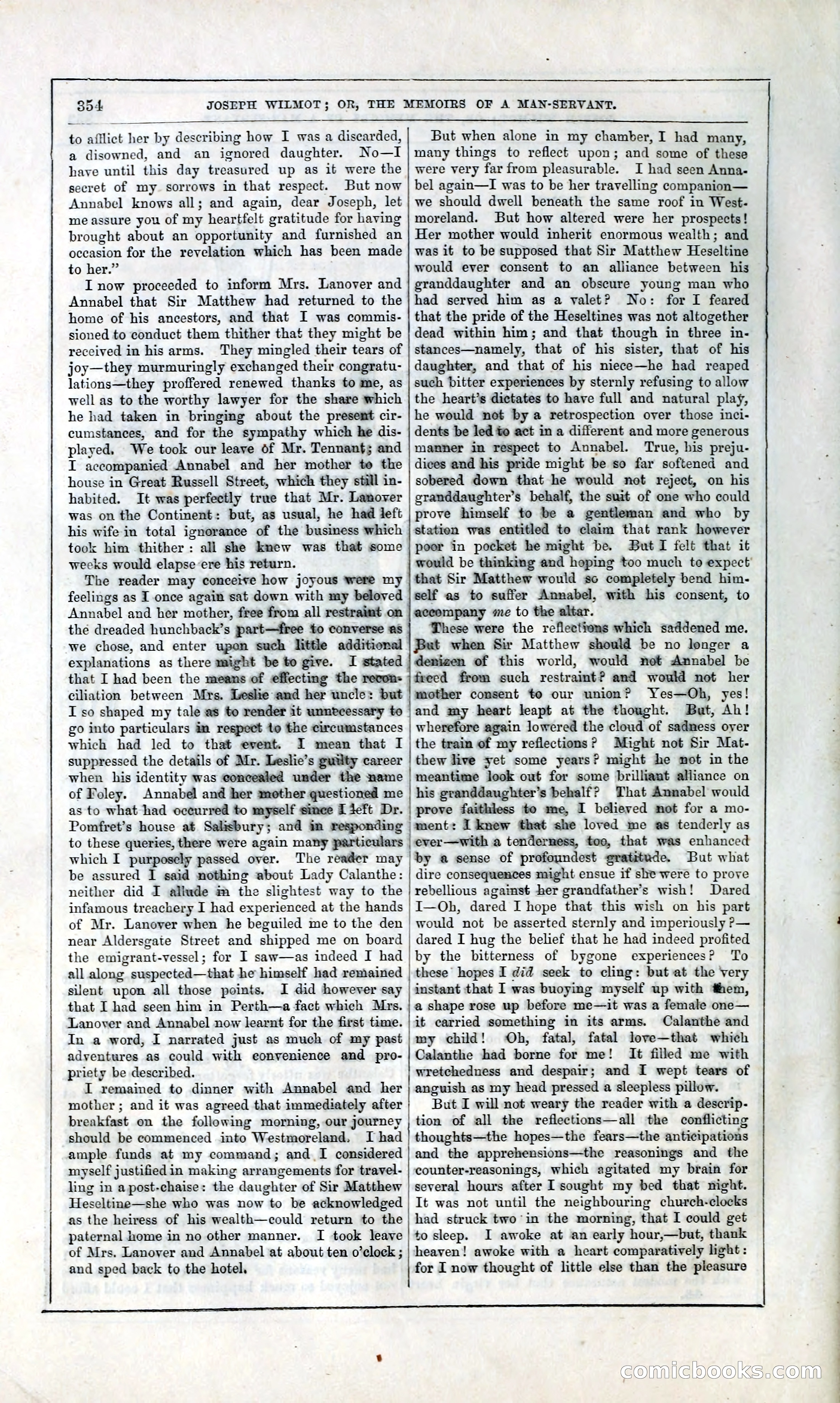
A restored page from Penny Dreadfuls, 1854. Page through the whole issue in the reader above.
📄 Transcribed text from this page (OCR, searchable)
Machine-transcribed from the original scan — historical spelling and the odd misread are preserved.
354 to afflict her by describing how I was a discarded, a disowned, and an ignored daughter. No—I have until this day treasured up as it were the secret of my sorrows in that respect. But now Annabel knows all; and again, dear Joseph, let me assure you of my heartfelt gratitude for having brought about an opportunity and furnished an occasion for the revelation which has been made to her.” I now proceeded to inform Mrs. Lanover and Annabel that Sir Matthew had returned to the home of his ancestors, and that I was commis- sioned to conduct them thither that they might be received in his arms. They mingled their tears of joy—they murmuringly exchanged their congratu- lations—they proffered renewed thanks to me, as well as to the worthy lawyer for the share which he had taken in bringing about the present cir- cumstances, and for the sympathy which he dis- played, We took our leave of Mr. Tennant; and I accompanied Annabel and her mother te the house in Great Russell Street, which they still in- habited. It was perfectly true that Mr. Lamover was on the Continent: but, as usual, he had left his wife in total ignorance of the business which took him thither: all she knew was that some weeks would elapse ere his return. The reader may conceive how joyous were my feelings as I once again sat down with my beloved Annabel and her mother, free from all restraimt on the dreaded hunchback’s part—free to converse #5 we chose, and enter upon such little additional explanations as there might be to give. I stated that I had been the meams of effecting the revon- ciliation between Mrs. Leslie and her uncle: but I so shaped my tale as to render it unnecessary to go into particulars im respect to the circumstances which had led to that event. I mean that I suppressed the details of Mr. Leslie’s guilty career when his identity was concealed under the name of Foley. Annabel and her mother questioned me as to what had occurred to myself simee I deft Dr. Pomfret’s house at Salisbury; and im responding to these queries, there were again many particulars which I purposely passed over. The reader may be assured I said nothing about Lady Calanthe: neither did I allude m the slightest way to the infamous treachery I had experienced at the hands of Mr. Lanover when he beguiled me to the den near Aldersgate Street and shipped me on board the emigrant-vessel; for I saw—as indeed I had all along suspected—that he himself had remained silent upon all those points. I did however say that I had seen him in Perth—a fact which Mrs. Lanover and Annabel now learnt for the first time. In a word, I narrated just as much of my past adventures as could with eonyenience and pro- priety be described. I remained to dinner with Annabel and her mother; and it was agreed that immediately after breakfast on the following morning, our journey should be commenced into Westmoreland. I had ample funds at my command; and I considered myself justified in making arrangements for travel- ling in apost-chaise: the daughter of Sir Matthew Heseltine—she who was now to be acknowledged as the heiress of his wealth—could return to the paternal home in no other manner. I took leave of Mrs. Lanover and Annabel at about ten o’cloek ; and sped back to the hotel. jand my heart leapt at the thought. i i cr EE Se JOSEPH WILMOT; OR, THE MEMOIRS OF A MAN-SERVANT. But when alone in my chamber, I had many, many things to reflect upon; and some of these were very far from pleasurable. I had seen Anna- bel again—I was to be her travelling companion— we should dwell beneath the same roof in West- moreland. But how altered were her prospects! Her mother would inherit enormous wealth; and was it to be supposed that Sir Matthew Heseltine would ever consent to an aljiance between his granddaughter and an obscure young man who had served him as a yalet? No: for I feared that the pride of the Heseltines was not altogether dead within him; and that though in three in- stances—namely, that of his sister, that of his daughter, and that of his niece—he had reaped such bitter experiences by sternly refusing to allow the heart’s dictates to have full and natural play, he would not by a retrospection over those inci- dents be led to act in a different and more generous manner in respect to Aunabel. True, bis preju- dices and his pride might be so far softened and sobered down that he would not reject, on his cranddaughter’s behalf, the suit of one who could prove himself to be a gentleman and who by statien was entitled to claim that rank however poor in pocket he might be. But I felt that it would be thinking and hoping too much to expect’ that Sir Matthew would sc completely bend him- self as to suffer Annabel, with his consent, to aceompany me to the altar. These were the reflections which saddened me. But when Sir Matthew should be no longer a denizen of this world, would not Annabel be freed from such restraint? and would not her mother consent to our union? Yes—QOh, yes! But, Ah! wherefore again lowered the cloud of sadmess oyer the train of my reflections? Might not Sir Mat- thew live yet some years? might he mot in the meantime look out for some brilliant alliance on his granddaughter’s behalf? That Annabel would prove faithless to me, I believed not for a mo- ment: I knew that she loved me as tenderly as ever—with a tenderness, too, that was enhanced by a sense of profoundest gratitude. But what dire consequences might ensue if she were to prove rebellious agamst her grandfather’s wish! Dared I—Oh, dared I hope that this wish on his part would not be asserted sternly and imperiously P— dared I hug the belief that he had indeed profited by the bitterness of bygone experiences? To these hopes I did seek to cling: but at the Very instant that I was buoying myself up with them, a shape rose up before me—it was a female one— it carried something in its arms. Calanthe and my child! Oh, fatal, fatal love—that which Calanthe had borne for me! It filled me with wretchedness and despair; and I wept tears of anguish as my head pressed a sleepless pillow. But I will not weary the reader with a descrip- tion of all the reflections—all the conflicting thoughts—the hopes—the fears—the anticipations and the apprehensions—the reasonings and the counter-reasonings, which agitated my brain for several hours after I sought my bed that night. It was not until the neighbouring church-clocks had struck two’in the morning, that I could get to sleep. I awoke at an early hour,—but, thank heaven! awoke with a heart comparatively light: for I now thought of little else than the pleasure CORNIECLOO@ S (C () th i ie i