
Penny Dreadfuls, 1854 · page 384 of 394
Joseph Wilmot, or, The Memoirs of a Man-Servant — page 384: what you’re looking at
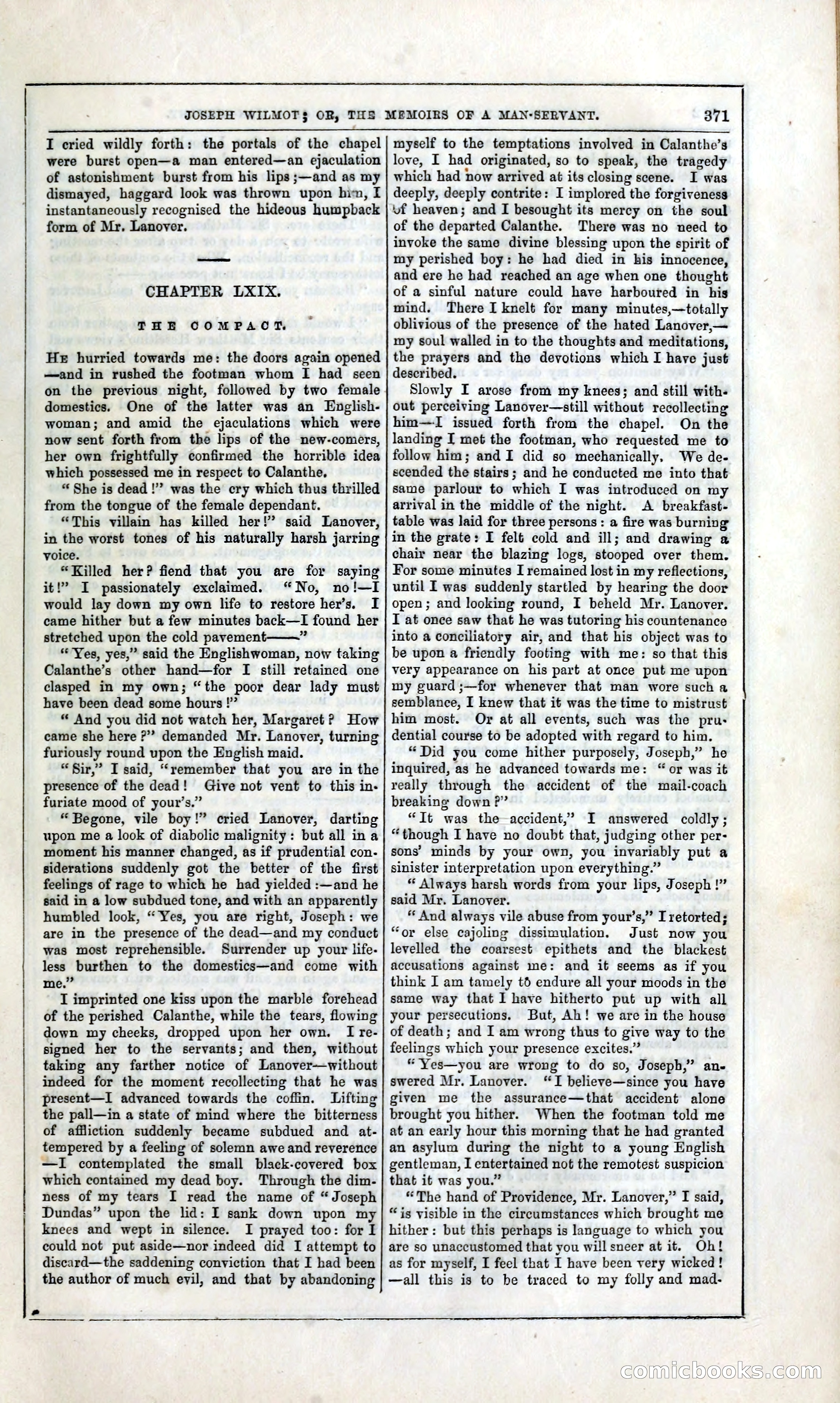
A restored page from Penny Dreadfuls, 1854. Page through the whole issue in the reader above.
📄 Transcribed text from this page (OCR, searchable)
Machine-transcribed from the original scan — historical spelling and the odd misread are preserved.
JOSEPH WILMOT$ OR, THE MEMOIRS OF A MAN-SERVANT. 371 I cried wildly forth: the portals of the chapel were burst open—a man entered—an ejaculation of astonishment burst from his lips ;—and as my dismayed, haggard look was thrown upon hin, I instantaneously recognised the hideous humpback form of Mr, Lanover. CHAPTER LXIX. THE COMPAOT. He hurried towards me: the doors again opened —and in rushed the footman whom I had seen on the previous night, followed by two female domestics. One of the latter was an English- woman; and amid the ejaculations which were now sent forth from the lips of the new-comers, her own frightfully confirmed the horrible idea which possessed me in respect to Calanthe. “ She is dead !” was the cry which thus thrilled from the tongue of the female dependant. “This villain has killed her!’ said Lanover, in the worst tones of his naturally harsh jarring voice. “Killed her? fiend that you are for saying it!” I passionately exclaimed. “No, no!—I would lay down my own life to restore her’s. I came hither but a few minutes back—I found her stretched upon the cold pavement——~” “Yes, yes,” said the Englishwoman, now taking Calanthe’s other hand—for I still retained one clasped in my own; “the poor dear lady must have been dead some hours !” “ And you did not watch her, Margaret? How eame she here ?” demanded Mr. Lanover, turning furiously round upon the English maid. “Sir,” I said, “remember that you are in the presence of the dead! Give not vent to this in- furiate mood of your’s.” “Begone, vile boy!” cried Lanover, darting upon me a look of diabolic malignity: but all in a moment his manner changed, as if prudential con- siderations suddenly got the better of the first feelings of rage to which he had yielded :—and he said in a low subdued tone, and with an apparently humbled look, “Yes, you are right, Joseph: we are in the presence of the dead—and my conduct was most reprehensible. Surrender up your life- less burthen to the domestics—and come with me.” I imprinted one kiss upon the marble forehead of the perished Calanthe, while the tears, flowing down my cheeks, dropped upon her own. I re- signed her to the servants; and then, without taking any farther notice of Lanover—without indeed for the moment recollecting that he was present—I advanced towards the coffin. Lifting the pall—in a state of mind where the bitterness of affliction suddenly became subdued and at- tempered by a feeling of solemn awe and reverence —I contemplated the small black-covered box which contained my dead boy. Through the dim- ness of my tears I read the name of “Joseph Dundas” upon the lid: I sank down upon my knees and wept in silence. I prayed too: for I could not put aside—nor indeed did I attempt to discard—the saddening conviction that I had been the author of much eyil, and that by abandoning myself to the temptations involved in Calanthe’s love, I had originated, so to speak, the tragedy which had now arrived at its closing scene. I was deeply, deeply contrite: I implored the forgiveness vf heaven; and I besought its mercy on the soul of the departed Calanthe. There was no need to invoke the same divine blessing upon the spirit of my perished boy: he had died in his innocence, and ere he had reached an age when one thought of a sinful nature could have harboured in his mind. There I knelt for many minutes,—totally oblivious of the presence of the hated Lanover,— my soul walled in to the thoughts and meditations, the prayers and the devotions which I have just described. Slowly I arose from my knees; and still with- out perceiving Lanover—still without recollecting him—I issued forth from the chapel. On the landing I met the footman, who requested me to follow him; and I did so ‘mechanically, We de- ecended the stairs ; and he conducted me into that same parlour to which I was introduced on my arrival in the middle of the night. A breakfast- table was laid for three persons : a fire was burning in the grate: I felt cold and ill; and drawing a chair near the blazing logs, stooped over them. For some minutes I remained lost in my reflections, until I was suddenly startled by hearing the door open; and looking round, I beheld Mr. Lanover. I at once saw that he was tutoring his countenance into a conciliatory air, and that his object was to be upon a friendly footing with me: so that this very appearance on his part at once put me upon my guard ;—for whenever that man wore such a semblance, I knew that it was the time to mistrust him most. Or at all events, such was the pru- dential course to be adopted with regard to him. “ Did you come hither purposely, Joseph,” he inquired, as he advanced towards me: “ or was it really through the accident of the mail-coach breaking down ?” “It was the accident,’ I answered coldly; “though I have no doubt that, judging other per- sons’ minds by your own, you invariably put a sinister interpretation upon everything.” “ Always harsh words from your lips, Joseph !” said Mr. Lanover. And always vile abuse from your’s,” I retorted; “or else cajoling dissimulation. Just now you levelled the coarsest epithets and the blackest accusations against me: and it seems as if you think I am tamely t6 endure all your moods in the same way that I have hitherto put up with all your persecutions. But, Ah! we are in the house of death; and I am wrong thus to give way to the feelings which your presence excites.” “ Yes—you are wrong to do so, Joseph,” an- swered Mr. Lanover. “I believe—since you have given me the assurance—that accident alone brought you hither. When the footman told me at an early hour this morning that he had granted an asylum during the night to a young English gentleman, I entertained not the remotest suspicion that it was you.” “The hand of Providence, Mr. Lanover,” I said, “is visible in the circumstances which brought me hither: but this perhaps is language to which you are so unaccustomed that you will sneer at it. Oh! as for myself, I feel that I have been very wicked! —all this is to be traced to my folly and mad- CORNICE OOO cS (CO) im