
Penny Dreadfuls, 1854 · page 388 of 394
Joseph Wilmot, or, The Memoirs of a Man-Servant — page 388: what you’re looking at
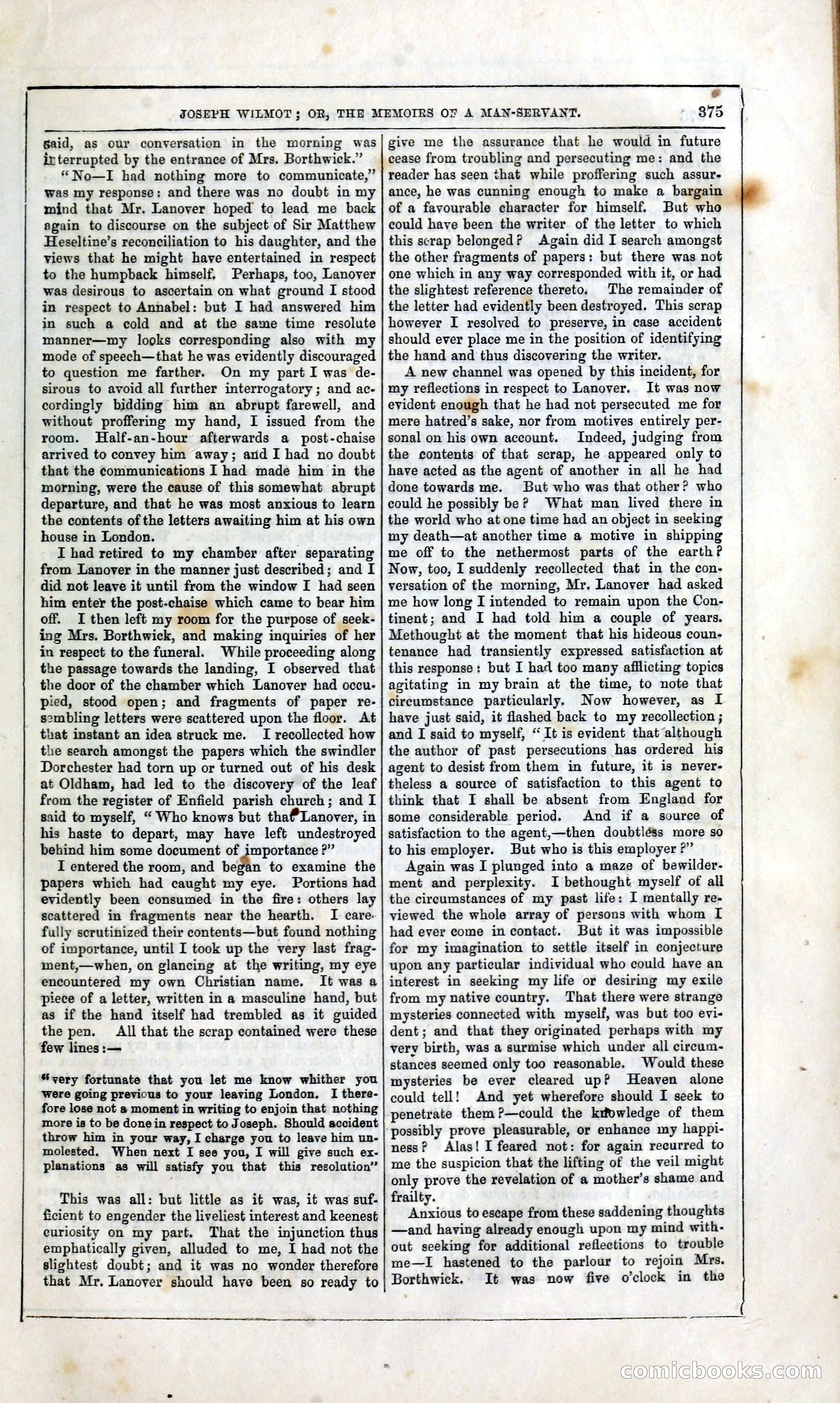
A restored page from Penny Dreadfuls, 1854. Page through the whole issue in the reader above.
📄 Transcribed text from this page (OCR, searchable)
Machine-transcribed from the original scan — historical spelling and the odd misread are preserved.
JOSEPH WILMOT; OR, THE MEMOIRS OF A MAN-SERVANT. —_ -—__ Said, as our conversation in the morning was interrupted by the entrance of Mrs, Borthwick.” * No—I had nothing more to communicate,” was my response; and there was no doubt in my mind that Mr. Lanover hoped to lead me back again to discourse on the subject of Sir Matthew Heseltine’s reconciliation to his daughter, and the views that he might have entertained in respect to the humpback himself, Perhaps, too, Lanover was desirous to ascertain on what ground I stood in respect to Annabel: but I had answered him in such a cold and at the same time resolute manner—my looks corresponding also with my mode of speech—that he was evidently discouraged to question me farther. On my part I was de- sirous to avoid all further interrogatory; and ac- cordingly bidding him an abrupt farewell, and without proffering my hand, I issued from the room. Half-an-hour afterwards a post-chaise arrived to convey him away; and I had no doubt that the communications I had made him in the morning, were the cause of this somewhat abrupt departure, and that he was most anxious to learn the contents of the letters awaiting him at his own house in London. I had retired to my chamber after separating from Lanover in the manner just described; and I did not leave it until from the window I had seen him enter the post-chaise which came to bear him off. I then left my room for the purpose of seek- ing Mrs. Borthwick, and making inquiries of her in respect to the funeral. While proceeding along the passage towards the landing, I observed that the door of the chamber which Lanover had occu- pied, stood open; and fragments of paper re- sembling letters were scattered upon the floor. At that instant an idea struck me. I recollected how the search amongst the papers which the swindler Dorchester had torn up or turned out of his desk at Oldham, had led to the discovery of the leaf from the register of Enfield parish church; and I said to myself, “ Who knows but that"Lanover, in his haste to depart, may have left undestroyed behind him some document of importance ?” I entered the room, and began to examine the papers which had caught my eye. Portions had evidently been consumed in the fire: others lay scattered in fragments near the hearth. I care- fully scrutinized their contents—but found nothing of importance, until I took up the very last frag- ment,—when, on glancing at the writing, my eye encountered my own Christian name. It was a piece of a letter, written in a masculine hand, but as if the hand itself had trembled as it guided the pen. ll that the scrap contained were these few lines :— “very fortunate that you let me know whither you Were going previous to your leaving London. I there- fore lose not a moment in writing to enjoin that nothing more is to be done in respect to Joseph. Should accident throw him in your way, I charge you to leave him un- molested. When next I see you, I will give such ex- planations as will satisfy you that this resolution” This was all: but little as it was, it was suf- ficient to engender the liveliest interest and keenest curiosity on my part. That the injunction thus emphatically given, alluded to me, I had not the slightest doubt; and it was no wonder therefore that Mr. Lanover should have been so ready to —ee es re SS ee © 375 give me the assurance that he would in future cease from troubling and persecuting me: and the reader has seen that while proffering such assur- ance, he was cunning enough to make a bargain of a favourable character for himself. But who could have been the writer of the letter to which this scrap belonged? Again did I search amongst the other fragments of papers: but there was not one which in any way corresponded with it, or had the slightest reference thereto. The remainder of the letter had evidently been destroyed. This scrap howeyer I resolved to preserve, in case accident should ever place me in the position of identifying the hand and thus discovering the writer. A new channel was opened by this incident, for my reflections in respect to Lanover. It was now evident enough that he had not persecuted me for mere hatred’s sake, nor from motives entirely per- sonal on his own account. Indeed, judging from the contents of that scrap, he appeared only to have acted as the agent of another in all he had done towards me. But who was that other? who could he possibly be? What man lived there in the world who at one time had an object in seeking my death—at another time a motive in shipping me off to the nethermost parts of the earth? Now, too, I suddenly recollected that in the con- versation of the morning, Mr. Lanover had asked me how long I intended to remain upon the Con- tinent; and I had told him a couple of years. Methought at the moment that his hideous coun- tenance had transiently expressed satisfaction at this response: but I had too many afflicting topics agitating in my brain at the time, to note that circumstance particularly, Now however, as I have just said, it flashed back to my recollection ; and I said to myself, “ It is evident that although the author of past persecutions has ordered his agent to desist from them in future, it is never- theless a source of satisfaction to this agent to think that I shall be absent from England for some considerable period. And if a source of satisfaction to the agent,—then doubtléss more so to his employer. But who is this employer ?” Again was I plunged into a maze of bewilder- ment and perplexity. I bethought myself of all the circumstances of my past life: I mentally re- viewed the whole array of persons with whom I had ever come in contact. But it was impossible for my imagination to settle itself in conjecture upon any particular individual who could have an interest in seeking my life or desiring my exile from my native country. That there were strange mysteries connected with myself, was but too evi- dent; and that they originated perhaps with my very birth, was a surmise which under all circum- stances seemed only too reasonable. Would these mysteries be ever cleared up? Heaven alone could tell! And yet wherefore should I seek to penetrate them ?—could the krfowledge of them possibly prove pleasurable, or enhance my happi- ness? Alas! I feared not: for again recurred to me the suspicion that the lifting of the veil might only prove the revelation of a mother’s shame and frailty. Anxious to eseape from these saddening thoughts —and having already enough upon my mind with- out seeking for additional reflections to trouble me—I hastened to the parlour to rejoin Mrs. Borthwick. It was now five o'clock in the s- eo ElO@OO <S co na