
Penny Dreadfuls, 1854 · page 39 of 394
Joseph Wilmot, or, The Memoirs of a Man-Servant — page 39: what you’re looking at
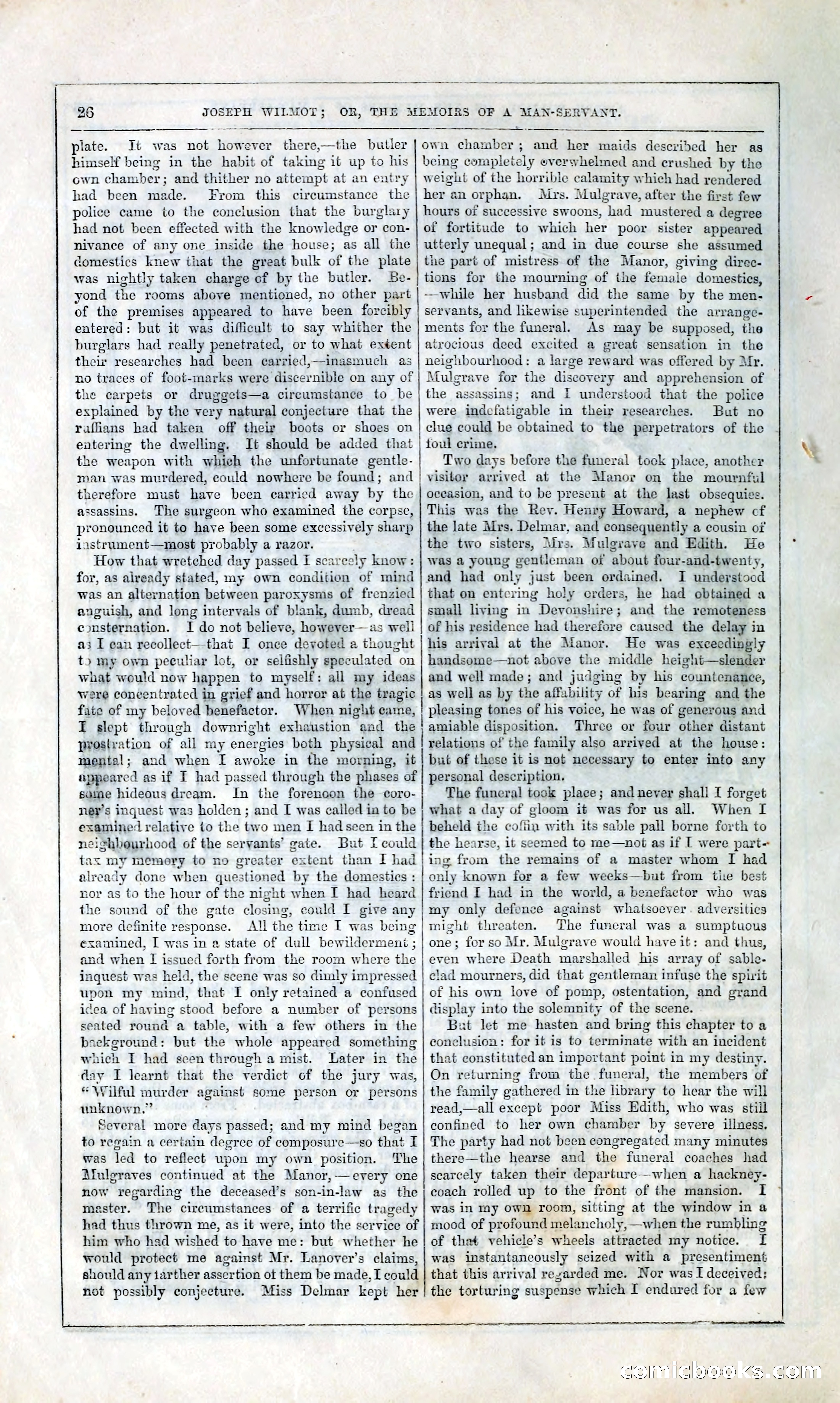
A restored page from Penny Dreadfuls, 1854. Page through the whole issue in the reader above.
📄 Transcribed text from this page (OCR, searchable)
Machine-transcribed from the original scan — historical spelling and the odd misread are preserved.
———— ee —$—$—_—_ 26 plate. It was not however there,—the butler himself being in the habit of taking it up to his own chamber; and thither no attempt at an entry had been made. From this circumstance the police came to the conclusion that the burglay had not been effected with the knowledge or con- nivance of any one inside the house; as all the Gomestics knew that the great bulk of the plate was nightly taken charge of by the butler. Be- yond the rooms above mentioned, no other part of the premises appeared to have been forcibly entered: but it was difficult to say whither the burglars had really penetrated, or to what exéent their researches had been earried,—inasmuch as no traces of foot-marks were discernible on any of the carpets or druggets—a circumstance to be explained by the very natural conjecture that the raffians had taken off their boots or shoes on entering the dwelling. It should be added that the weapon with which the unfortunate gentle- man was murdered, could nowhere be found; and therefore must have been carried away by the assassins. The surgeon who examined the corpse, pronounced it to have been some excessively sharp iastrument—most probably a razor. How that wretched day passed I scareely know: for, as already stated, my own condition of mind was an alternation between paroxysms of frenzied anguish, and long intervals of blank, dumb, dread consternation. I do not believe, however—as well a3 I can recollect—that I once deyoted a thought t> my own peculiar lot, or selfishly speculated on what would now happen to myself: all my ideas were concentrated in grief and horror at the tragic fate of my beloved benefactor. When night came, I slept through downright exhaustion and the prostration of all my energies both physical and mental; and when I awoke in the morning, it appeared as if I had passed through the phases of suine hideous dream. In the forenoon the coro- ner’s inguest was holden; and I was called im to be examined relative to the two men I had seen in the neishbeurhood of the seryants’ gate. But I could tax my Memory to no greater extent than I had already done when questioned by the domesties : nor as to the hour of the night when I had heard the sound of the gate closing, could I give any more definite response. All the time I was being examined, I was in a state of dull bewilderment ; and when I issued forth from the room where the inquest was held, the scene was so dimly impressed upon my mind, that I only retained a confused idea of having stood before a number of persons seated round a table, with a few others in the background: but the whole appeared something which I had scen through a mist. Later in the day I learnt that the verdict of the jury was, *\ilful murder against some person or persons unknown.” Several more days passed; and my mind began to regain a certain degree of composure—so that I was led to reflect upon my own position. The AMulgraves continued at the Manor,—every one now regarding the deceased’s son-in-law as the master. The circumstances of a terrific tragedy had thus thrown me, as it were, into the service of him who had wished to have me: but whether he would protect me against Mr. Lanover’s claims, should any iarther assertion ot them be made,I could not possibly conjecture. Miss Delmar kept her en JOSEPH WILMOT; OR, THE MEMOIRS OF A MAN-SERVANT. own chamber; and her maids described her as being completely everwhelmed and crushed by the weight of the horrible calamity which had rendered her an orphan. Mrs. Mulgrave, after the first few hours of successive swoons, had mustered a degree of fortitude to which her poor sister appeared utterly unequal; and in due course she assumed the part of mistress of the Manor, giving direc- tions for the mourning of the female domestics, —while her husband did the same by the men- servants, and likewise superintended the arrange- ments for the funeral. As may be supposed, the airocious deed excited a great sensation in the neighbourhood: a large reward was offered by Mr. Mulgrave for the discovery and apprehension of the assassins; and I understood that the police were indcfatigable in their researches. But no clue could be obtained to the perpetrators of the foul crime. Two days before the funeral tock place, another visitor arrived at the Manor on the mournful occasion, and to be present at the last obsequies. This was the Rey. Henry Howard, a nephew cf the late Myrs. Delmar, and consequently a cousin of the two sisters, Mrs. Mulgrave and Edith. He 7 was a young gentleman of about four-and-twenty, and had only just been ordained. I understood that on entcring holy orders, he had obtained a small living in Devonshire; and the remoteness of his residence had therefore caused the delay in his arrival at the Manor. He was exceedingly handsome—not above the middle heizht—slender and well made; andl judging by his countenance, as well as by the affability of his bearing and the pleasing tones of his voice, he was of generous and amiable disposition. Three or four other distant relations of the family also arrived at the house: but of these it is not necessary to enter into any personal description. The funeral took place; and never shall I forget what a day of gloom it was for us all. When I beheld the coffin with its sable pall borne forth to the hearse, it seemed to me—not as if I were part- ing from the remains of a master whom I had only known for a few weeks—but from tie best friend I had in the world, a benefactor who was my only defence against whatsoever. adversities might threaten. The funeral was a sumptuous one; for so Mr. Mulgrave would have it: and thus, even where Death marshalled his array of sable- clad mourners, did that gentleman infuse the spirit of his own love of pomp, ostentation, and grand display into the solemnity of the scene. But let me hasten and bring this chapter to a conclusion: for it is to terminate with an incident that constituted an important point in my destiny. On returning from the funeral, the members of the family gathered in the library to hear the will read,—all except poor Miss Edith, who was still confined to her own chamber by severe illness, The party had not been congregated many minutes there—the hearse and the funeral coaches had searcely taken their departure—when a hackney- coach rolled up to the front of the mansion. IL was in my own room, sitting at the window in a mood of profound melancholy,—when the rumbling of that vehicle’s wheels attracted my notice. [ was instantaneously seized with a presentiment that this arrival rezarded me. Nor was I deceived: the torturing suspense which I endured for a few E@ Doo (C bs