
Penny Dreadfuls, 1854 · page 397 of 394
Joseph Wilmot, or, The Memoirs of a Man-Servant — page 397: what you’re looking at
A restored page from Penny Dreadfuls, 1854. Page through the whole issue in the reader above.
📄 Transcribed text from this page (OCR, searchable)
Machine-transcribed from the original scan — historical spelling and the odd misread are preserved.
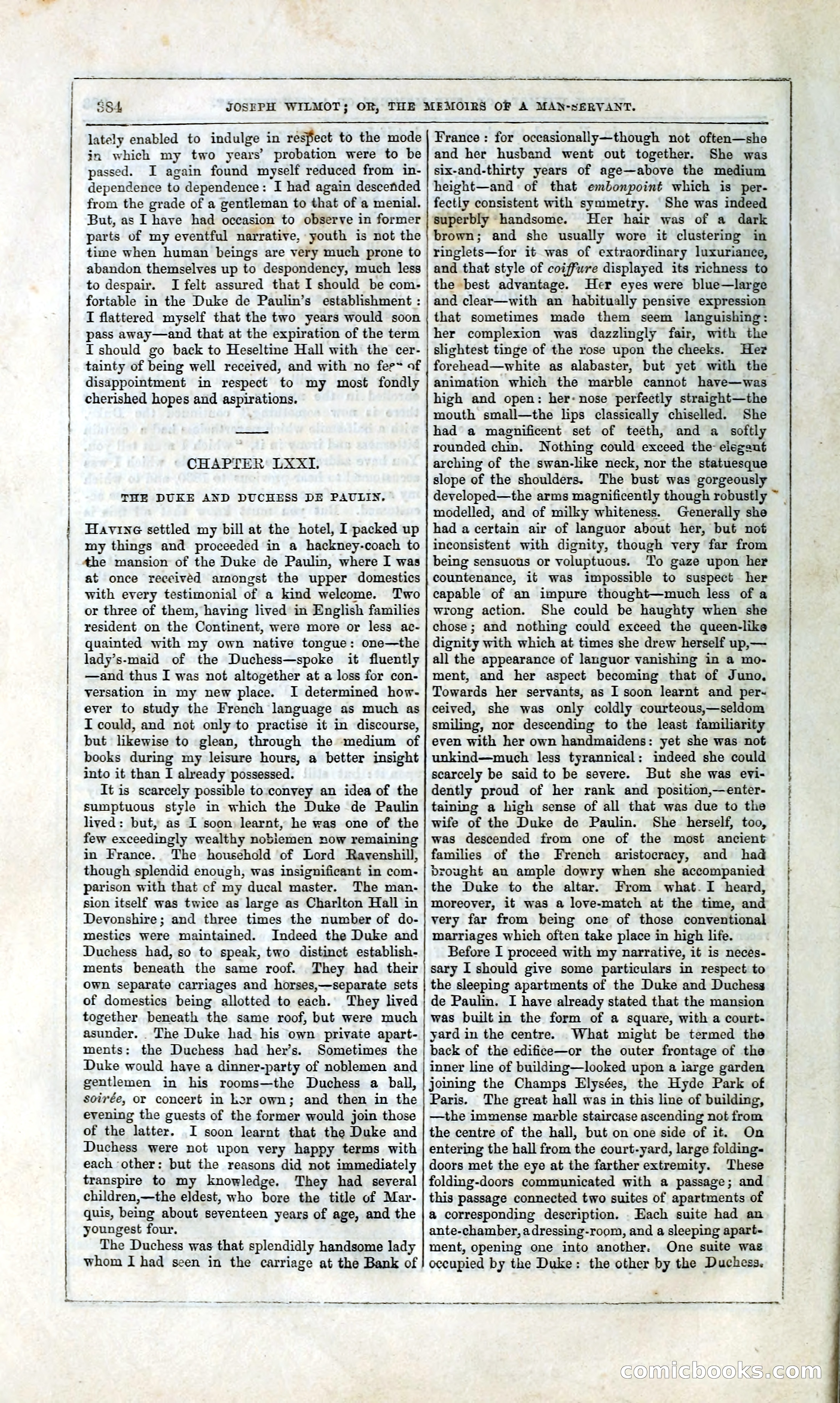
— S84 lately enabled to indulge in resfect to the mode in which my two years’ probation were to be passed. I again found myself reduced from in- dependence to dependence: I had again descended from the grade of a gentleman to that of a menial. But, as I have had occasion to observe in former parts of my eventful narrative, youth is not the time when human beings are very much prone to abandon themselves up to despondency, much less to despair. I felt assured that I should be com- fortable in the Duke de Paulin’s establishment : I flattered myself that the two years would soon pass away—and that at the expiration of the term I should go back to Heseltine Hall with the cer- tainty of being well received, and with no fee~ of disappointment in respect to my most fondly cherished hopes and aspirations. neat CHAPTER LXXI. THE DUKE AND DUCHESS DE PAULIN. Havine settled my bill at the hotel, I packed up my things and proceeded in a hackney-coach to the mansion of the Duke de Paulin, where I was at once receivéd armongst the upper domestics with every testimonial of a kind welcome. Two or three of them, having lived in English families resident on the Continent, were more or less ac- quainted with my own native tongue: one—the lady’s-maid of the Duchess—spoke it fluently —and thus I was not altogether at a loss for con- versation in my new place. I determined how- ever to study the French language as much as I could, and not only to practise it in discourse, but likewise to glean, through the medium of books during my leisure hours, a better insight into it than I already possessed. It is scarcely possible to:convey an idea of the sumptuous style in which the Duke de Paulin lived: but, as I soon learnt, he was one of the few exceedingly wealthy nobiemen now remaining in France. The household of Lord Ravenshill, though splendid enough, was insignificant in com- parison with that cf my ducal master. The man- sion itself was twice as large as Charlton Hall in Devonshire; and three times the number of do- mesties were maintained. Indeed the Duke and Duchess had, so to speak, two distinct establish- ments beneath the same roof. They had their own separate carriages and horses,—separate sets of domestics being allotted to each. They lived together beneath the same roof, but were much asunder. _The Duke had his own private apart- ments: the Duchess had her’s. Sometimes the Duke would have a dinner-party of noblemen and gentlemen in his rooms—the Duchess a ball, soirée, or concert in hor own; and then in the evening the guests of the former would join those of the latter. I soon learnt that the Duke and Duchess were not upon very happy terms with each other: but the reasons did not immediately transpire to my knowledge. They had several children,—the eldest, who bore the title of Mar- quis, being about seventeen years of age, and the youngest four. The Duchess was that splendidly handsome lady whom I had seen in the carriage at the Bank of JOSEPH WILMOT; OR, THE MEMOIRS OF A MAN-sSERVANT. France: for occasionally—though not often—she and her husband went out together. She was six-and-thirty years of age—above the medium height—and of that embonpoint which is per- fectiy consistent with symmetry. She was indeed superbly handsome. Her hair was of a dark brown; and she usually wore it clustering in ringlets—for it was of extraordinary luxuriance, and that style of coiffure displayed its richness to the best advantage. Her eyes were blue—large and clear—with an habitually pensive expression that sometimes made them seem languishing: her complexion was dazzlingly fair, with the slightest tinge of the rose upon the cheeks. Her forehead—white as alabaster, but yet with the animation which the marble cannot hayve—was high and open: her- nose perfectly straight—the mouth small—the lips classically chiselled. She had a magnificent set of teeth, and a softly rounded chin. Nothing could exceed the- elegant arching of the swan-like neck, nor the statuesque slope of the shoulders. The bust was gorgeously developed—the arms magnificently though robustly ~ modelled, and of milky whiteness. Generally she had a certain air of languor about her, but not inconsistent with dignity, though very far from being sensuous or voluptuous. ‘To gaze upon her countenance, it was impossible to suspect her capable of an impure thought—much less of a wrong action. She could be haughty when she chose; and nothing could exceed the queen-like dignity with which at times she drew herself up,— all the appearance of languor vanishing in a mo- ment, and her aspect becoming that of Juno, Towards her servants, as I soon learnt and per~ ceived, she was only coldly courteous,—seldom smiling, nor descending to the least familiarity even with her own handmaidens: yet she was not unkind—much less tyrannical: indeed she could scarcely be said to be severe. But she was evi- dently proud of her rank and position,—enter- taining a high sense of all that was due to the wife of the Duke de Paulin. She herself, too, was descended from one of the most ancient families of the French aristocracy, and had rought an ample dowry when she accompanied the Duke to the altar. From what.I heard, moreover, it was a love-match at the time, and very far from being one of those conventional marriages which often take place in high life. Before I proceed with my narrative, it is neces- sary I should give some particulars in respect to the sleeping apartments of the Duke and Duchess de Paulin. I have already stated that the mansion was built in the form of a square, with a court- yard in the centre. What might be termed the back of the edifice—or the outer frontage of the inner line of building—looked upon a iarge garden joing the Champs Elysées, the Hyde Park of Paris. The great hall was in this line of building, —the immense marble staircase ascending not from the centre of the hall, but on one side of it. On entering the hall from the court-yard, large folding- doors met the eye at the farther extremity. These folding-doors communicated with a passage; and this passage connected two suites of apartments of & corresponding description. Each suite had an ante-chamber,adressing-room, and a sleeping apart- ment, opening one into another. One suite was occupied by the Duke: the other by the Duchess. LE EE eS iS sss stisenee eaten — es “ i _——— a GDOaks (E(@)