
Penny Dreadfuls, 1854 · page 41 of 394
Joseph Wilmot, or, The Memoirs of a Man-Servant — page 41: what you’re looking at
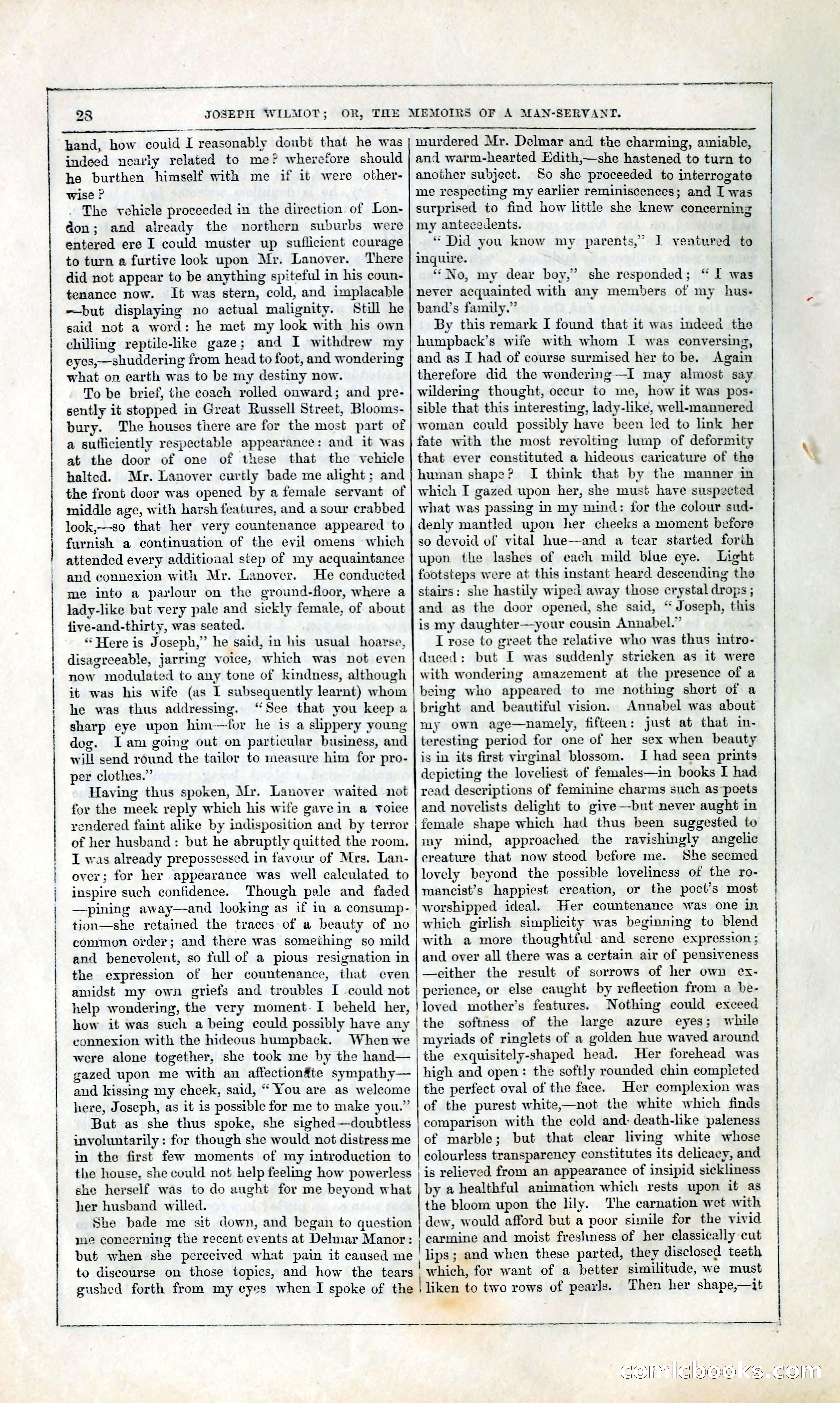
A restored page from Penny Dreadfuls, 1854. Page through the whole issue in the reader above.
📄 Transcribed text from this page (OCR, searchable)
Machine-transcribed from the original scan — historical spelling and the odd misread are preserved.
acne ageless | | | oe er er ee Se 28 JOSEPH WILMOT; OR, THE fi at SS ane fe PEE ESE hand, how couid I reasonably doubt that he was indeed nearly related to me? wherefore should he burthen himself with me if it were other- wise ? _ The vehiele proceeded in the direction of Lon- don; and already the northern suburbs were entered ere I could muster up suflicient courage to turn a furtive look upon Myr. Lanover. There did not appear to be anything spiteful in his coun- tenance now. It was stern, cold, and implacable —but displaying no actual malignity. Stil he said not a word: he met my look with his own chiliing reptile-like gaze; and I withdrew my eyes,—shuddering from head to foot, and wondering what on earth was to be my destiny now. To be brief, the coach rolled onward; and pre- sently it stopped in Great Russell Street, Blooms- bury. The houses there are for the most part of a suiliciently respectable appearance: and it Was at the door of one of these that the vehicle halted. Mr. Lanover curtly bade me alight; and the front door was opened by a female servant of middle age, with harsh features, and a sour crabbed look,—so that her very countenance appeared to furnish a continuation of the evil omens which attended every additional step of my acquaintance and connexion with Mr. Lanover. He conducted me into a parlour on the ground-floor, where a lady-like but very pale and sickly female, of about five-and-thirty, was seated. “Here is Joseph,” he said, in his usual hoarse, disagreeable, jarring voice, which was not even now modulated to any tone of kindness, although it was his wife (as I subsequently learnt) whom he was thus addressing. “See that you keep a sharp eye upon him—for he is a slippery young dog. Iam going out on particular busmess, and will send round the tailor to measure him for pro- per clothes.” Having thus spoken, Mr. Lanover waited not for the meek reply which his wife gavein a Yoice yendered faint alike by indisposition and by terror of her husband: but he abruptly quitted the room. I was already prepossessed in favour of Mrs. Lan- over; for her appearance was well calculated to inspire such confidence. Though pale and faded —pining away—and looking as if in a consump- tion—she retained the traces of a beauty of no common order; and there was something so mild and benevolent, so full of a pious resignation in the expression of her countenance, that even amidst my own griefs and troubles I could not help wondering, the very moment-1 beheld her, how it was such a being could possibly have any connexion with the hideous humpback. When we were alone together, she took me by the hand— gazed upon me with an affection#te sympathy— and kissing my cheek, said, “ You are as welcome here, Joseph, as it is possible for me to make you.” But as she thus spoke, she sighed—doubtless involuntarily: for though she would not distress me in the first few moments of my introduction to the house, she could not help feeling how powerless she herself was to do aught for me beyond what her husband willed. She bade me sit down, and began to question me concerning the recent events at Delmar Manor: but when she perceived what pain it caused me to discourse on those topics, and how the tears eushed forth from my eyes when I spoke of the he ea ee ee ee il MEMOIRS OF A MAN-SERVANT. murdered Mr. Delmar and the charming, amiable, and warm-hearted Edith,—she hastened to turn to another subject. So she proceeded to interrogate me respecting my earlier reminiscences; and I was surprised to find how little she knew concerninz my antecedents. * Did you know my parents,” I ventured to ingulre. “No, my dear boy,” she responded; “ I was never acquainted with any members of my hus- band’s family.” By this remark I found that it was indeed the humpback’s wife with whom I was conversing, and as I had of course surmised her to be. Again therefore did the wondering—I may almost say wildering thought, occur to me, how it was pos- sible that this interesting, lady-like, well-mannered woman could possibly have been led to lnk her fate with the most revolting lump of deformity that ever constituted a hideous caricature of the human shape? I think that by the manner in which I gazed upon her, she must have suspected what was passing in my mind: for the colour sud- denly mantled upon her cheeks a moment before so devoid of vital hue—and a tear started forth upon the lashes of each mild blue eye. Light footsteps were at this instant heard descending the stairs: she hastily wiped away those crystal drops; and as the door opened, she said, “ Joseph, this is my daughter—your cousin Annabel.” I rose to greet the relative who was thus intro- duced: but I was suddenly stricken as it were with wondering amazement at the presence of a being who appeared to me nothing short of a bright and beautiful vision. Annabel was about my own age—namely, fifteen: just at that im- teresting period for one of her sex when beauty is in its first virginal blossom. I had seen prints depicting the loveliest of females—in books I had read descriptions of feminine charms such as-poets and novelists delight to give—but never aught in female shape which had thus been suggested to my mind, approached the ravishingly angelic creature that now stcod before me. She seemed lovely beyond the possible loveliness of the ro- mancist’s happiest creation, or the poet’s most worshipped ideal. Her countenance was one in which girlish simplicity was beginning to blend with a more thoughtful and serene expression ; and over all there was a certain air of pensiveness —either the result of sorrows of her own ex- perience, or else caught by reflection from a he- loved mother’s features. Nothing could exceed the softness of the large azure eyes; while myriads of ringlets of a golden hue waved around the exquisitely-shaped head. Her forehead was high and open: the softly rounded chin completed the perfect oval of the face. Her complexion was of the purest white,—not the white which finds comparison with the cold and- death-like paleness of marble; but that clear living white whose colourless transparency constitutes its delicacy, and is relieved from an appearance of insipid sickliness by a healthful animation which rests upon it as the bloom upon the lily. The carnation wet with dew, would afford but a poor simile for the vivid carmine and moist freshness of her classically cut | tis and when these parted, they disclosed teeth ‘which, for want of a better similitude, we must liken to two rows of pearls. Then her shape,—1it nm “ett OC A i 2 a a a a a a a a ET TS ‘ YS eeeerenr ears creer EN Le ECORMMEAO@ C] S (C(O)