
Penny Dreadfuls, 1854 · page 61 of 394
Joseph Wilmot, or, The Memoirs of a Man-Servant — page 61: what you’re looking at
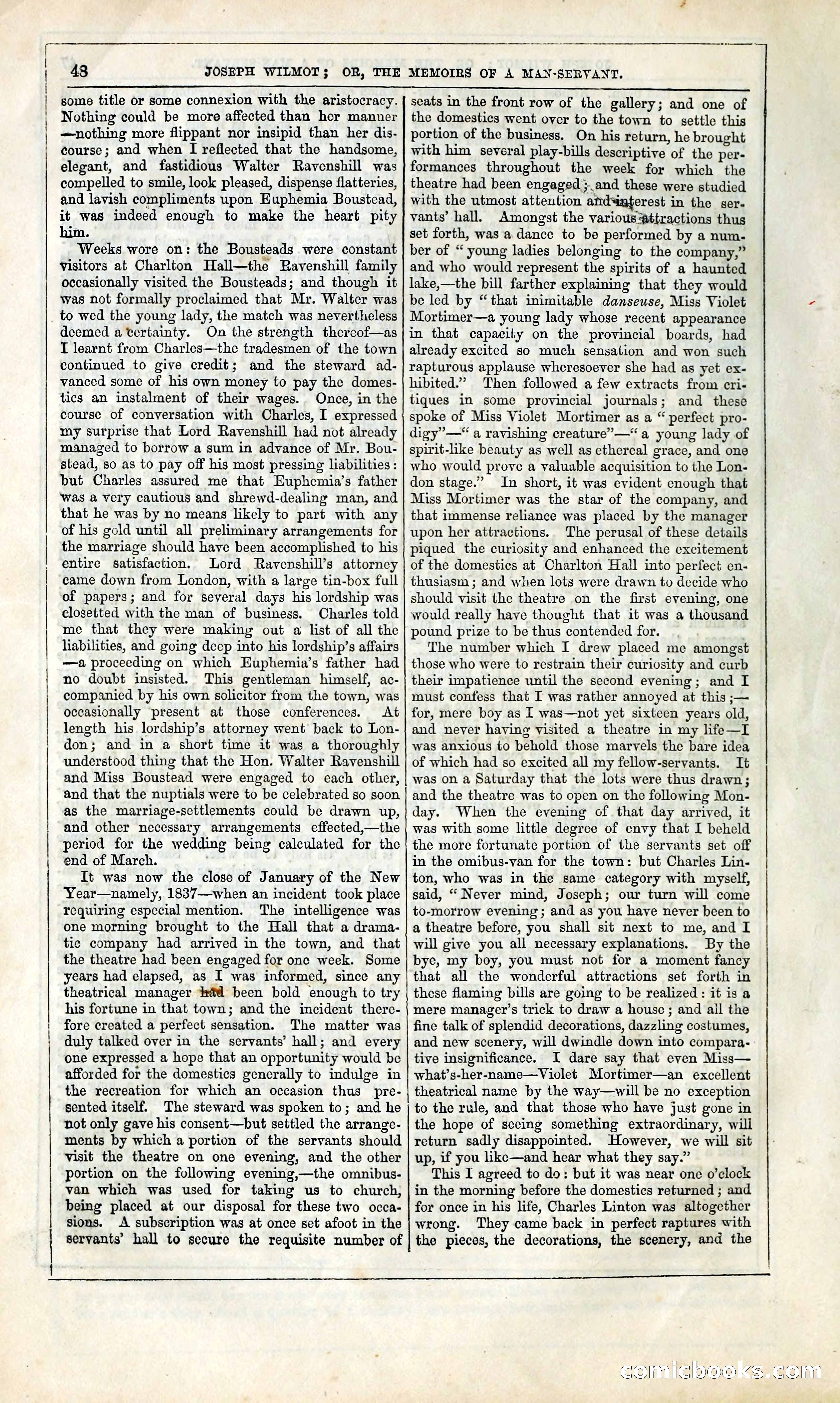
A restored page from Penny Dreadfuls, 1854. Page through the whole issue in the reader above.
📄 Transcribed text from this page (OCR, searchable)
Machine-transcribed from the original scan — historical spelling and the odd misread are preserved.
— ——- 48 some title or some connexion with the aristocracy. Nothing could be more affected than her manner —nothing more flippant nor insipid than her dis- course; and when I reflected that the handsome, elegant, and fastidious Walter Ravenshill was compelled to smile, look pleased, dispense flatteries, and lavish compliments upon Euphemia Boustead, it was indeed enough to make the heart pity him. Weeks wore on: the Bousteads were constant visitors at Charlton Hall—the Ravenshill family occasionally visited the Bousteads; and though it was not formally proclaimed that Mr. Walter was to wed the young lady, the match was nevertheless deemed a tertainty. On the strength thereof—as T learnt from Charles—the tradesmen of the town continued to give credit; and the steward ad- vanced some of his own money to pay the domes- tics an instalment of their wages. Once, in the course of conversation with Charles, I expressed my surprise that Lord Ravenshill had not already managed to borrow a sum in advance of Mr. Bou- stead, so as to pay off his most pressing liabilities: but Charles assured me that Euphemia’s father was a very cautious and shrewd-dealing man, and that he was by no means likely to part with any of his gold until all preliminary arrangements for the marriage should have been accomplished to his entire satisfaction. Lord Ravenshill’s attorney came down from London, with a large tin-box full of papers; and for several days his lordship was closetted with the man of business. Charles told me that they were making out a list of all the liabilities, and going deep into his lordship’s affairs —a proceeding on which Euphemia’s father had no doubt insisted. This gentleman himself, ac- companied by his own solicitor from the town, was occasionally present at those conferences. At length his lordship’s attorney went back to Lon- don; and in a short time it was a thoroughly understood thing that the Hon. Walter Ravenshill and Miss Boustead were engaged to each other, and that the nuptials were to be celebrated so soon as the marriage-scttlements could be drawn up, and other necessary arrangements effected,—the period for the wedding being calculated for the end of March. | Tt was now the close of January of the New Year—namely, 1837—when an incident took place requiring especial mention. The intelligence was one morning brought to the Hall that a drama- tic company had arrived in the town, and that the theatre had been engaged for one week. Some years had elapsed, as I was informed, since any theatrical manager ‘kl been bold enough to try his fortune in that town; and the incident there- fore created a perfect sensation. The matter was duly talked over in the servants’ hall; and every one expressed a hope that an opportunity would be afforded for the domestics generally to indulge in the recreation for which an occasion thus pre- sented itself. The steward was spoken to; and he not only gave his consent—but settled the arrange- ments by which a portion of the servants should visit the theatre on one evening, and the other portion on the following evening,—the omnibus- van which was used for taking us to church, being placed at our disposal for these two occa- sions. A subscription was at once set afoot in the servants’ hall to secure the requisite number of JOSEPH WILMOT; OR, THE MEMOIRS OF A MAN-SERVANT. seats in the front row of the gallery; and one of the domestics went over to the town to settle this portion of the business. On his return, he brought with him several play-bills descriptive of the per- formances throughout the week for which the theatre had been engaged };-..and these were studied with the utmost attention atd“iaterest in the ser. vants’ hall. Amongst the various @ttractions thus set forth, was a dance to be performed by a num- ber of “young ladies belonging to the company,” and who would represent the spirits of a haunted lake,—the bill farther explaining that they would be led by “that inimitable danseuse, Miss Violet Mortimer—a young lady whose recent appearance in that capacity on the provincial boards, had already excited so much sensation and won such rapturous applause wheresoever she had as yet ex- hibited.” Then followed a few extracts from cri- tiques in some provincial journals; and these spoke of Miss Violet Mortimer as a “ perfect pro- digy’—* a ravishing creature”—“ a young lady of spirit-like beauty as well as ethereal grace, and one who would prove a valuable acquisition to the Lon- don stage.” In short, it was evident enough that Miss Mortimer was the star of the company, and that immense reliance was placed by the manager upon her attractions. The perusal of these details piqued the curiosity and enhanced the excitement of the domestics at Charlton Hall into perfect en- thusiasm ; and when lots were drawn to decide who should visit the theatre on the first evening, one would really have thought that it was a thousand pound prize to be thus contended for. The number which I drew placed me amongst those who were to restrain their curiosity and curb their impatience until the second evening; and I must confess that I was rather annoyed at this ;— for, mere boy as I was—not yet sixteen years old, and never having visited a theatre in my life—I was anxious to behold those marvels the bare idea of which had so excited all my fellow-servants. It was on a Saturday that the lots were thus drawn; and the theatre was to open on the following Mon- day. When the evening of that day arrived, it was with some little degree of envy that I beheld the more fortunate portion of the servants set off in the omibus-van for the town: but Charles Lin- ton, who was in the same category with myself, said, “ Never mind, Joseph; our turn will come to-morrow evening; and as you have never been to a theatre before, you shall sit next to me, and I will give you all necessary explanations. By the bye, my boy, you must not for a moment fancy that all the wonderful attractions set forth in these flaming bills are going to be realized: it is a mere manager’s trick to draw a house; and ail the fine talk of splendid decorations, dazzling costumes, and new scenery, will dwindle down into compara- tive insignificance. I dare say that even Miss— what’s-her-name—Violet Mortimer—an excellent theatrical name by the way—will be no exception to the rule, and that those who have just gone in the hope of seeing something extraordinary, will return sadly disappointed. However, we will sit up, if you like—and hear what they say.” This I agreed to do: but it was near one o’clock in the morning before the domestics returned ; and for once in his life, Charles Linton was altogether wrong. They came back in perfect raptures with the pieces, the decorations, the scenery, and the Ig ge eg a I oe I a a a 0)(0)) cS (C@) “ AA