
Penny Dreadfuls, 1854 · page 64 of 394
Joseph Wilmot, or, The Memoirs of a Man-Servant — page 64: what you’re looking at
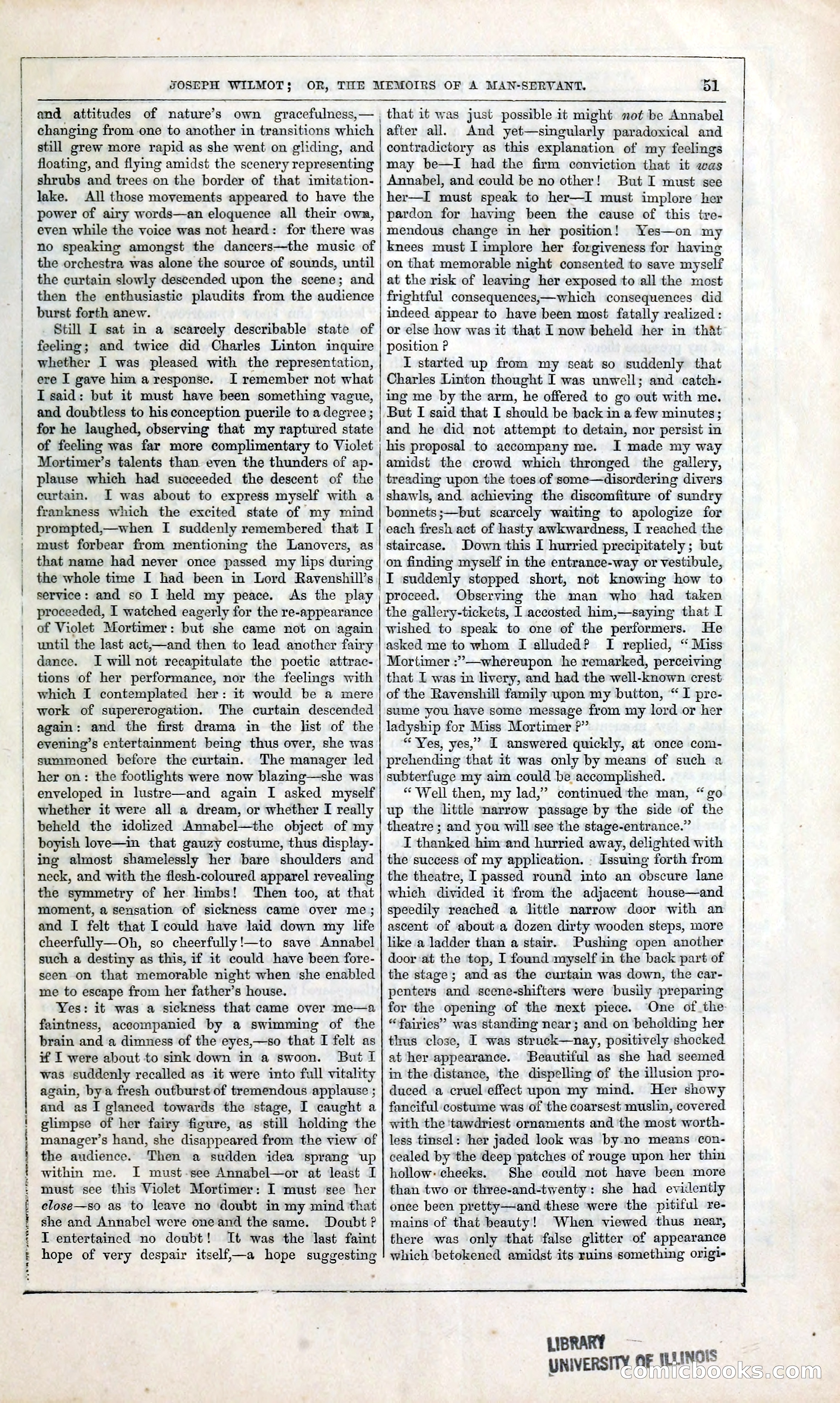
A restored page from Penny Dreadfuls, 1854. Page through the whole issue in the reader above.
📄 Transcribed text from this page (OCR, searchable)
Machine-transcribed from the original scan — historical spelling and the odd misread are preserved.
a a a mc — FOSEPH WILMOT; OR, THE MEMOIRS OF A MAN-SERVANT. dl and attitudes of nature’s own gracefulness,— changing from one to another in transitions which still grew more rapid as she went on gliding, and floating, and flying amidst the scenery representing shrubs and trees on the border of that imitation- lake. All those movements appeared to have the power of airy words—an eloquence all their own, even while the voice was not heard: for there was no speakine amongst the dancers—the music of the orchestra was alone the source of sounds, until the curtain slowly descended upon the scene; and then the enthusiastic plaudits from the audience burst forth anew. Still I sat in a scarcely describable state of feeling; and twice did Charles Linton inquire whether I was pleased with the representation, ere I gave him aresponse. I remember not what I said: but it must have been something vacue, and doubtless to his conception puerile to a degree ; for he laughed, observing that my raptured state of feeling was far more complimentary to Violet Mortimer’s talents than even the thunders of ap- plause which had succeeded the descent of the curtain. I was about to express myself with a frankness which the excited state of my mind prompted,—when I suddenly remembered that I must forbear from mentioning the Lanovers, as that name had never once passed my lips during the whole time I had been in Lord Ravenshill’s service: and so I held my peace. As the play proceeded, I watched eagerly for the re-appearance of Violet Mortimer: but she came not on again until the last act,—and then to lead another fairy dance. I will not recapitulate the poetic attrac- tions of her performance, nor the feelings with which I contemplated her: it would be a mere EE —— EE eS eee - a cieigmneeiiee Sd “= ———————————E————EE work of supererogation. The curtain descended again: and the first drama in the lst of the evening’s entertainment being thus over, she was summoned before the curtain. The manager led her on: the foothghts were now blazing—she was enveloped in lustre—and again I asked myself whether it were all a dream, or whether I really beheld the idolized Annabel—the object of my boyish love—in that gauzy costume, thus display- ing almost shamelessly her bare shoulders and neck, and with the flesh-coloured apparel revealing the symmetry of her hmbs! Then too, at that moment, a sensation of sickness came over me; and I felt that I could have laid down my life cheerfully—Oh, so cheerfully!—to save Annabel such a destiny as this, if 1t could have been fore- seen on that memorable night when she enabled me to escape from her father’s house. Yes: it was a sickness that came over me—a faintness, accompanied by a swimming of the brain and a dimness of the eyes,—so that I felt as if I were about to sink down in a swoon. But I was suddenly recalled as it were into full vitality again, bya fresh outburst of tremendous applause ; and as I glanced towards the stage, I caught a glimpse of her fairy figure, as still holding the manager’s hand, she disappeared from the view of } the audience. Then a sudden idea sprang up within me. I must-see Annabel—or at least I must see this Violet Mortimer: I must see her elose—so as to leave no doubt in my mind that she and Annabel were oneand the same. Doubt? I entertained no doubt! It was the last faint hope of very despair itself;—a hope suggesting that it was just possible it might mot be Annabel after all. And yet—singularly paradoxical and contradictory as this explanation of my feelings may be—I had the firm conviction that it was Annabel, and could be no other! But I must see her—I must speak to her—I must implore her pardon for having been the cause of this tre- mendous change in her position! Yes—on my knees must I implore her forgiveness for having on that memorable night consented to save myself at the risk of leaving her exposed to all the most frightful consequences,—which consequences did indeed appear to have been most fatally realized : or else how was it that I now beheld her in that position P I started up from my seat so suddenly that Charles Linton thought I was unwell; and catch- ing me by the arm, he offered to go out with me. But I said that I should be back in a few minutes; and he did not attempt to detain, nor persist in his proposal to accompany me. I made my way amidst the crowd which thronged the gallery, treading upon the toes of some—disordering divers shawls, and. achieving the discomfiture of sundry bonnets ;—but scarcely waiting to apologize for each fresh act of hasty awkwardness, I reached the staircase. Down this I hurried precipitately; but on finding myself in the entrance-way or vestibule, I suddenly stopped short, not knowing how to proceed. Observing the man who had taken the gallery-tickets, I accosted him,—sayimg that I wished to speak to one of the performers. He asked me to whom I alluded? I replied, “ Miss Mortimer :’—whereupon he remarked, perceiving that I was in livery, and had the well-known crest of the Ravenshill family upon my button, “I pre- sume you have some message from my lord or her ladyship for Miss Mortimer ?” “Yes, yes,’ I answered quickly, at once com- prehending that it was only by means of such a subterfuge my aim could be accomplished. “Well then, my lad,” continued the man, “go up the little narrow passage by the side of the theatre ; and you will see the stage-entrance.” I thanked him and hurried away, delighted with the success of my application. . Issuing forth from the theatre, I passed round into an obscure lane which divided it from the adjacent house—and speedily reached a little narrow door with an ascent of about a dozen dirty wooden steps, more like a ladder than a stair. Pushimg open another door ‘at the top, I found myself in the back part of the stage; and as the curtain was down, the car- penters and scene-shifters were busily preparing for the opening of the mext piece. One of the “fairies” was standing near; and on beholding her thus close, I was struck—nay, positively shocked at her appearance. Beautiful as she had seemed in the distance, the dispelling of the illusion pro- duced a cruel effect upon my mind. Her showy fanciful costume was of the coarsest muslin, covered with the 'tawdriest ornaments and the most worth- less tinsel: her jaded look was by no means con- cealed by ‘the deep patches of rouge upon her thin hollow: cheeks. She could not have been more than two or three-and-twenty: she had evidently ence been eee these were the pitiful re- mains of that beauty! When viewed thus near, there was only that false glitter of appearance which betokened amidst its ruins something origi- —— ee ee ee - a i TT TT A TT 5 ——_—— ES LIBRARY UNIVERSITY. FL sNOIS Ooks (SO) im