
Penny Dreadfuls, 1854 · page 81 of 394
Joseph Wilmot, or, The Memoirs of a Man-Servant — page 81: what you’re looking at
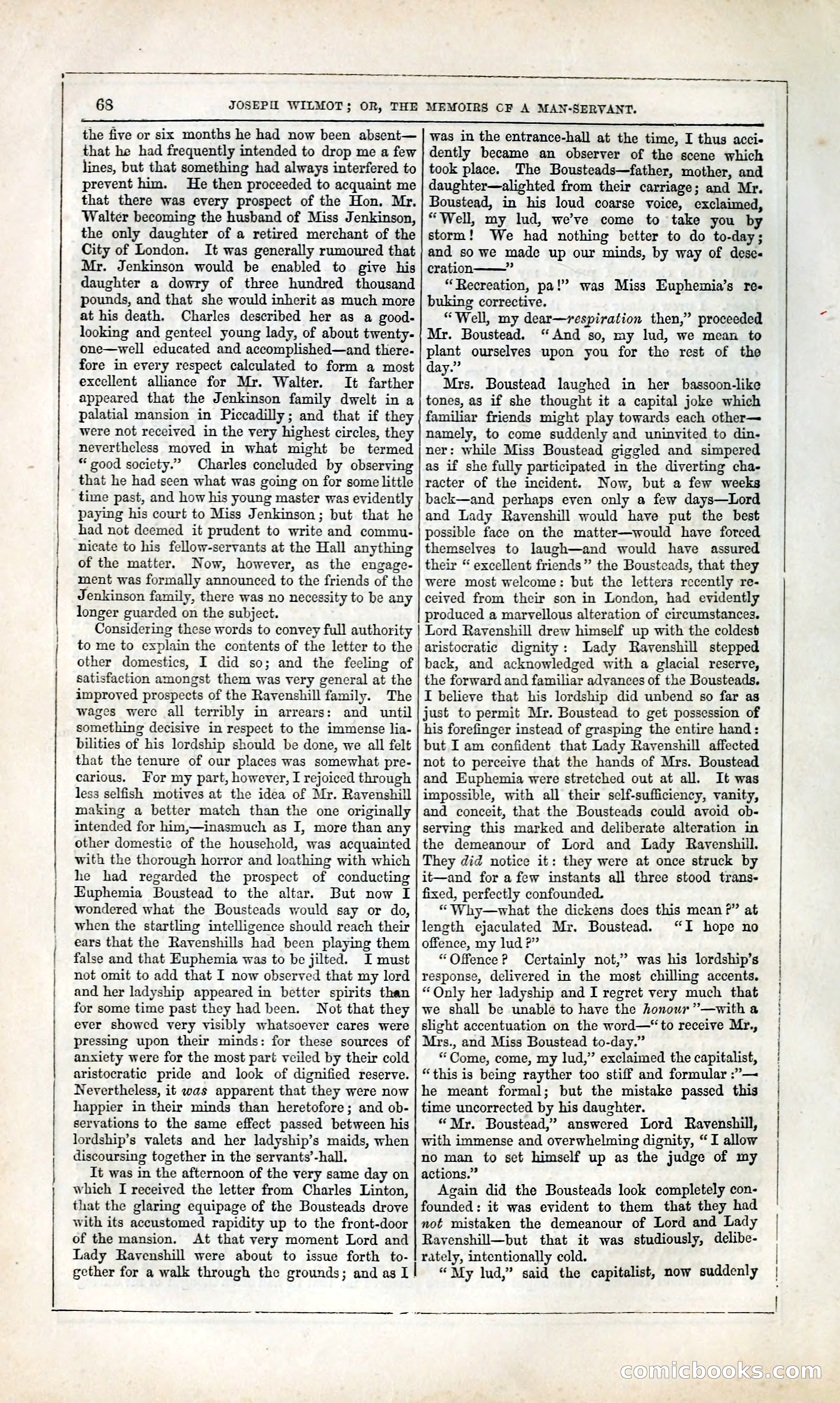
A restored page from Penny Dreadfuls, 1854. Page through the whole issue in the reader above.
📄 Transcribed text from this page (OCR, searchable)
Machine-transcribed from the original scan — historical spelling and the odd misread are preserved.
-_—- 68 JOSEPH WILMOT; OR, THE —_———- MEMOIRS CF A MAN-SERVANT. the five or six months he had now been absent— | was in the entrance-hall at the time, I thus acci- that he had frequently intended to drop me a few lines, but that something had always interfered to prevent him. He then proceeded to acquaint me that there was every prospect of the Hon. Mr. Walter becoming the husband of Miss Jenkinson, the only daughter of a retired merchant of the City of London. It was generally rumoured that Mr. Jenkinson would be enabled to give his daughter a dowry of three hundred thousand pounds, and that she would inherit as much more at his death. Charles described her as a good- looking and genteel young lady, of about twenty- one—well educated and accomplished—and there- fore in every respect calculated to form a most excellent alliance for Mr. Walter. It farther appeared that the Jenkinson family dwelt in a palatial mansion in Piccadilly; and that if they were not received in the very highest circles, they nevertheless moved in what might be termed * good society.” Charles concluded by observing that he had seen what was going on for some little time past, and how his young master was evidently paying his court to Miss Jenkinson; but that he had not deemed it prudent to write and commu- nicate to his fellow-servants at the Hall anything of the matter. Now, however, as the engage- ment was formally announced to the friends of the Jenkinson family, there was no necessity to be any longer guarded on the subject. Considering these words to convey full authority to me to explain the contents of the letter to the other domestics, I did so; and the feeling of satisfaction amongst them was very general at the improved prospects of the Rayenshill family. The wages were all terribly in arrears: and until something decisive in respect to the immense lia- bilities of his lordship should be done, we all felt that the tenure of our places was somewhat pre- carious. For my part, however, I rejoiced through less selfish motives at the idea of Mr. Ravenshill making a better match than the one originally intended for him,—inasmuch as I, more than any other domestic of the household, was acquainted with the thorough horror and loathing with which he had regarded the prospect of conducting Euphemia Boustead to the altar. But now I wondered what the Bousteads would say or do, when the startling intelligence should reach their ears that the Ravenshills had been playing them false and that Euphemia was to be jilted. I must not omit to add that I now observed that my lord and her ladyship appeared in better spirits than for some time past they had been. Not that they ever showcd very visibly whatsoever cares were pressing upon their minds: for these sources of anxiety were for the most part veiled by their cold aristocratic pride and look of dignified reserve. Nevertheless, it was apparent that they were now happier in their minds than heretofore; and ob- servations to the same effect passed between his lordship’s valets and her ladyship’s maids, when discoursing together in the servants’-hall. It was in the afternoon of the very same day on which I received the letter from Charles Linton, that the glaring equipage of the Bousteads drove with its accustomed rapidity up to the front-door of the mansion. At that very moment Lord and Lady Ravyenshill were about to issue forth to- gether for a walk through the grounds; and as I! dently became an observer of the scene which took place. The Bousteads—father, mother, and daughter—alighted from their carriage; and Mr. Boustead, in his loud coarse voice, exclaimed, “Well, my lud, we’ve come to take you by storm! We had nothing better to do to-day; and so we made up our minds, by way of dese cration a “Recreation, pa!’ was Miss Euphemia’s ree buking corrective. “Well, my dear—respiration then,” proceeded Mr. Boustead. “And so, my lud, we mean to plant ourselves upon you for tho rest of the day.” Mrs. Boustead laughed in her bassoon-like tones, as if she thought it a capital joke which familiar friends might play towards each other— namely, to come suddenly and uninvited to din- ner: while Miss Boustead giggled and simpered as if she fully participated in the diverting cha- racter of the incident. Now, but a few weeks back—and perhaps even only a few days—Lord and Lady Ravenshill would have put the best possible face on the matter—would have forced themselves to laugh—and would have assured their “ excellent friends” the Bousteads, that they were most welcome: but the letters recently re- ceived from their son in London, had evidently produced a marvellous alteration of circumstances. Lord Ravenshill drew himself up with the coldest aristocratic dignity: Lady MRavenshill stepped back, and acknowledged with a glacial reserve, the forward and familiar advances of the Bousteads. I believe that his lordship did unbend so far as just to permit Mr. Boustead to get possession of his forefinger instead of grasping the entire hand: but I am confident that Lady Ravenshill affected not to perceive that the hands of Mrs. Boustead and Euphemia were stretched out at all. It was impossible, with all their self-sufficiency, vanity, and conceit, that the Bousteads could avoid ob- serving this marked and deliberate alteration in the demeanour of Lord and Lady Ravenshill. They did notice it: they were at once struck by it—and for a few instants all three stood trans- fixed, perfectly confounded. “ Why—what the dickens does this mean ?” at length ejaculated Mr. Boustead. “I hope no offence, my lud ?” “Offence? Certainly not,’ was his lordship’s response, delivered in the most chilling accents. “Only her ladyship and I regret very much that we shall be unable to have the honows”—with a slight accentuation on the word—* to receive Mr., Mrs., and Miss Boustead to-day.” “Come, come, my lud,” exclaimed the capitalist, “this is being rayther too stiff and formular :”’— he meant formal; but the mistake passed this time uncorrected by his daughter. “Mr. Boustead,’ answered Lord Ravenshill, with immense and overwhelming dignity, “I allow no man to set himself up as the judge of my actions.” Again did the Bousteads look completely con- founded: it was evident to them that they had not mistaken the demeanour of Lord and Lady Rayenshill—but that it was studiously, delibe- rately, intentionally cold. “My lud,” said the capitalist, now suddenly em — —o eee ———— —_--— —— : ° — — — SF ee ee ee Oe ee ee ———eee————————eE——eeeee ElOoOOK<S Cc (0)