
Penny Dreadfuls, 1854 · page 89 of 394
Joseph Wilmot, or, The Memoirs of a Man-Servant — page 89: what you’re looking at
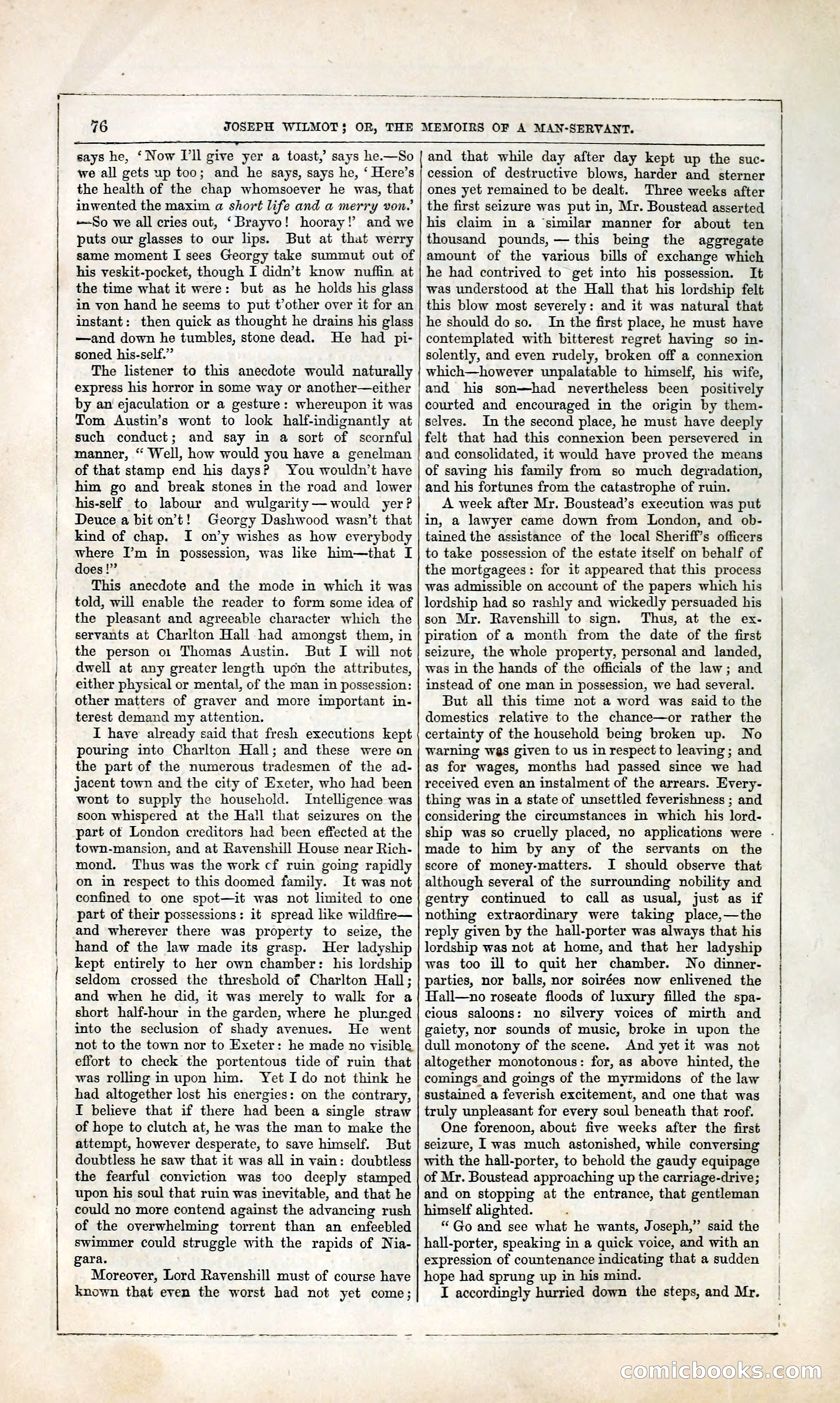
A restored page from Penny Dreadfuls, 1854. Page through the whole issue in the reader above.
📄 Transcribed text from this page (OCR, searchable)
Machine-transcribed from the original scan — historical spelling and the odd misread are preserved.
says he, ‘Now I'll give yer a toast,’ says he.—So we all gets up too; and he says, says he, ‘ Here’s the health of the chap whomsoever he was, that inwented the maxim a short life and a merry von.’ —So we all cries out, ‘Brayvo! hooray!’ and we puts our glasses to our lips. But at that werry same moment I sees Georgy take summut out of his yeskit-pocket, though I didn’t know nuffin at the time what it were: but as he holds his glass in yon hand he seems to put t’other over it for an instant: then quick as thought he drains his glass —and down he tumbles, stone dead. He had pi- soned his-self.” The listener to this anecdote would naturally express his horror in some way or another—either by an ejaculation or a gesture: whereupon it was Tom Austin’s wont to look half-indignantly at such conduct; and say in a sort of scornful manner, “ Well, how would you have a genelman of that stamp end his days? You wouldn’t have him go and break stones in the road and lower his-self to labour and wulgarity— would yer? Deuce a bit ont! Georgy Dashwood wasn’t that kind of chap. I on’y wishes as how everybody where [’m in possession, was hke him—that I does!” This anecdote and the mode in which it was told, will enable the reader to form some idea of the pleasant and agreeable character which the servants at Charlton Hall-had amongst them, in the person o1 Thomas Austin. But I will not dwell at any greater length upon the attributes, either physical or mental, of the man in possession: other matters of graver and more important in- terest demand my attention. I have already said that fresh executions kept pouring into Charlton Hall; and these were on the part of the numerous tradesmen of the ad- jacent town and the city of Exeter, who had been wont to supply the household. Intelligence was soon whispered at the Hail that seizures on the part of London creditors had been effected at the town-mansion, and at Ravenshill House near Rich- mond. Thus was the work cf ruin going rapidly on in respect to this doomed family. It was not confined to one spot—it was not limited to one part of their possessions: it spread like wildfire— and wherever there was property to seize, the hand of the law made its grasp. Her ladyship kept entirely to her own chamber: his lordship seldom crossed the threshold of Charlton Hall; and when he did, it was merely to walk for a short half-hour in the garden, where he plunged into the seclusion of shady avenues. He went not to the town nor to Exeter: he made no visible effort to check the portentous tide of ruin that was rolling in upon him. Yet Ido not think he had altogether lost his energies: on the contrary, I believe that if there had been a single straw of hope to clutch at, he was the man to make the attempt, however desperate, to save himself. But doubtless he saw that it was all in vain: doubtless the fearful conviction was too deeply stamped upon his soul that ruin was inevitable, and that he could no more contend against the advancing rush of the overwhelming torrent than an enfeebled swimmer could struggle with the rapids of Nia- gara. Moreover, Lord Ravenshill must of course have known that even the worst had not yet come; eee ees See Se een eee ee eee Se —— a ee eee JOSEPH WILMOT$ OR, THE MEMOIRS OF A MAN-SERVANT. and that while day after day kept up the suc- cession of destructive blows, harder and sterner ones yet remained to be dealt. Three weeks after the first seizure was put in, Mr. Boustead asserted his claim in a ‘similar manner for about ten thousand pounds,— this being the aggregate amount of the various bills of exchange which he had contrived to get into his possession. It was understood at the Hall that his lordship felt this blow most severely: and it was natural that he should do so. In the first place, he must have contemplated with bitterest regret having so in- solently, and even rudely, broken off a connexion which—however unpalatable to himself, his wife, and his son—had nevertheless been positively courted and encouraged in the origin by them- selves. In the second place, he must have deeply felt that had this connexion been persevered in and consolidated, it would have proved the means of saving his family from so much degradation, and his fortunes from the catastrophe of ruin. A week after Mr. Boustead’s execution was put in, a lawyer came down from London, and ob- tained the assistance of the local Sheriff’s officers to take possession of the estate itself on behalf of the mortgagees: for it appeared that this process was admissible on account of the papers which his lordship had so rashly and wickedly persuaded his son Mr. Ravenshill to sign. Thus, at the ex- piration of a month from the date of the first seizure, the whole property, personal and landed, was in the hands of the officials of the law; and instead of one man in possession, we had several. But all this time not a word was said to the domestics relative to the chance—or rather the certainty of the household being broken up. No Warning was given to us in respect to leaving; and as for wages, months had passed since we had received even an instalment of the arrears. Every- thing was in a state of unsettled feverishness ; and considering the circumstances in which his lord- ship was so cruelly placed, no applications were - made to him by any of the servants on the score of money-matters. JI should observe that although several of the surrounding nobility and gentry continued to call as usual, just as if nothing extraordinary were taking place,—the reply given by the hall-porter was always that his lordship was not at home, and that her ladyship was too ill to quit her chamber. No dinner- parties, nor balls, nor soirées now enlivened the Hall—no roseate floods of luxury filled the spa- cious saloons: no silvery voices of mirth and gaiety, nor sounds of music, broke in upon the dull monotony of the scene. And yet it was not altogether monotonous: for, as above hinted, the comings and goings of the myrmidons of the law sustained a feverish excitement, and one that was truly unpleasant for every soul beneath that roof. One forenoon, about five weeks after the first seizure, [ was much astonished, while conversing with the hall-porter, to behold the gaudy equipage of Mr. Boustead approaching up the carriage-drive; and on stopping at the entrance, that gentleman himself alighted. “Go and see what he wants, Joseph,” said the hall-porter, speaking in a quick voice, and with an expression of countenance indicating that a sudden hope had sprung up in his mind. I accordingly hurried down the steps, and Mr. TTT rn = I TE I NT ce ect _— - ee cS Eloo im