
Penny Dreadfuls, 1854 · page 100 of 399
Joseph Wilmot, or, The Memoirs of a Man-Servant — page 100: what you’re looking at
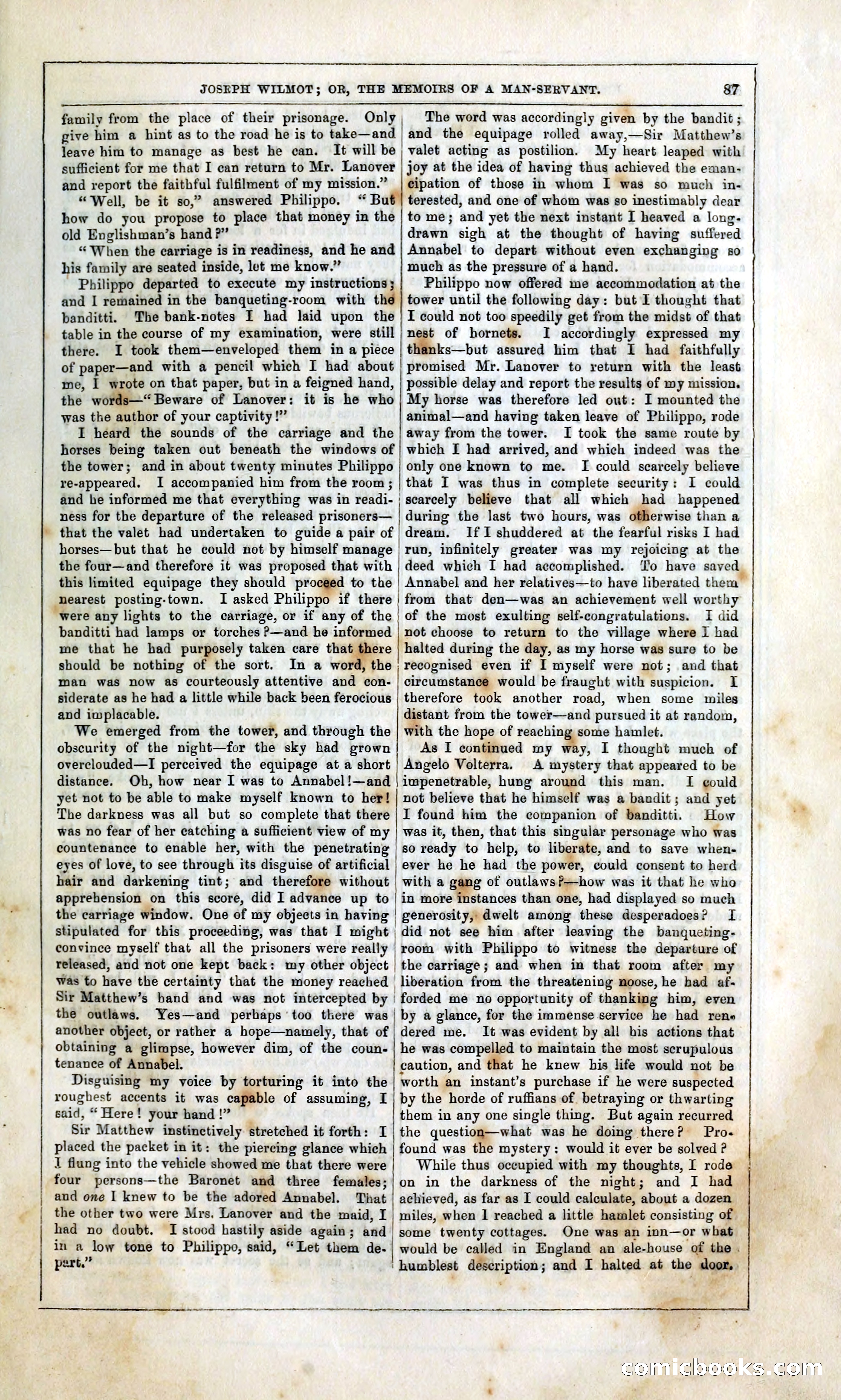
A restored page from Penny Dreadfuls, 1854. Page through the whole issue in the reader above.
📄 Transcribed text from this page (OCR, searchable)
Machine-transcribed from the original scan — historical spelling and the odd misread are preserved.
” * st JOSEPH WILMOT; OR, THE MEMOIRS OF A MAN-SERVANT. 87 family from the place of their prisonage. Only The word was accordingly given by the bandit ; give him a hint as to the road he is to take—and | and the equipage rolled away,—Sir Matthew’s leave him to manage as best he can. It will be sufficient for me that I can return to Mr. Lanover and report the faithful fulfilment of my mission.” “Well, be it so,” answered Philippo. “Bu how do you propose to place that money in the old Evglishman’s hand ?” “ When the carriage is in readiness, and he and his family are seated inside, let me know.” Philippo departed to execute my instructions; and I remained in the banqueting-room with the banditti. The bank-notes I had laid upon the table in the course of my examination, were still there. I took them—enveloped them in a piece of paper—and with a pencil which I had about me, I wrote on that paper, but in a feigned hand, the words—“ Beware of Lanover: it is he who was the author of your captivity !” I heard the sounds of the carriage and the horses being taken out beneath the windows of the tower; and in about twenty minutes Philippo re-appeared. I accompanied him from the room; and he informed me that everything was in readi- ness for the departure of the released prisoners— that the valet had undertaken to guide a pair of horses—but that he could not by himself manage the four—and therefore it was proposed that with this limited equipage they should proceed to the nearest posting-town. I asked Philippo if there were any lights to the carriage, or if any of the banditti had lamps or torches ?—and he informed me that he had purposely taken care that there should be nothing of the sort. In a word, the man was now as courteously attentive and con- siderate as he had a little while back been ferocious and implacable. We emerged from the tower, and through the obscurity of the night—for the sky had grown overclouded—I perceived the equipage at a short distance. Oh, how near I was to Annabel!—and yet not to be able to make myself known to her! The darkness was all but so complete that there was no fear of her catching a sufficient view of my countenance to enable her, with the penetrating eyes of love, to see through its disguise of artificial hair and darkening tint; and therefore without apprehension on this score, did I advance up to the carriage window. One of my objects in having stipulated for this proceeding, was that I might convince myself that all the prisoners were really released, and not one kept back: my other object was to have the certainty that the money reached Sir Matthew’s hand and was not intercepted by | the outlaws. Yes—and perhaps too there was another object, or rather a hope—namely, that of obtaining a glimpse, however dim, of the coun- tenance of Annabel. Disguising my voice by torturing it into the roughest accents it was capable of assuming, I said, “ Here! your hand !” Sir Matthew instinctively stretched it forth: I placed the packet in it: the piercing glance which 1 flung into the vehicle showed me that there were four persons—the Baronet and three females; and one | knew to be the adored Annabel. That the other two were Mrs. Lanover and the maid, I had no doubt. I stocd hastily aside again; and in a low tone to Philippo, said, “Let them de-| would be called in England an ale-house of pert.” ee er er a em te ee a valet acting as postilion. My heart leaped with joy at the idea of having thus achieved the eman- cipation of those in whom I was so much in- terested, and one of whom was so inestimably dear to me; and yet the next instant I heaved a long- drawn sigh at the thought of having suffered Annabel to depart without even exchanging s0 much as the pressure of a hand. Philippo now offered me accommodation at the tower until the following day: but I thought that I could not too speedily get from the midst of that nest of hornets. I accordingly expressed my thanks—but assured him that I had faithfully promised Mr. Lanover to return with the least possible delay and report the results of my mission. My horse was therefore led out: I mounted the animal—and having taken leave of Philippo, rode away from the tower. I took the same route by which I had arrived, and which indeed was the only one known to me. I could scarcely believe that I was thus in complete security: I could scarcely believe that all which had happened during the last two hours, was otherwise than a dream. If I shuddered at the fearful risks I had run, infinitely greater was my rejoicing at the deed which I had accomplished. ‘To have saved Annabel and her relatives—to have liberated them from that den—was an achievement well worthy of the most exulting self-congratulations. I did not choose to return to the village where i had halted during the day, as my horse was sure to be recognised even if I myself were not; and that circumstance would be fraught with suspicion. I therefore took another road, when some miles ih from the tower—and pursued it at random, th the hope of reaching some hamlet. As I continued my a I thought much of Angelo Volterra. A mystery that appeared to be impenetrable, hung around this man. I gould not believe that he himself was a bandit; and yet I found him the companion of banditti. How was it, then, that this singular personage who was so ready to help, to liberate, and to save when. ever he he had the power, could consent to herd with a gang of outlaws?—how was it that he who in more instances than one, had displayed so much generosity, dwelt among these desperadoes? I did not see him after leaving the banqueting- room with Philippo to witness the departure of the carriage ; and when in that room after my liberation from the threatening noose, he had af- forded me no opportunity of thanking him, even by a glance, for the immense service he had rene dered me. It was evident by all his actions that he was compelled to maintain the most scrupulous caution, and that he knew his life would not be worth an instant’s purchase if he were suspected by the horde of ruffians of betraying or thwarting them in any one single thing. But again recurred the question—what was he doing there? Pro- found was the mystery: would it ever be solved ? 6 While thus occupied with my thoughts, I rode — on in the darkness of the night; and I had © achieved, as far as I could calculate, about a dozen miles, when I reached a little hamlet consisting of ; some twenty cottages. One was an inn—or what oa humblest description; and I halted at the d a res Ehoo “S (E(0)