
Penny Dreadfuls, 1854 · page 109 of 399
Joseph Wilmot, or, The Memoirs of a Man-Servant — page 109: what you’re looking at
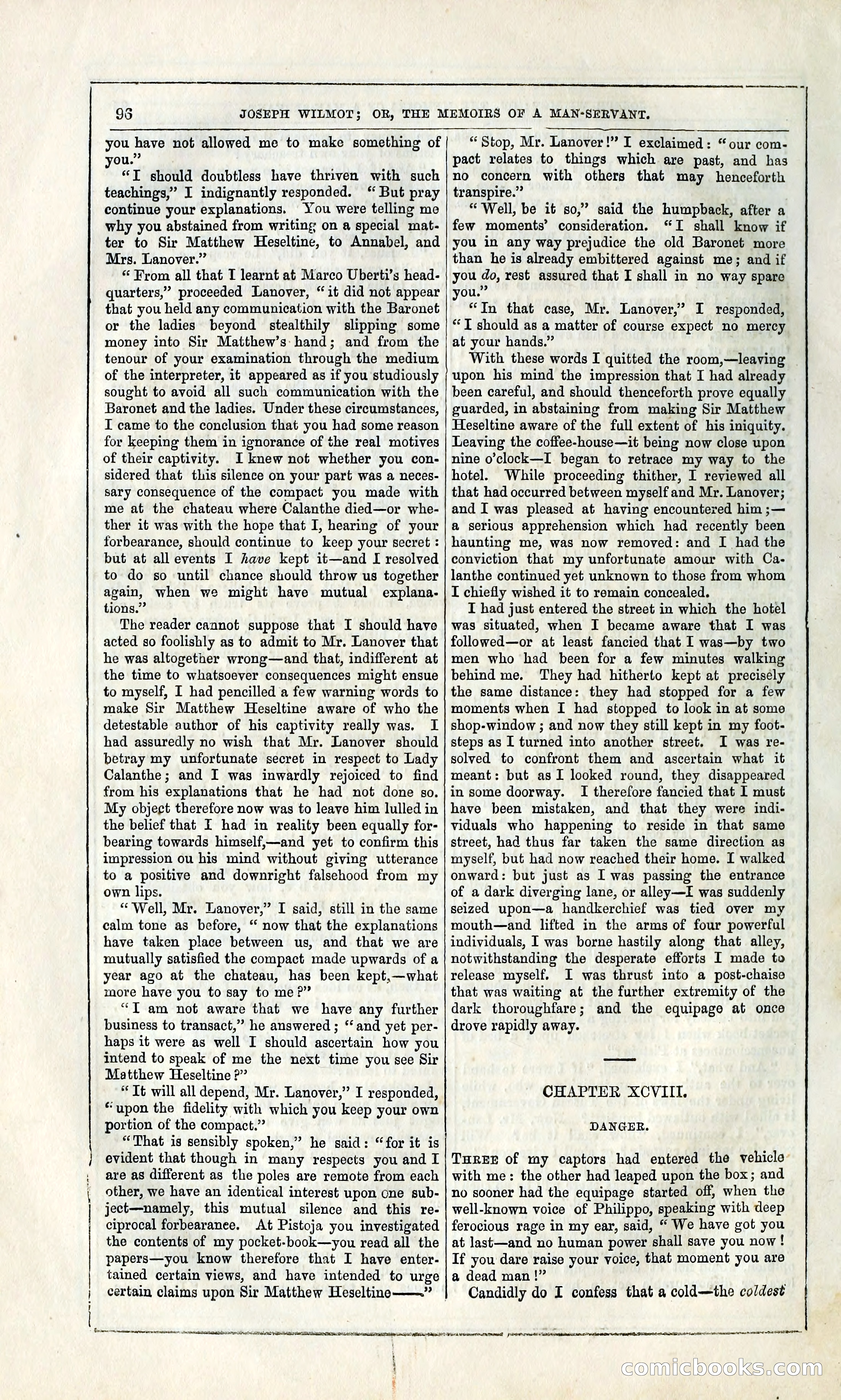
A restored page from Penny Dreadfuls, 1854. Page through the whole issue in the reader above.
📄 Transcribed text from this page (OCR, searchable)
Machine-transcribed from the original scan — historical spelling and the odd misread are preserved.
| 95 you have not allowed me to make something of ou.” “T should doubtless have thriven with such teachings,” I indignantly responded. “ But pray continue your explanations. You were telling me why you abstained from writing on a special mat- ter to Sir Matthew Heseltine, to Annabel, and Mrs. Lanover.” “From all that I learnt at Marco Uberti’s head- quarters,” proceeded Lanover, “it did not appear that you held any communication with the Baronet or the ladies beyond stealthily slipping some money into Sir Matthew’s: hand; and from the tenour of your examination through the medium of the interpreter, if appeared as if you studiously sought to avoid all such communication with the Baronet and the ladies. Under these circumstances, I came to the conclusion that you had some reason for keeping them in ignorance of the real motives of their captivity. I knew not whether you con- sidered that this silence on your part was a neces- sary consequence of the compact you made with me at the chateau where Calanthe died—or whe- ther it was with the hope that I, hearing of your forbearance, should continue to keep your secret : but at all events I have kept it—and I resolved to do so until chance should throw us together again, when we might have mutual explana- tions.” The reader cannot suppose that I should have acted so foolishly as to admit to Mr. Lanover that he was altogether wrong—and that, indifferent at the time to whatsoever consequences might ensue to myself, I had pencilled a few warning words to make Sir Matthew Heseltine aware of who the detestable author of his captivity really was. I had assuredly no wish that Mr. Lanover should betray my unfortunate secret in respect to Lady Calanthe; and I was inwardly rejoiced to find from his explanations that he had not done so. My object therefore now was to leave him lulled in the belief that I had in reality been equally for- bearing towards himself,—and yet to confirm this impression ou his mind without giving utterance to a positive and downright falsehood from my own lips. “Well, Mr. Lanover,” I said, still in the same calm tone as before, “ now that the explanations have taken place between us, and that we are mutually satisfied the compact made upwards of a year ago at the chateau, has been kept,—what more have you to say to me?” “T am not aware that we have any further business to transact,” he answered ; “and yet per- haps it were as well I should ascertain how you intend to speak of me the next time you see Sir Matthew Heseltine ?” Tt will all depend, Mr. Lanover,” I responded, “upon the fidelity with which you keep your own portion of the compact.” “That is sensibly spoken,” he said: “for it is | evident that though in many respects you and I are as different as the poles are remote from each other, we have an identical interest upon one sub- ject—namely, this mutual silence and this re- ciprocal forbearanee. At Pistoja you investigated the contents of my pocket-book—you read all the papers—you know therefore that I have enter- tained certain views, and have intended to urge certain claims upon Sir Matthew Heseltine——.” Py - ee ESS IONS OY rR Ya ALIS Ca LN Rae eS 2 il al ht a i tain Word eererr ene mad pela ore de +S , t a ? t JOSEPH WILMOT; OR, THE MEMOIRS OF A MAN-SERVANT. “ Stop, Mr. Lanover!” I exclaimed: “our com- pact relates to things which are past, and has no concern with others that may henceforth transpire.” “Well, be it so,” said the humpback, after a few moments’ consideration. “I shall know if you in any way prejudice the old Baronet more than he is already embittered against me; and if you do, rest assured that I shall in no way spare ou.” “In that case, Mr. Lanover,” I responded, “T should as a matter of course expect no mercy at your hands.” With these words I quitted the room,—leaving upon his mind the impression that I had already been careful, and should thenceforth prove equally guarded, in abstaining from making Sir Matthew Heseltine aware of the full extent of his iniquity. Leaving the coffee-house—it being now close upon nine o’clock—I began to retrace my way to the hotel. While proceeding thither, I reviewed all that had occurred between myself and Mr. Lanover; and I was pleased at having encountered him ;— a serious apprehension which had recently been haunting me, was now removed: and I had the conviction that my unfortunate amour with Ca- lanthe continued yet unknown to those from whom I chiefly wished it to remain concealed. T had just entered the street in which the hotel was situated, when I became aware that I was followed—or at least fancied that I was—by two men who had been for a few minutes walking behind me. They had hitherto kept at precisely the same distance: they had stopped for a few moments when I had stopped to look in at some shop-window ; and now they still kept in my foot- steps as I turned into another street. I was re- solved to confront them and ascertain what it meant: but as I looked round, they disappeared in some doorway. I therefore fancied that I must have been mistaken, and that they were indi- viduals who happening to reside in that same street, had thus far taken the same direction as myself, but had now reached their home. I walked onward: but just as I was passing the entrance of a dark diverging lane, or alley—I was suddenly seized upon—a handkerchief was tied over my mouth—and lifted in the arms of four powerful individuals, I was borne hastily along that alley, notwithstanding the desperate efforts I made to release myself. I was thrust into a post-chaise that was waiting at the further extremity of the dark thoroughfare; and the equipage at once drove rapidly away. | CHAPTER XCVIII. DANGER. TuREE of my captors had entered the vehicle with me: the other had leaped upon the box; and no sooner had the equipage started off, when the well-known voice of Philippo, speaking with deep ferocious rage in my ear, said, “ We have got you at last—and no human power shall save you now! If you dare raise your voice, that moment you are a dead man |!” | Candidly do I confess that a cold—the coldest Cee ANS em en ns A ONE EN EDIT LL CELL LLL LE TOLLED CE CL IE LC LLL TT A CECT St AT A Se ate, ‘tt ein ts heme tom ElOo@OOkKS (c@) AA