
Penny Dreadfuls, 1854 · page 120 of 399
Joseph Wilmot, or, The Memoirs of a Man-Servant — page 120: what you’re looking at
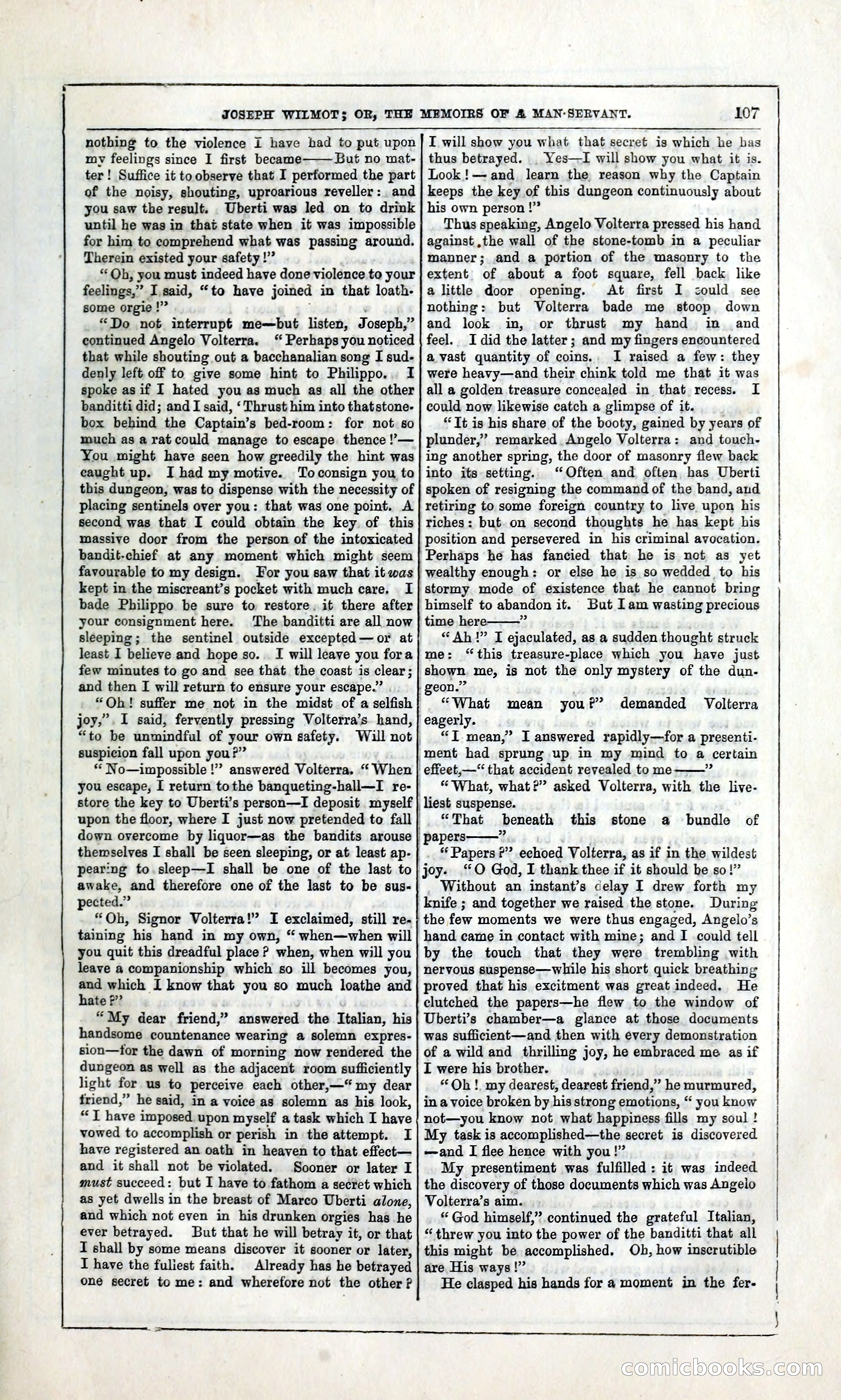
A restored page from Penny Dreadfuls, 1854. Page through the whole issue in the reader above.
📄 Transcribed text from this page (OCR, searchable)
Machine-transcribed from the original scan — historical spelling and the odd misread are preserved.
JOSEPH WILMOT; OR, THE MEMOIRS OF 42 MAN-SERVANT. 107 nothing to the violence i have had to put upon mv feelings since I first became But no mat- ter! Suffice it toobserve that I performed the part of the noisy, shouting, uproarious reveller: and you saw the result. Uberti was led on to drink until he was in that state when it was impossible for him to comprehend what was passing around. Therein existed your safety!” ‘Oh, you must indeed have done violence to your feelings,” Isaid, “to have joined in that loath- some orgie !” “Do not interrup§ me—but listen, Joseph,” continued Angelo Volterra. ‘“ Perhaps you noticed that while shouting out a bacchanalian song I sud- denly left off to give some hint to Philippo.. I spoke asif I hated you as much as all the other banditti did; and I said, ‘ Thrust him into thatstone- box behind the Captain’s bed-room: for not so much as a rat could manage to escape thence !’— You might have seen how greedily the hint was eaught up. I had my motive. Toconsign you to this dungeon, was to dispense with the necessity of placing sentinels over you: that was one point. A second was that I could obtain the key of this massiye door from the person of the intoxicated bandit-chief at any moment which might seem favourable to my design. For you saw that it was kept in the miscreant’s pocket with much care, I bade Philippo be sure to restore, it there after your consignment here. The banditti are all now sleeping; the sentinel outside excepted—or at least I believe and hope so... I will leave you fora few minutes to go and see that the coast is clear; and then I will return to ensure your escape.” . “Oh! suffer me not in the midst of a selfish joy,’ 1 said, fervently pressing Volterra’s. hand, “to be unmindful of your own safety. Wall not suspicion fall upon you?” ** No—impossible !” answered Volterra, “ When you escape, I return tothe banqueting-hall—I re- store the key to Uberti’s person—I deposit myself upon the floor, where I just now pretended to fall down overcome by liquor—as the bandits arouse themselves I shall be seen sleeping, or at least ap- pearing to.sleep—I shall be one of the last to awake, and therefore one of the last to be sus- pected.” “Oh, Signor Volterra!’ I exclaimed, still re- taining his hand in my own, “ when—when will you quit this dreadful place P when, when will you leave a companionship which so ill becomes you, ~ which I know that you so much loathe and te P” “My dear friend,” answered the Italian, his handsome countenance wearing a solemn expres- sion—for the dawn of morning now rendered the dungeon as well as the adjacent room sufficiently light for us to perceive each other,—* my dear friend,” he said, in a voice as solemn as his look, “J have imposed upon myself a task which I have vowed to accomplish or perish in the attempt. I have registered an oath in heaven to that effect— and it shall not be violated. Sooner or later I must succeed: but I have to fathom a secret which as yet dwells in the breast of Marco Uberti alone, and which not even in his drunken orgies has he ever betrayed. But that he will betray it, or that I shall by some means discover it sooner or later, I have the fuliest faith. Already has he betrayed one secret to me: and wherefore not the other? ‘papers joy: I will show you what thaé secret is which he bas thus betrayed. . Yes—I will show you what it is. Look!— and learn the reason why the Captain keeps the key of this dungeon continuously about his own person !” Thus speaking, Angelo Volterra pressed his hand against ,the wall of the stone-tomb in a peculiar manner; and a portion of the masonry to the extent of about a foot square, fell back like a little door opening. At first I could see nothing: but Volterra bade me stoop down and look in, or thrust my hand in and feel. I did the latter; and my fingers encountered avast quantity of coins.. I raised a few: they were heavy—and their chink told me that it was all a golden treasure concealed in that recess. I could now likewise catch a glimpse of it. “Tt is his share of the booty, gained by years of plunder,” remarked Angelo Volterra: and touch- ing another spring, the door of masonry flew back into its setting. “Often and often has Uberti spoken of resigning the command of the band, and retiring to some foreign country to live upon his riches: but on second thoughts he has kept his position and persevered in his criminal avocation. Perhaps he has fancied that he is not as yet wealthy enough: or else he is so wedded to his stormy mode of existence that he cannot bring himself to abandon it. But Lam wasting precious time here a “Ah!” I ejaculated, as a sudden thought struck me: “this treasure-place which you have just shown. me, is not the only mystery of the dun- geon.” “What mean your” eagerly. “TIT mean,” I answered rapidly—for a presenti- demanded Volterra ment had sprung up in my mind to a certain -effeet,— that accident revealed to me 339 “ What, what?” asked Volterra, with the live- liest suspense. beneath this stone a bundle of 33 © That ** Papers P” echoed Volterra, as if in the wildest “OQ God, I thank thee if it should be so!” Without an instant’s celay I drew forth my knife ; and together we raised the stone. During the few moments we were thus engaged, Angelo’s hand came in contact with mine; and I could tell by the touch that they were trembling with nervous suspense—while his short quick breathing proved that his excitment was great indeed. He clutched the papers—he flew to the window of Uberti’s chamber—a glance at those documents was sufficient—and then with every demonstration of a wild and thrilling joy, he embraced me as if I were his brother. “Oh! my dearest, dearest friend,” he murmured, in a voice broken by his strong emotions, “ you know not—you know not what happiness fills my soul ! My task is accomplished—the secret is discovered —and I flee hence with you!” My presentiment was fulfilled: it was indeed the discovery of those documents which was Angelo Volterra’s aim. “ God himself,” continued the grateful Italian, “threw you into the power of the banditti that all this might be accomplished. Ob, how inscrutible are His ways!” He clasped his hands for a moment in the fer- GIOaks