
Penny Dreadfuls, 1854 · page 145 of 399
Joseph Wilmot, or, The Memoirs of a Man-Servant — page 145: what you’re looking at
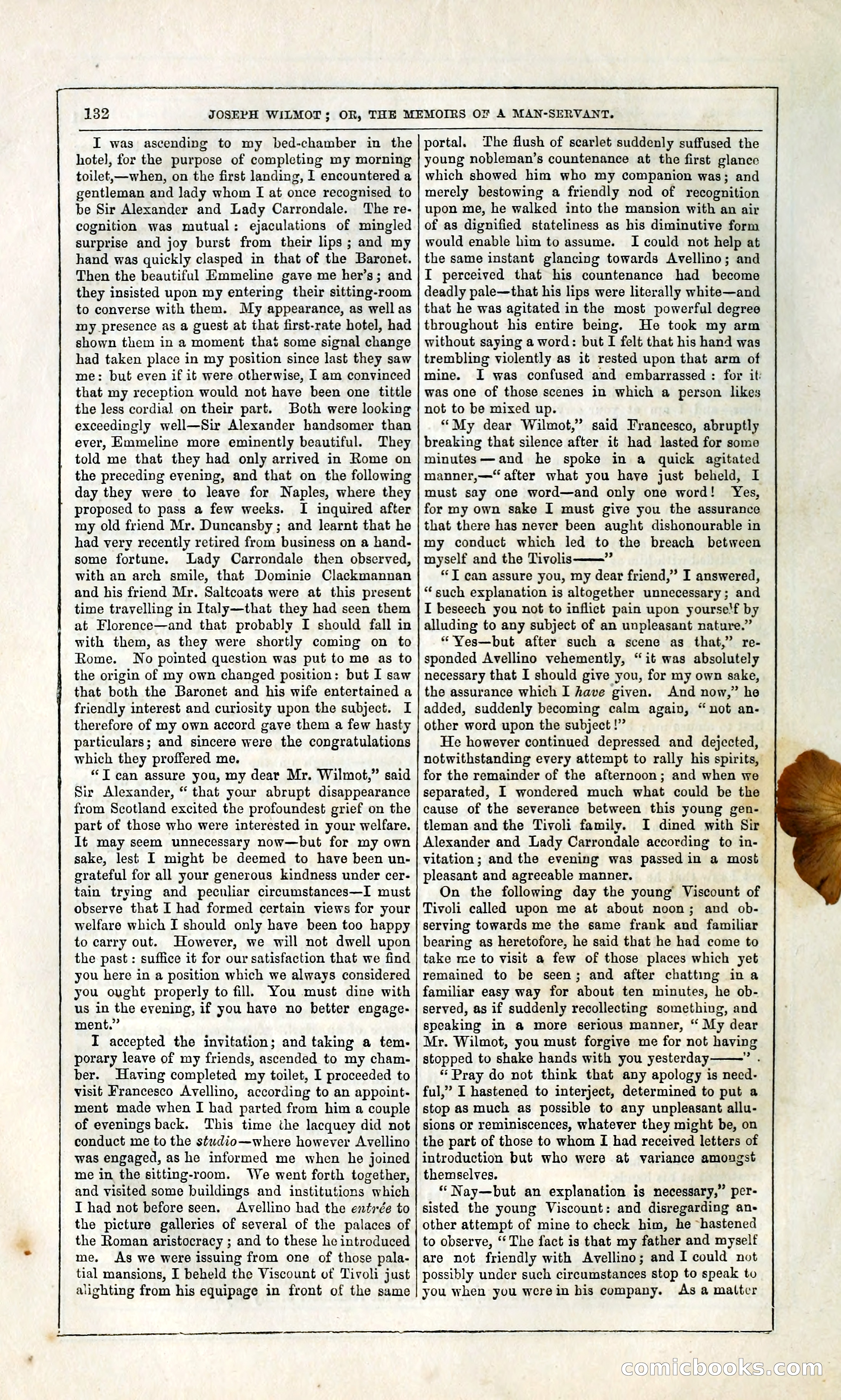
A restored page from Penny Dreadfuls, 1854. Page through the whole issue in the reader above.
📄 Transcribed text from this page (OCR, searchable)
Machine-transcribed from the original scan — historical spelling and the odd misread are preserved.
a JOSEPH WILMOT; OR, THE MEMOIRS OF A MAN-SERVANT. I was ascending to my bed-chamber in the hotel, for the purpose of completing my morning toilet,—when, on the first landing, I encountered a gentleman and lady whom I at once recognised to be Sir Alexander and Lady Carrondale. The re- cognition was mutual: ejaculations of mingled surprise and joy burst from their lips; and my hand was quickly clasped in that of the Baronet. Then the beautiful Emmeline gave me her’s; and they insisted upon my entering their sitting-room to converse with them. My appearance, as well as my presence as a guest at that first-rate hotel, had shown them in a moment that some signal change had taken place in my position since last they saw me: but even if it were otherwise, I am convinced that my reception would not have been one tittle the less cordial on their part. Both were looking exceedingly well—Sir Alexander handsomer than ever, Emmeline more eminently beautiful. They told me that they had only arrived in Rome on the preceding evening, and that on the following day they were to leave for Naples, where they proposed to pass a few weeks. I inquired after my old friend Mr. Duncansby ; and learnt that he had very recently retired from business on a hand- some fortune. Lady Carrondale then observed, with an arch smile, that Dominie Clackmannan and his friend Mr. Saltcoats were at this present time travelling in Italy—that they had seen them at Florence—and that probably I should fall in with them, as they were shortly coming on to Rome. No pointed question was put to me as to the origin of my own changed position: but I saw that both the Baronet and his wife entertained a friendly interest and curiosity upon the subject. I therefore of my own accord gave them a few hasty particulars; and sincere were the congratulations which they proffered me. “T can assure you, my dear Mr. Wilmot,” said Sir Alexander, “ that your abrupt disappearance from Scotland excited the profoundest grief on the part of those who were interested in your welfare. It may seem unnecessary now—but for my own sake, lest I might be deemed to have been un- grateful for all your generous kindness under cer- tain trying and peculiar circumstances—I must observe that I had formed certain views for your welfare which I should only have been too happy to carry out. However, we will not dwell upon the past : suffice it for our satisfaction that we find you here in a position which we always considered you ought properly to fill. You must dine with us in the eyening, if you have no better engage- ment.” I accepted the invitation; and taking a tem- porary leave of my friends, ascended to my cham- ber. Having completed my toilet, I proceeded to visit Francesco Avellino, according to an appoint- ment made when I had parted from him a couple of evenings back. This time the lacquey did not conduct me to the stwdio—where however Avellino was engaged, as he informed me when he joined me in the sitting-room. We went forth together, and visited some buildings and institutions which I had not before seen. Avellino had the entrée to the picture galleries of several of the palaces of the Roman aristocracy ; and to these he introduced me. As we were issuing from one of those pala- tial mansions, I beheld the Viscount of Tivoli just alighting from his equipage in front of the same portal. The flush of scarlet suddenly suffused the young nobleman’s countenance at the first glance which showed him who my companion was; and merely bestowing a friendly nod of recognition upon me, he walked into the mansion with an air of as dignified stateliness as his diminutive form would enable him to assume. I could not help at the same instant glancing towards Avellino; and I perceived that his countenance had become deadly pale—that his lips were literally white—and that he was agitated in the most powerful degree throughout his entire being. He took my arm without saying a word: but I felt that his hand was trembling violently as it rested upon that arm of mine. I was confused and embarrassed : for it: was one of those scenes in which a person likes not to be mixed up. “My dear Wilmot,” said Francesco, abruptly breaking that silence after it had lasted for some minutes—and he spoke in a quick agitated manner,—“ after what you have just beheld, I must say one word—and only one word! Yes, for my own sake I must give you the assurance that there has never been aught dishonourable in my conduct which led to the breach between myself and the Tivolis * “I can assure you, my dear friend,” I answered, “such explanation is altogether unnecessary; and I beseech you not to inflict pain upon yourself by alluding to any subject of an unpleasant nature.” “Yes—but after such a scene as that,” re- sponded Avellino vehemently, “it was absolutely necessary that I should give you, for my own sake, the assurance which I fave given. And now,” he added, suddenly becoming calm again, “not an- other word upon the subject !” He however continued depressed and dejected, notwithstanding every attempt to rally his spirits, for the remainder of the afternoon; and when we separated, I wondered much what could be the cause of the severance between this young gen- tleman and the Tivoli family. I dined with Sir Alexander and Lady Carrondale according to in- vitation ; and the evening was passed in a most pleasant and agreeable manner. On the following day the young’ Viscount of Tivoli called upon me at about noon; and ob- serving towards me the same frank and familiar bearing as heretofore, he said that he had come to take me to visit a few of those places which yet remained to be seen; and after chatting in a familiar easy way for about ten minutes, he ob- served, as if suddenly recollecting something, and speaking in & more serious manner, “ My dear Mr. Wilmot, you must forgive me for not having stopped to shake hands with you yesterday asa “Pray do not think that any apology is need- ful,” I hastened to interject, determined to put a stop as much as possible to any unpleasant allu- sions or reminiscences, whatever they might be, on the part of those to whom [ had received letters of introduction but who were at variance amongst themselves. “ Nay—but an explanation is necessary,” per- sisted the young Viscount: and disregarding an- other attempt of mine to check him, he “hastened to observe, “The fact is that my father and myself are not friendly with Avellino; and I could not possibly under such circumstances stop to speak to you when you werein bis company. <As a matter ——_—____—_— Gdooks (CO)