
Penny Dreadfuls, 1854 · page 157 of 399
Joseph Wilmot, or, The Memoirs of a Man-Servant — page 157: what you’re looking at
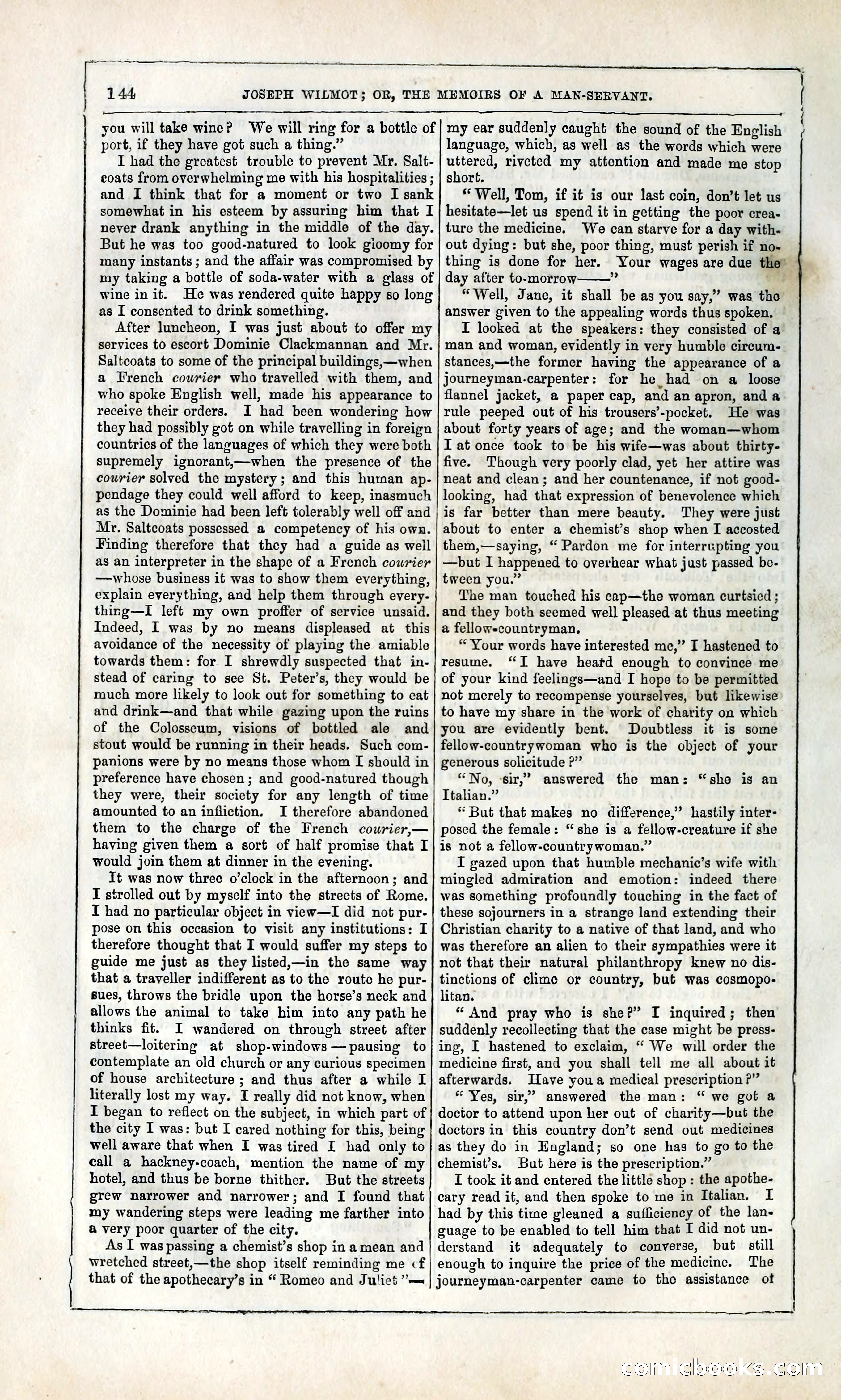
A restored page from Penny Dreadfuls, 1854. Page through the whole issue in the reader above.
📄 Transcribed text from this page (OCR, searchable)
Machine-transcribed from the original scan — historical spelling and the odd misread are preserved.
JOSEPH WILMOT; OR, THE MEMOIRS OF A MAN-SERVANT, you will take wine? We will ring for a bottle of port, if they have got such a thing.” I had the greatest trouble to prevent Mr. Salt- coats from overwhelming me with his hospitalities ; and I think that for a moment or two I sank somewhat in his esteem by assuring him that I never drank anything in the middle of the day. But he was too good-natured to look gioomy for many instants; and the affair was compromised by my taking a bottle of soda-water with a glass of wine in it. He was rendered quite happy so long as I consented to drink something. After luncheon, I was just about to offer my services to escort Dominie Clackmannan and Mr. Saltcoats to some of the principal buildings,—when a French courier who travelled with them, and who spoke English well, made his appearance to receive their orders. I had been wondering how they had possibly got on while travelling in foreign countries of the languages of which they were both supremely ignorant,—when the presence of the courier solved the mystery; and this human ap- pendage they could well afford to keep, inasmuch as the Dominie had been left tolerably well off and Mr. Saltcoats possessed a competency of his own. Finding therefore that they had a guide as well as an interpreter in the shape of a French courier —whose business it was to show them everything, explain everything, and help them through every- thing—I left my own proffer of service unsaid. Indeed, I was by no means displeased at this avoidance of the necessity of playing the amiable towards them: for I shrewdly suspected that in- stead of caring to see St. Peter’s, they would be much more likely to look out for something to eat and drink—and that while gazing upon the ruins of the Colosseum, visions of bottled ale and stout would be running in their heads. Such com- panions were by no means those whom [I should in preference have chosen; and good-natured though they were, their society for any length of time amounted to an infliction. I therefore abandoned them to the charge of the French courier,— having given them a sort of half promise that I would join them at dinner in the evening. It was now three o’clock in the afternoon; and I strolled out by myself into the streets of Rome. I had no particular object in view—I did not pur- pose on this occasion to visit any institutions: I therefore thought that I would suffer my steps to guide me just as they listed,—in the same way that a traveller indifferent as to the route he pur- sues, throws the bridle upon the horse’s neck and allows the animal to take him into any path he thinks fit. I wandered on through street after street—loitering at shop-windows — pausing to contemplate an old church or any curious specimen of house architecture ; and thus after a while I literally lost my way. I really did not know, when I began to reflect on the subject, in which part of the city I was: but I cared nothing for this, being well aware that when I was tired I had only to call a hackney-coach, mention the name of my hotel, and thus be borne thither. But the streets grew narrower and narrower; and I found that my wandering steps were leading me farther into & very poor quarter of the city. As I was passing a chemist’s shop in amean and wretched street,—the shop itself reminding me cf that of the apothecary’s in “ Romeo and Juliet ’— my ear suddenly caught the sound of the English language, which, as well as the words which were uttered, riveted my attention and made me stop short. * Well, Tom, if if is our last coin, don’t let us hesitate—let us spend it in getting the poor crea- ture the medicine. We can starve for a day with- out dying: but she, poor thing, must perish if no- thing is done for her. Your wages are due day after to-morrow be Oe tie? “Well, Jane, it shall be as you say,” was the answer given to the appealing words thus spoken. © I looked at the speakers: they consisted of a man and woman, evidently in very humble circum- stances,—the former having the appearance of a journeyman.carpenter: for he had on a loose flannel jacket, a paper cap, and an apron, anda rule peeped out of his trousers’-pocket. He was about forty years of age; and the woman—whom IT at once took to be his wife—was about thirty- five. Though very poorly clad, yet her attire was neat and clean; and her countenance, if not good- looking, had that expression of benevolence which is far better than mere beauty. They were just about to enter a chemist’s shop when I accosted them,—saying, “ Pardon me for interrupting you —but I happened to overhear what just passed be- tween you.” The man touched his cap—the woman curtsied ; and they both seemed well pleased at thus meeting a fellowecountryman. Your words have interested me,”’ I hastened to resume. “IT have heatd enough to convince me of your kind feelings—and I hope to be permitted not merely to recompense yourselves, but likewise to have my share in the work of charity on which you are evidently bent. Doubtless it is some fellow-countrywoman who is the object of your generous solicitude ?” “No, sir,’ answered the man: “she is an Italian.” “But that makes no difference,” hastily inter- posed the female: “she is a fellow-creature if she is not a fellow-countrywoman.” I gazed upon that humble mechaniec’s wife with mingled admiration and emotion: indeed there was something profoundly touching in the fact of these sojourners in a strange land extending their Christian charity to a native of that land, and who was therefore an alien to their sympathies were it not that their natural philanthropy knew no dis- tinctions of clime or country, but was cosmopo- litan. * And pray who is she?” I inquired; then suddenly recollecting that the case might be press- ing, I hastened to exclaim, “ We will order the medicine first, and you shall tell me all about it afterwards. Have youa medical prescription ?P” * Yes, sir,’ answered the man: “ we got a doctor to attend upon her out of charity—but the doctors in this country don’t send out medicines as they do in England; so one has to go to the chemist’s. But here is the prescription.” I took it and entered the little shop : the apothe- cary read it, and then spoke to me in Italian. I had by this time gleaned a sufficiency of the lan- guage to be enabled to tell him that I did not un- derstand it adequately to converse, but still enough to inquire the price of the medicine. The journeyman-carpenter came to the assistance of a an i ei ooo ECORICOOOKS (C@)