
Penny Dreadfuls, 1854 · page 168 of 399
Joseph Wilmot, or, The Memoirs of a Man-Servant — page 168: what you’re looking at
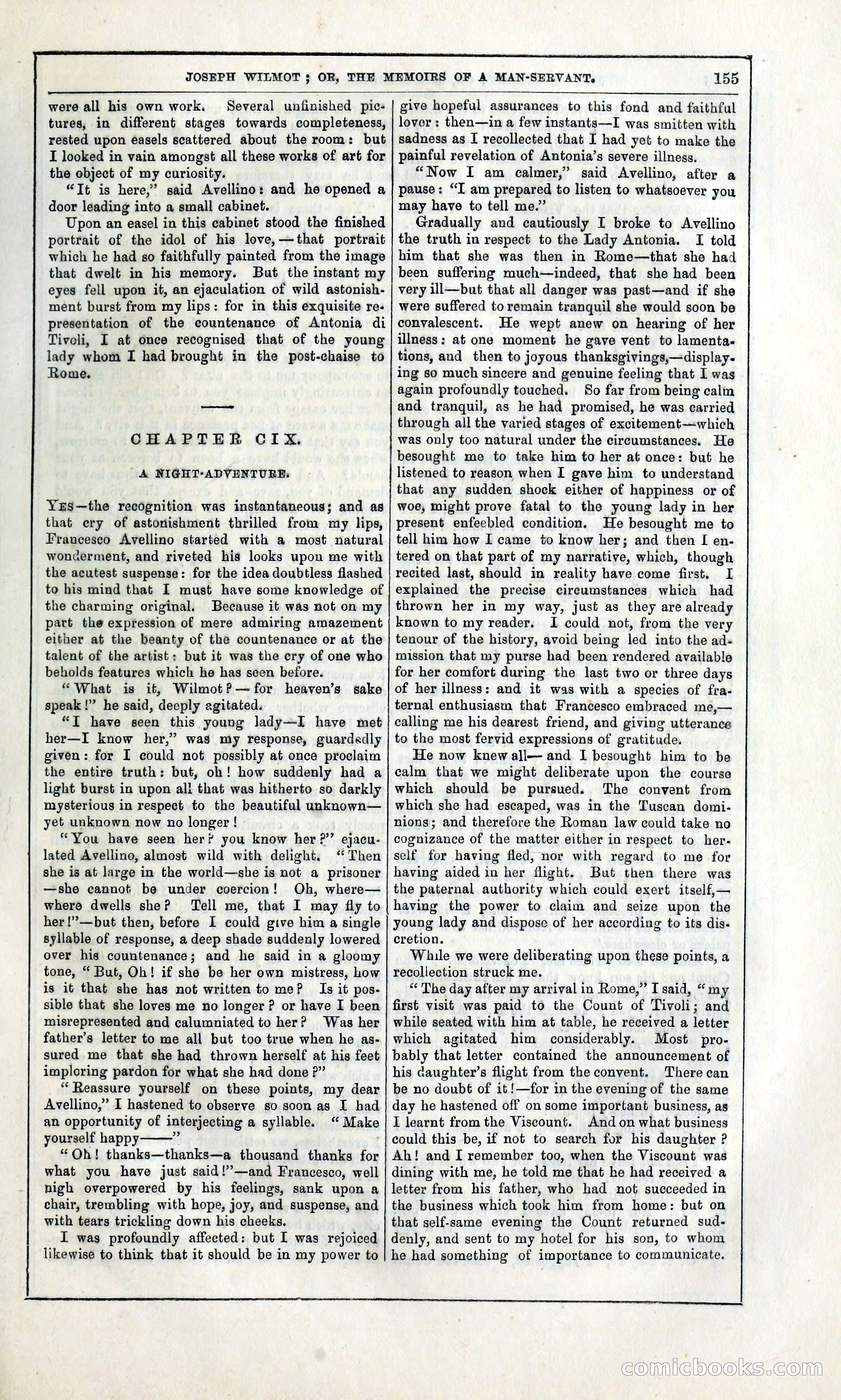
A restored page from Penny Dreadfuls, 1854. Page through the whole issue in the reader above.
📄 Transcribed text from this page (OCR, searchable)
Machine-transcribed from the original scan — historical spelling and the odd misread are preserved.
JOSEPH WILMOT $3; OR, THE MEMOIRS OF A MAN-SERVANT. were all his own work. Several unfinished pic- tures, in different stages towards completeness, rested upon éasels scattered about the room: but I looked in vain amongst all these works of art for the object of my curiosity. “Tt is here,” said Avellino: and he opened a door leading into a small cabinet. Upon an easel in this cabinet stood the finished portrait of the idol of his love, —that portrait which he had so faithfully painted from the image that dwelt in his memory. But the instant my eyes fell upon it, an ejaculation of wild astonish- ment burst from my lips: for in this exquisite re- presentation of the countenance of Antonia di Tivoli, I at once recognised that of the young lady whom I had brought in the post-chaise to Rome. Come wake CHAPTER CIX., A NIGHT-ADVHENTURE: YzEs—the recognition was instantaneous; and as that ery of astonishment thrilled from my lips, Francesco Avellino started with a most natural woncerment, and riveted his looks upon me with the acutest suspense: for the idea doubtless flashed to his mind that I must have some knowledge of the charming original. Because it was not on my part the expression of mere admiring amazement either at the beanty of the countenance or at the talent of the artist: but it was the ery of one who beholds features which he has seen before. “What is it, Wilmot?—for heaven’s sake speak!” he said, deeply agitated. “I have seen this young lady—I have met her—I know her,” was my response, guardedly given: for I could not possibly at once proclaim the entire truth: but, oh! how suddenly had a light burst in upon ali that was hitherto so darkly mysterious in respect to the beautiful unknown— yet unknown now no longer ! “You have seen her? you know her ?”’ ejacu- lated Avellino, almost wild with delight, “Then she is at large in the world—she is not a prisoner —she cannot be under coercion! Oh, where— where dwells she? Tell me, that I may fly to her!”—but then, before I could give him a single syllable of response, a deep shade suddenly lowered over his countenance; and he said in a gloomy tone, “ But, Oh! if she be her own mistress, how is it that she has not written to meP Is it pos- sible that she loves me no longer? or have I been misrepresented and calumniated to her? Was her father’s letter to me all but too true when he as- sured me that she had thrown herself at his feet imploring pardon for what she had done ?” “‘Reassure yourself on these points, my dear Avellino,” I hastened to observe so soon as I had an opportunity of interjecting a syllable. “Make yourself happy vs “Oh! thanks—thanks—a thousand thanks for what you have just said!”—and Francesco, well nigh overpowered by his feelings, sank upon a chair, trembling with hope, joy, and suspense, and with tears trickling down his cheeks. I was profoundly affected: but [I was rejoiced likewise to think that it should be in my power to give hopeful assurances to this fond and faithful lover: then—in a few instants—I was smitten with sadness as I recollected that I had yet to make the painful revelation of Antonia’s severe illness. “Now I am calmer,” said Avellino, after a pause: “I am prepared to listen to whatsoever you may have to tell me.” Gradually and cautiously I broke to Avellino the truth in respect to the Lady Antonia. I told him that she was then in Rome—that she had been suffering much—indeed, that she had been very ill—but that all danger was past—and if she were suffered to remain tranquil she would soon be convalescent. He wept anew on hearing of her illness: at one moment he gave vent to lamenta- tions, and then to joyous thanksgivings,—display- ing so much sincere and genuine feeling that I was again profoundly touched. So far from being calm and tranquil, as he had promised, he was carried through all the varied stages of excitement—which was only too natural under the circumstances. He besought me to take him to her at once: but he listened to reason when I gave him to understand that any sudden shock either of happiness or of woe, might prove fatal to the young lady in her present enfeebled condition. He besought me to tell him how I came to know her; and then [ en- tered on that part of my narrative, which, though recited last, should in reality have come first, I explained the precise circumstances which had thrown her in my way, just as they are already known to my reader. I could not, from the very tenour of the history, avoid being led into the ad- mission that my purse had been rendered available for her comfort during the last two or three days of her illness: and it was with a species of fra- ternal enthusiasm that Francesco embraced me,— calling me his dearest friend, and giving utterance to the most fervid expressions of gratitude. He now knew all— and I besought him to be calm that we might deliberate upon the course which should be pursued. The convent from which she had escaped, was in the Tuscan domi- nions; and therefore the Roman law could take no cognizance of the matter either in respect to her- self for having fled, nor with regard to me for having aided in her flight. But then there was the paternal authority which could exert itself,— having the power to claim and seize upon the young lady and dispose of her according to its dis- cretion. While we were deliberating upon these points, a recollection struck me. “ The day after my arrival in Rome,” I said, “my first visit was paid to the Count of Tivoli; and while seated with him at table, he received a letter which agitated him considerably. Most pro- bably that letter contained the announcement of his caughter’s flight from the convent. There can be no doubt of it!—for in the evening of the same day he hastened off on some important business, as I learnt from the Viscount. Andon what business could this be, if not to search for his daughter P Ah! and I remember too, when the Viscount was dining with me, he told me that he had received a letter from his father, who had not succeeded in the business which took him from home: but on that self-same evening the Count returned sud- denly, and sent to my hotel for his son, to whom he had something of importance to communicate. I a ES | 155 | Giyoo ‘S co