
Penny Dreadfuls, 1854 · page 196 of 399
Joseph Wilmot, or, The Memoirs of a Man-Servant — page 196: what you’re looking at
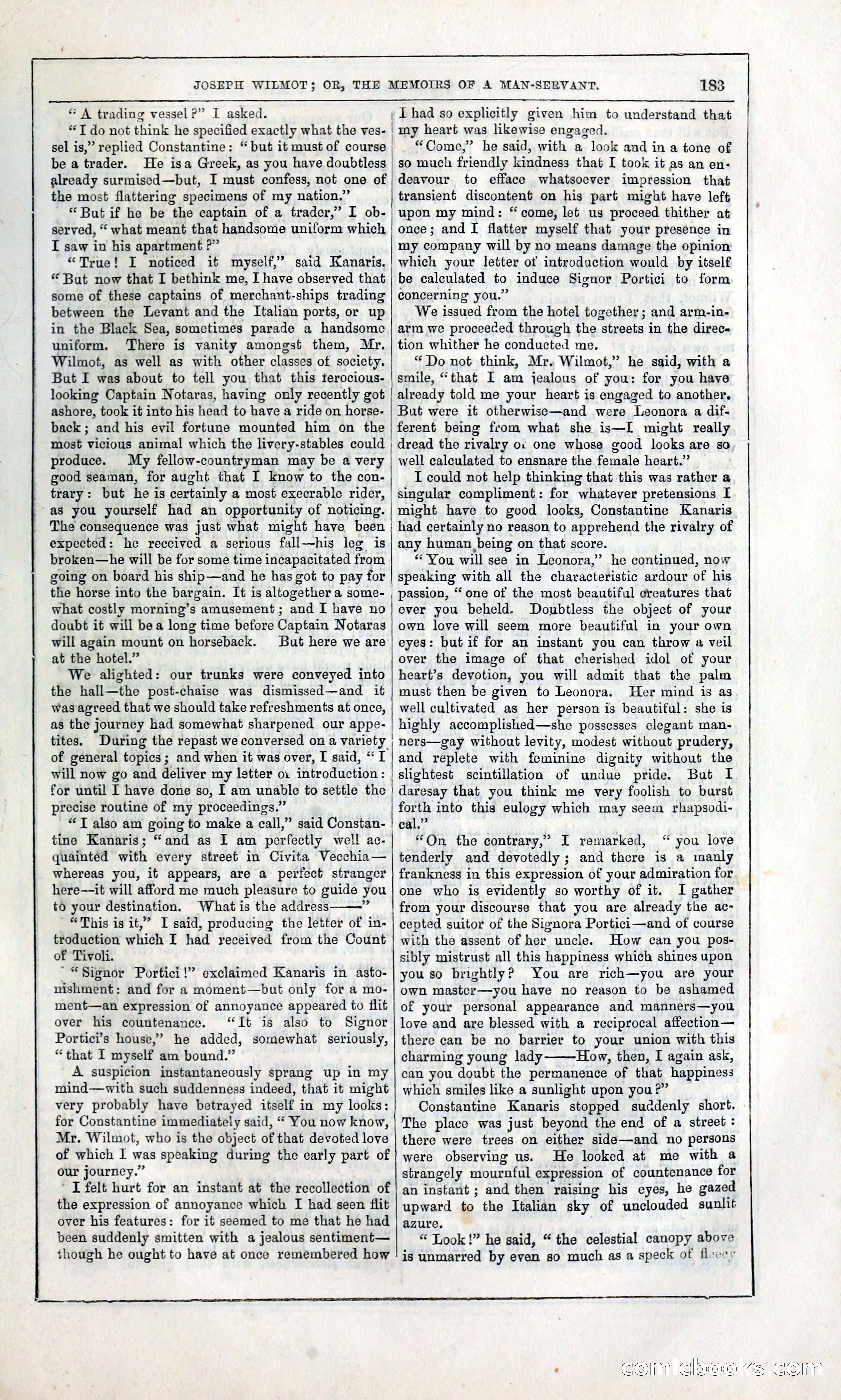
A restored page from Penny Dreadfuls, 1854. Page through the whole issue in the reader above.
📄 Transcribed text from this page (OCR, searchable)
Machine-transcribed from the original scan — historical spelling and the odd misread are preserved.
JOSEPH WILMOT; OR, THE MEMOIRS OF A MAN-SERVANT, 183 * A trading vessel?” I asked. | L had so explicitly given him to understand that “T do not think he specified exactly what the ves- | my heart was likewise engaged. sel is,” replied Constantine: “but it must of course | be a trader. He isa Greek, as you have doubtless already surmised—but, I must confess, not one of the most flattering specimens of my nation.” “But if he be the captain of a trader,’ I ob- served, “ what meant that handsome uniform which I saw in his apartment ?” “True! I noticed it myself,’ said Kanaris. * But now that I bethink me, I have observed that some of these captains of merchant-ships trading between the Levant and the Italian ports, or up in the Black Sea, sometimes parade a handsome uniform. There is vanity amongst them, Mr. Wilmot, as well as with other classes ot society. But I was about to tell you that this terocious- looking Captain Notaras, having only recently got ashore, took it into his head to have a ride on horse- back ; and his evil fortune mounted him on the most vicious animal which the livery-stables could produce. My fellow-countryman may be a very good seaman, for aught that I know to the con- trary: but he is certainly a most execrable rider, 'as you yourself had an opportunity of noticing. The consequence was just what might have been | expected: he received a serious fall—his leg is broken—he will be for some time incapacitated from going on board his ship—and he has got to pay for the horse into the bargain. It is altogether a some- what costly morning’s amusement ; and I have no doubt it will bea long time before Captain Notaras will again mount on horseback. But here we are at the hotel.” We alighted: our trunks were conveyed into the hall—the post-chaise was dismissed—and it was agreed that we should take refreshments at once, as the journey had somewhat sharpened our appe- tites. During the repast we conversed on a variety of general topics; and when it was over, [ said, “I will now go and deliver my letter ox introduction: for until I have done so, I am unable to settle the precise routine of my proceedings.” “T also am going to make a call,” said Constan- tine Kanaris; “and as I am perfectly well ac- quainted with every street in Civita Vecchia— whereas you, it appears, are a perfect stranger here—-it will afford me much pleasure to guide you to your destination. What is the address 2 “This is it,” I said, producing the letter of in- troduction which I had received from the Count of Tivoli. ' “Signor Portici!” exclaimed Kanaris in asto- nishment: and for a moment—but only for a mo- ment—an expression of annoyance appeared to flit over his countenance. “It is also to Signor Portici’s house,” he added, somewhat seriously, “that I myself am bound.” A suspicion instantaneously sprang up in my mind—with such suddenness indeed, that it might very probably have betrayed itself in my looks: for Constantine immediately said, “ You now know, Mr. Wilmot, who is the object of that devoted love of which I was speaking during the early part of our journey.” ~I felt hurt for an instant at the recollection of the expression of annoyance which I had seen flit over his features: for it seemed to me that he had been suddenly smitten with a jealous sentiment— though he ought to have at once remembered how “Come,” he said, with a look and in a tone of so much friendly kindness that [ took it as an en: deavour to efface whatsoever impression that transient discontent on his part might have left upon my mind: “come, let us proceed thither at once; and I flatter myself that your presence in my company will by no means damage the opinion which your letter of introduction would by itself be calculated to induce Signor Portici to form concerning you.” We issued from the hotel together; and arm-in- arm we proceeced through the streets in the direc- tion whither he conducted me. * Do not think, Mr. Wilmot,” he said, with a smile, “that I am jealous of you: for you have already told me your heart is engaged to another. But were it otherwise—and were Leonora a dif- ferent being from what she is—I might really dread the rivalry oc one whose good looks are so well calculated to ensnare the female heart.” I could not help thinking that this was rather a singular compliment: for whatever pretensions I might have to good looks, Constantine Kanaris had certainly no reason to apprehend the rivalry of any human being on that score. “You will see in Leonora,” he continued, now speaking with all the characteristic ardour of his passion, “one of the most beautiful creatures that ever you beheld. Doubtless the object of your own love will seem more beautiful in your own eyes: but if for an instant you can throw a veil over the image of that cherished idol of your heart’s devotion, you will admit that the palm must then be given to Leonora. Her mind is as well cultivated as her person is beautiful: she is highly accomplished—she possesses elegant man- ners—gay without levity, modest without prudery, and replete with feminine dignity without the slightest scintillation of undue pride. But IL daresay that you think me very foolish to burst forth into this eulogy which may seem rhapsodi- cal,” “On the contrary,’ I remarked, “ you love tenderly and devotedly; and there is a manly frankness in this expression of your admiration for one who is evidently so worthy of it. I gather from your discourse that you are already the ac- cepted suitor of the Signora Portici—and of course with the assent of her uncle. How can you pos- sibly mistrust all this happiness which shines upon you so brightly? You are rich—you are your own master—you have no reason to be ashamed of your personal appearance and manners—you love and are blessed with a reciprocal affection— there can be no barrier to your union with this charming young lady How, then, I again ask, can you doubt the permanence of that happiness which smiles like a sunlight upon you?” Constantine Kanaris stopped sucdenly short. The place was just beyond the end of a street : there were trees on either side—and no persons were observing us. He looked at me with a strangely mournful expression of countenance for an instant ; and then raising his eyes, he gazed upward to the Italian sky of unclouded sunlit azure. “ Took!” he said, “the celestial canopy above is unmarred by even so much as a speck of flovey eg i I, A STE TDI ELLE LEI LET TOLLE IE LL LE ELL LL ALL A ElNOQO cS (C@)