
Penny Dreadfuls, 1854 · page 20 of 399
Joseph Wilmot, or, The Memoirs of a Man-Servant — page 20: what you’re looking at
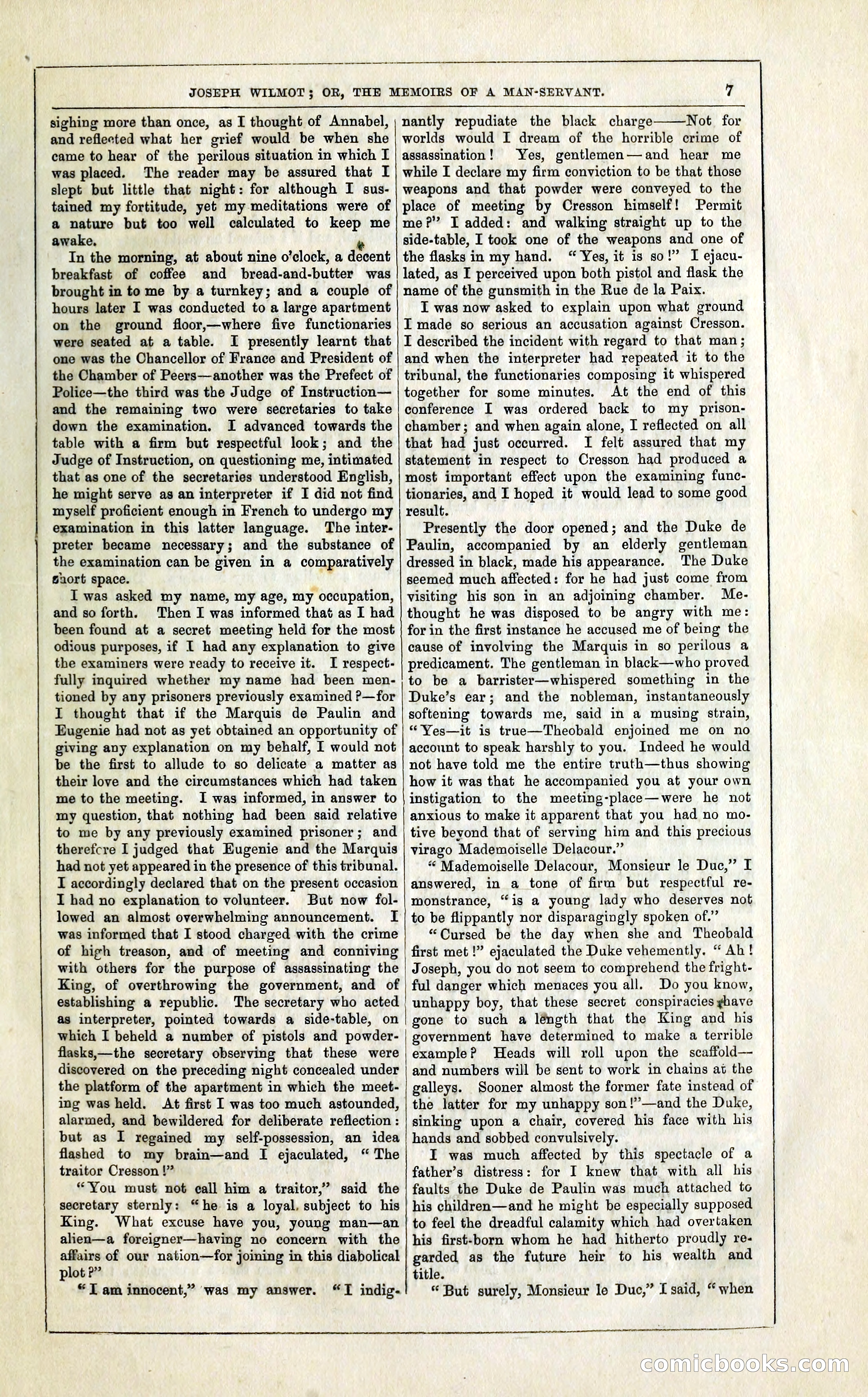
A restored page from Penny Dreadfuls, 1854. Page through the whole issue in the reader above.
📄 Transcribed text from this page (OCR, searchable)
Machine-transcribed from the original scan — historical spelling and the odd misread are preserved.
+ re ee ee et JOSEPH WILMOT; OR, THE MEMOIRS OF A MAN-SERVANT. 7 sighing more than once, as I thought of Annabel, and reflected what her grief would be when she came to hear of the perilous situation in which I was placed. The reader may be assured that I slept but little that night: for although I sus- tained my fortitude, yet my meditations were of a nature but too well calculated to keep me awake, e In the morning, at about nine o’clock, a decent breakfast of coffee and bread-and-butter was brought in tome by a turnkey; and a couple of hours later I was conducted to a large apartment on the ground floor,—where five functionaries were seated at a table. I presently learnt that one was the Chancellor of France and President of the Chamber of Peers—another was the Prefect of Police—the third was the Judge of Instruction— and the remaining two were secretaries to take down the examination. I advanced towards the table with a firm but respectful look; and the Judge of Instruction, on questioning me, intimated that as one of the secretaries understood English, he might serve as an interpreter if I did not find myself proficient enough in French to undergo my examination in this latter language. The inter- preter became necessary; and the substance of the examination can be given in a comparatively snort space. I was asked my name, my age, my occupation, and so forth. Then I was informed that as I had been found at a secret meeting held for the most odious purposes, if I had any explanation to give the examiners were ready to receive it. I respect- fully inquired whether my name had been men- tioned by any prisoners previously examined P—for I thought that if the Marquis de Paulin and Eugenie had not as yet obtained an opportunity of giving any explanation on my behalf, I would not be the first to allude to so delicate a matter as their love and the circumstances which had taken me to the meeting. I was informed, in answer to my question, that nothing had been said relative to me by any previously examined prisoner; and therefcre I judged that Eugenie and the Marquis had not yet appeared in the presence of this tribunal. I accordingly declared that on the present occasion I had no explanation to volunteer. But now fol- lowed an almost overwhelming announcement. I[ was informed that I stood charged with the crime of high treason, and of meeting and conniving with others for the purpose of assassinating the King, of overthrowing the government, and of establishing a republic. The secretary who acted as interpreter, pointed towards a side-table, on which I beheld a number of pistols and powder- flasks,—the secretary observing that these were discovered on the preceding night concealed under the platform of the apartment in which the meet- ing was held. At first I was too much astounded, alarmed, and bewildered for deliberate reflection : but as I regained my self-possession, an idea flashed to my brain—and I ejaculated, “ The traitor Cresson !” “You must not call him a traitor,” said the secretary sternly: “he is a loyal, subject to his King. What excuse have you, young man—an alien—a foreigner—having no concern with the affairs of our nation—for joining in this diabolical plot ?” “I am innocent,” was my answer. “T indig- nantly repudiate the black charge Not for worlds would I dream of the horrible crime of assassination! Yes, gentlemen—and hear me while I declare my firm conviction to be that those weapons and that powder were conveyed to the place of meeting by Cresson himself! Permit me?” T added: and walking straight up to the side-table, I took one of the weapons and one of the flasks in my hand. “ Yes, it is so!” I ejacu- lated, as I perceived upon both pistol and flask the name of the gunsmith in the Rue de la Paix. I was now asked to explain upon what ground I made so serious an accusation against Cresson. I described the incident with regard to that man; and when the interpreter had repeated it to the tribunal, the functionaries composing it whispered together for some minutes. At the end of this conference I was ordered back to my prison- chamber; and when again alone, I reflected on all that had just occurred. I felt assured that my statement in respect to Cresson had produced a most important effect upon the examining func- tionaries, and I hoped it would lead to some good result. Presently the door opened; and the Duke de Paulin, accompanied by an elderly gentleman dressed in black, made his appearance. The Duke seemed much affected: for he had just come from visiting his son in an adjoining chamber. Me- thought he was disposed to be angry with me: for in the first instance he accused me of being the cause of involving the Marquis in so perilous a predicament. The gentleman in black—who proved to be a barrister—whispered something in the Duke’s ear; and the nobleman, instantaneously softening towards me, said in a musing strain, “Yes—it is true—Theobald enjoined me on no account to speak harshly to you. Indeed he would not have told me the entire truth—thus showing how it was that he accompanied you at your own instigation to the meeting-place—were he not anxious to make it apparent that you had no mo- tive beyond that of serving him and this precious virago Mademoiselle Delacour.” * Mademoiselle Delacour, Monsieur le Duc,” I answered, in a tone of firm but respectful re- monstrance, “is a young lady who deserves not to be flippantly nor disparagingly spoken of.” “Cursed be the day when she and Theobald first met !” ejaculated the Duke vehemently. “ Ah! Joseph, you do not seem to comprehend the fright- ful danger which menaces you all. Do you know, unhappy boy, that these secret conspiracies ghave gone to such a léngth that the King and his government have determined to make a terrible example? Heads will roll upon the scaffold— and numbers will be sent to work in chains at the galleys. Sooner almost the former fate instead of the latter for my unhappy son!’—and the Duke, sinking upon a chair, covered his face with his hands and sobbed convulsively. I was much affected by this spectacle of a father’s distress: for I knew that with all his faults the Duke de Paulin was much attached to his children—and he might be especially supposed to feel the dreadful calamity which had overtaken his first-born whom he had hitherto proudly re- garded as the future heir to his wealth and title. “But surely, Monsieur le Duc,” I said, “when ——— - A (E() Ghboo 6S (E@)