
Penny Dreadfuls, 1854 · page 207 of 399
Joseph Wilmot, or, The Memoirs of a Man-Servant — page 207: what you’re looking at
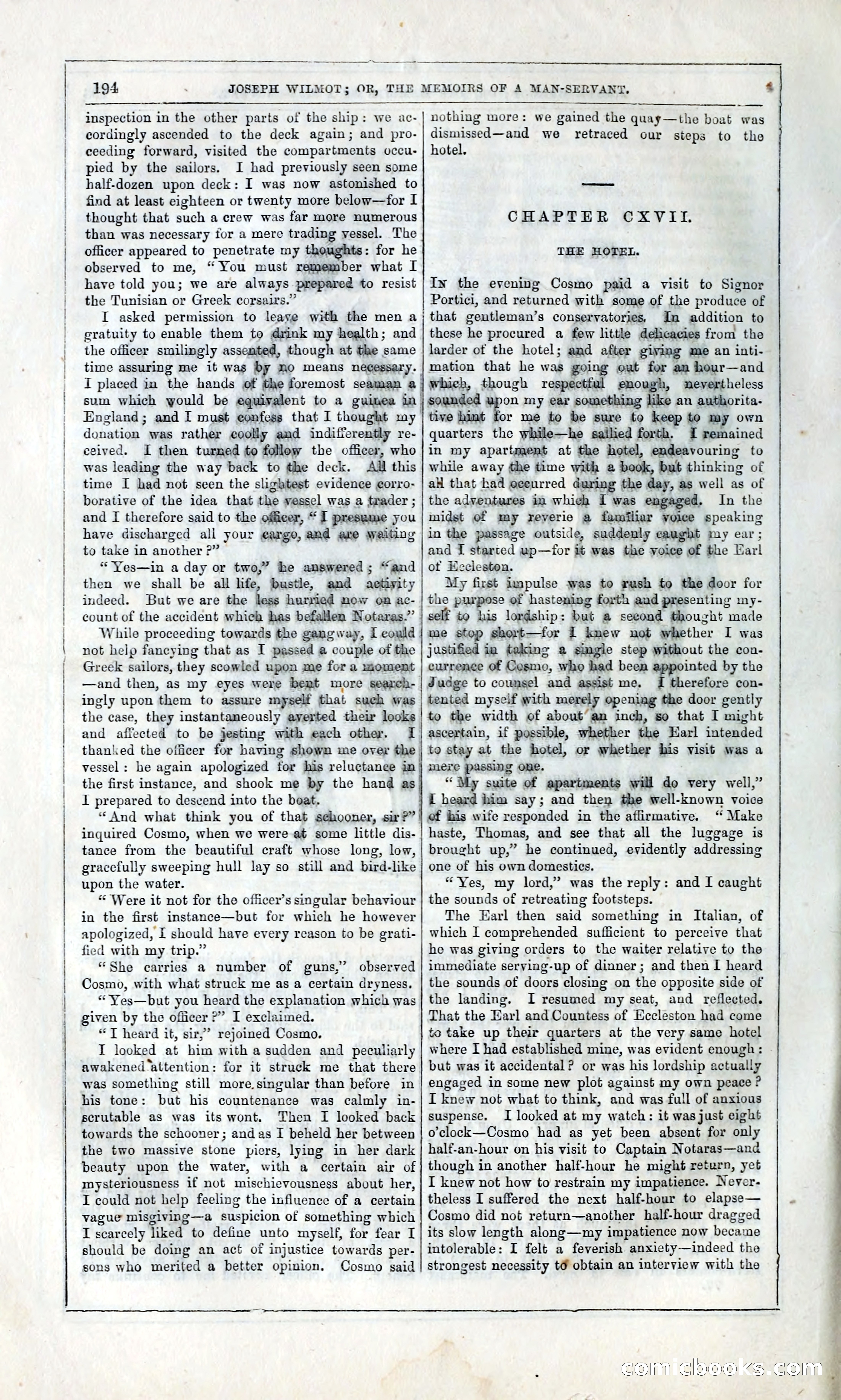
A restored page from Penny Dreadfuls, 1854. Page through the whole issue in the reader above.
📄 Transcribed text from this page (OCR, searchable)
Machine-transcribed from the original scan — historical spelling and the odd misread are preserved.
—_— Se ON a -_-—_——— 194 JOSEPH WILMOT; OR, THE MEMOIRS OF A MAN-SERVANT. $ inspection in the other parts of the ship: we ac- cordingly ascended to the deck again; and pro- ceeding forward, visited the compartments occu- pied by the sailors. I had previously seen some half-dozen upon deck: I was now astonished to find at least eighteen or twenty more below—for I thought that such a crew was far more numerous than was necessary for a mere trading vessel. The officer appeared to penetrate my tho : for he observed to me, “ You must remember what I have told you; we are always prepared to resist the Tunisian or Greek corsairs.” I asked permission to leaye with the men a gratuity to enable them to drink my health; and the officer smilingly assented, though at the same time assuring me it was by mo means necessary. | Which, though respectful enough, nevertheless sum which would be equivalent to a guinea in| T placed in the hands of the foremost seaman a England; and I must confess that I thought my donation was rather coolly amd indifferently re- ceived. I then turned to follow the officer, who was leading the way back to the deck. AW this time I had not seen the slightest evidence eorro- borative of the idea that the vessel was a trader ; and I therefore said to the officer, “I presume you have discharged all your eango, and ane waiting to take in another ?” “Yes—in a day or two,” he answered; “and then we shall be all life, bustle, amd aetiyity indeed. But we are the hurned now on ac- count of the accident which has befallen Notaras.” » While proceeding towards the gangway, I could | not helo fancying that as I passed a couple of the Greek sailors, they scowled upon me for a moment —and then, as my eyes were bemt more seanch- ingly upon them to assure myself that such was the case, they instantaneously averted their looks and affected to be jesting with each othe. I thanked the officer for having shown me over the vessel: he again apologized for his reluctance in the first instance, and shook me by the hand as) I prepared to descend into the boat. “And what think you of that sehooner, sir?” inquired Cosmo, when we were at some little dis- tance from the beautiful craft whose long, low, gracefully sweeping hull lay so still and bird-like upon the water. “Were it not for the officer’s singular behaviour in the first instance—but for which he however apologized, I should have every reason to be grati- fied with my trip.” “She carries a number of guns,” observed Cosmo, with what struck me as a certain dryness. *Yes—but you heard the explanation which was given by the officer ?” I exclaimed. “T heard it, sir,’ rejoined Cosmo. I looked at him with a sudden and peculiarly awakened attention: for it struck me that there was something still more.singular than before in his tone: but his countenance was calmly in- scrutable as was its wont. Then I looked back towards the schooner; andas I beheld her between the two massive stone piers, lying in her dark beauty upon the water, with a certain air of mysteriousness if not mischievousness about her, I could not help feeling the influence of a certain vague misgiving—a suspicion of something which I scarcely liked to define unto myself, for fear I should be doing an act of injustice towards per- sons who merited a better opinion. Cosmo said —<—ws nothing more: we gained the quay—the boat was dismissed—and we retraced our steps to the hotel. CHAPTER CXVIL. THE HOTEL. In the evening Cosmo paid a visit to Signor Portici, and returned with some of the produce of i that gentleman’s conservatories, In addition to these he procured a few little delicacies from the larder of the hotel; amd after giying me an inti- mation that he was going eut for an hour—and sounded upon my ear something like an authorita- tive himt for me to be sure to keep to my own quarters the while—he sailied forth. iI remained in my apartment at the hotel, endeavouring to while away the time with a book, but thinking of al that had eeeurred during the day, as well as of the adventures in whieh I was aged. In the midst of my reverie a familiar voice speaking in the passage outside, suddenly caught my ear ; and {I started up—for it was the yoice of the Earl ot Eccleston. My first impulse was to rush to the door for the purpose of hastening forth and presenting my- self to his lordship: but a seeond @hought made me stop short—for i knew uot whether I was justified ia taking a single step without the con- currence of Cosmo, who had been appointed by the Judge to counsel and assist me. I therefore con- tented myself with merely opening the door gently to the width of about’ an inch, so that I might ascertain, if possible, whether the Earl intended to stay at the hotel, or whether his visit was a mere passing one. % suite of ments will do very well,” I heard him say; and then the well-known voice of his wife responded in the affirmative. “ Make haste, Thomas, and see that all the luggage is brought up,” he continued, evidently addressing one of his own domestics. “Yes, my lord,” was the reply: and I caught the sounds of retreating footsteps. The Earl then said something in Italian, of which I comprehended sufficient to perceive that he was giving orders to the waiter relative to the immediate servying-up of dinner; and then I heard the sounds of doors closing on the opposite side of the landing. I resumed my seat, and reflected. That the Earl and Countess of Eccleston had come to take up their quarters at the very same hotel where I had established mine, was evident enough: - but was it accidental? or was his lordship actually engaged in some new plot against my own peace? I knew not what to think, and was full of anxious suspense. I looked at my watch: it was just eight o’clock—Cosmo had as yet been absent for only half-an-hour on his visit to Captain Notaras—and though in another half-hour he might return, yet I knew not how to restrain my impatience. Never- theless I suffered the next half-hour to elapse— Cosmo did not return—another half-hour dragged its slow length along—my impatience now became intolerable: I felt a feverish anxiety—indeed the strongest necessity t@ obtain an interview with the Gioo