
Penny Dreadfuls, 1854 · page 229 of 399
Joseph Wilmot, or, The Memoirs of a Man-Servant — page 229: what you’re looking at
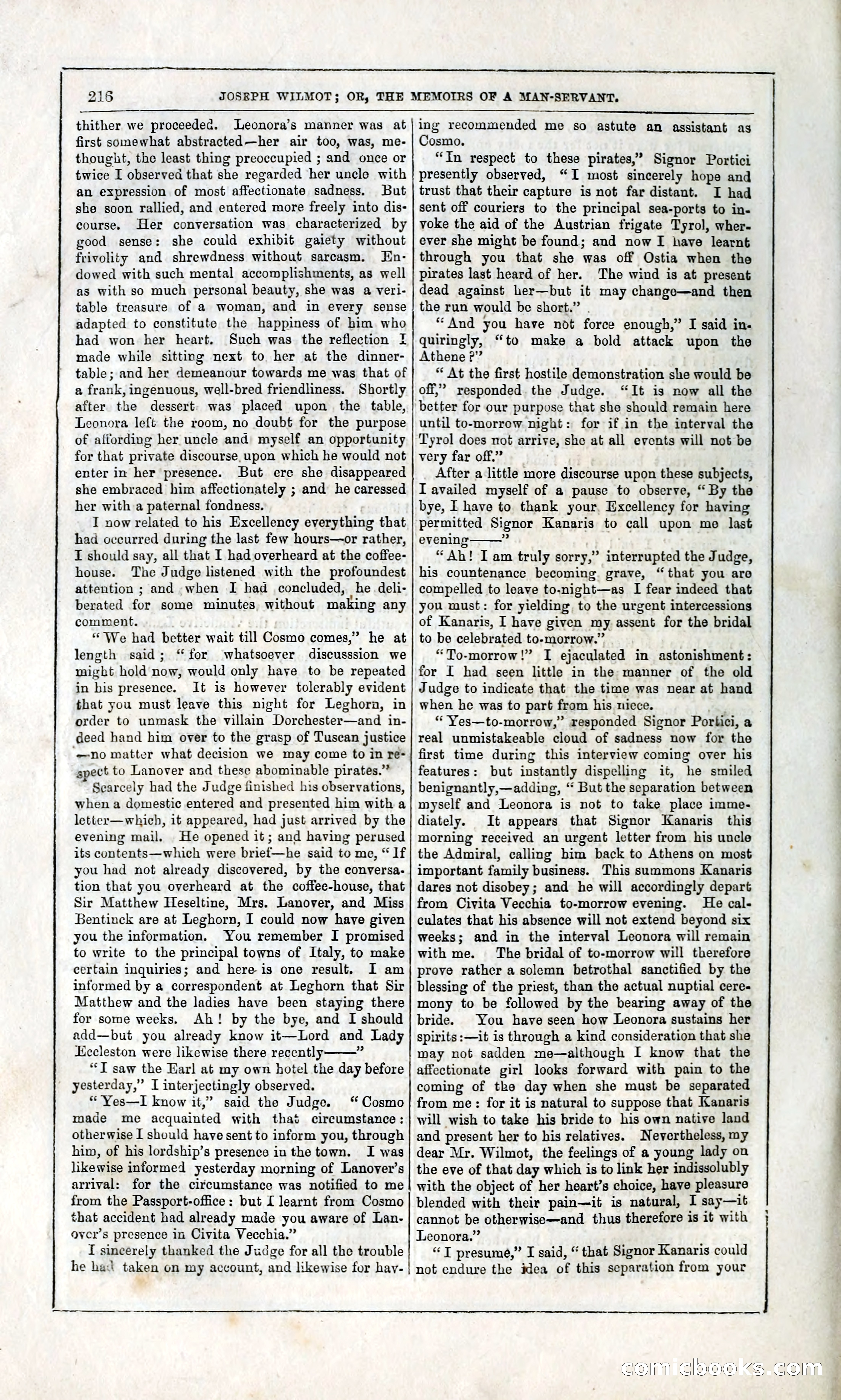
A restored page from Penny Dreadfuls, 1854. Page through the whole issue in the reader above.
📄 Transcribed text from this page (OCR, searchable)
Machine-transcribed from the original scan — historical spelling and the odd misread are preserved.
215 LLL LL OL LLL LO ILL AL CLC LLL LA a I JOSEPH WILMOT; OR, THE MEMOIRS OF A MAN-SERVANT, thither we proceeded. Leonora’s manner was at first somewhat abstracted—her air too, was, me- thought, the least thing preoccupied ; and once or twice I observed that she regarded her uncle with an expression of most affectionate sadness. But she soon rallied, and entered more freely into dis- course. Her conversation was characterized by good sense: she could exhibit gaiety without frivolity and shrewdness without sarcasm. LEn- dowed with such mental accomplishments, as well as with so much personal beauty, she was a verl- table treasure of a woman, and in every sense adapted to constitute the happiness of him who had won her heart. Such was the reflection I made while sitting next to her at the dinner- table; and her demeanour towards me was that of a frank, ingenuous, well-bred friendliness. Shortly after the dessert. was placed upon the table, Leonora left the room, no doubt for the purpose of affording her uncle and myself an opportunity for that private discourse, upon which he would not enter in her presence. But ere she disappeared she embraced him affectionately ; and he caressed her with a paternal fondness. I now related to his Excellency everything that had occurred during the last few hours—or rather, I should say, all that I had overheard at the coffee- house. The Judge listened with the profoundest attention ; and when I had concluded, he deli- berated for some minutes without making any comment. : “We had better wait till Cosmo comes,” he at length said; “for whatsoever discusssion we might hold now, would only have to be repeated in his presence. It is however tolerably evident that you must leave this night for Leghorn, in order to unmask the villain Dorchester—and in- deed hand him over to the grasp of Tuscan justice ‘—no matter what decision we may come to in re- spect to Lanover and these abominable pirates.” Searcely had the Judge finished his observations, when a domestic entered and presented him with a letter—which, it appeared, had just arrived by the evening mail. He opened it; and having perused its contents—which were brief—he said to me, “If you had not already discovered, by the conversa- tion that you overheard at the coffee-house, that Sir Matthew Heseltine, Mrs. Lanover, and Miss Bentinck are at Leghorn, I could now have given you the information. You remember I promised to write to the principal towns of Italy, to make certain inquiries; and here is one result. I am informed by a correspondent at Leghorn that Sir Matthew and the ladies have been staying there for some weeks. Ah! by the bye, and I should add—but you already know it—Lord and Lady Ficcleston were likewise there recently 7 “T saw the Earl at my own hotel the day before yesterday,” I interjectingly observed. * Yes—I know it,” said the Judge. ‘ Cosmo made me acquainted with that circumstance: otherwise I should have sent to inform you, through him, of his lordship’s presence in the town. I was likewise informed yesterday morning of Lanover’s arrival: for the circumstance was notified to me from the Passport-office: but I learnt from Cosmo that accident had already made you aware of Lan- oycr’s presence in Civita Vecchia.” I sineerely thanked the Judge for all the trouble he ha:t taken on my account, and likewise for hay- ing recommended me so astute an assistant as Cosmo. “In respect to these pirates,’ Signor Portici presently observed, “I most sincerely hope and trust that their capture is not far distant. I had sent off couriers to the principal sea-ports to in- voke the aid of the Austrian frigate Tyrol, wher- ever she might be found; and now I have learnt through you that she was off Ostia when the pirates last heard of her. The wind is at present dead against her—but it may change—and then the run would be short.” . “And you have not force enough,” I said in. quiringly, “to make a bold attack upon the Athene ?” “ At the first hostile demonstration she would be off,’ responded. the Judge. “It is now all the better for our purpose that she should remain here until to-morrow night: for if in the interval the Tyrol does not arrive, she at all events will not be very far off.” After a little more discourse upon these subjects, I availed myself of a pause to observe, “ By the bye, L have to thank your. Excellency for having permitted Signor Kanaris to call upon me last evening ‘1 “Ah! I am truly sorry,” interrupted the Judge, his countenance becoming. grave, “that you are compelled to leave to-night—as I fear indeed that you must: for yielding, to the urgent intercessions of Kanaris, I have given my assent for the bridal to be celebrated to-morrow.” “To-morrow!” I ejaculated in astonishment: for I had seen little in the manner of the old Judge to indicate that the time was near at hand when he was to part from his miece. es “ Yes—to-morrow,” responded Signor Portici, a real unmistakeable cloud of sadness now for the first time during this interview coming over his features: but instantly dispelling it, he smiled benignantly,—adding, ‘“‘ But the separation between myself and Leonora is not to take place imme- diately. It appears that Signor Kanaris_ this morning received an urgent letter from his uncle the Admiral, calling him back to Athens on most important family business. This summons Kanaris dares not disobey; and he will accordingly depart from Civita Vecchia to-morrow evening. He cal- culates that his absence will not extend beyond six weeks; and in the interval Leonora will remain with me. The bridal of to-morrow will therefore prove rather a solemn betrothal sanctified by the blessing of the priest, than the actual nuptial cere- mony to be followed by the bearing away of the bride. You have seen how Leonora sustains her spirits :—it is through a kind consideration that she may not sadden me—although I know that the affectionate girl looks forward with pain to the coming of the day when she must be separated from me: for it is natural to suppose that Kanaris will wish to take his bride to his own native land and present her to his relatives. Nevertheless, my dear Mr. Wilmot, the feelings of a young lady on the eve of that day which is to link her indissolubly with the object of her heart’s choice, have pleasure blended with their pain—it is natural, I say—it cannot be otherwise—and thus therefore is if with Leonora.” : “T presume,” I said, “ that Signor Kanaris could not endure the idea of this separation from your CORNICE LO@ <S) (c@)