
Penny Dreadfuls, 1854 · page 23 of 399
Joseph Wilmot, or, The Memoirs of a Man-Servant — page 23: what you’re looking at
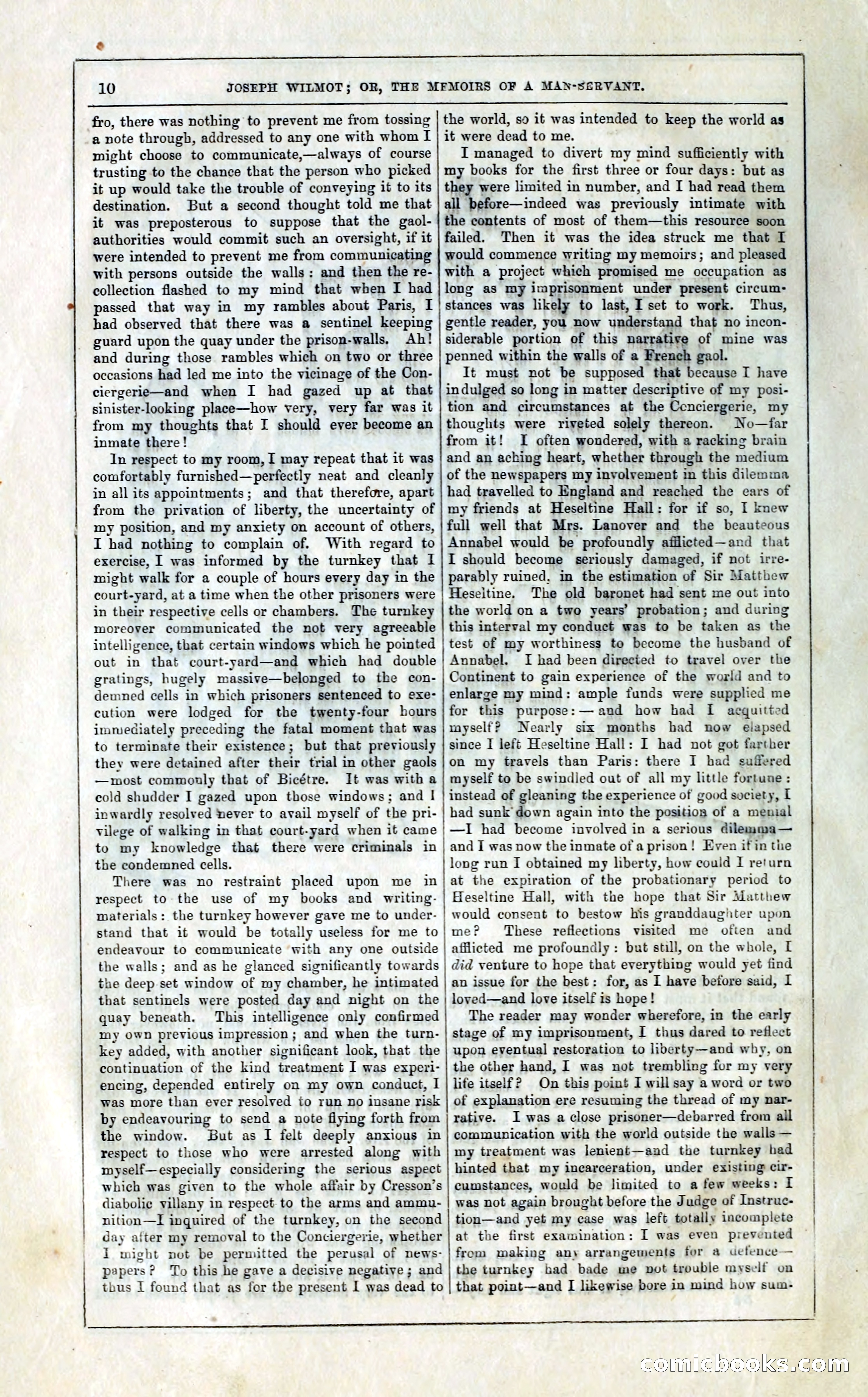
A restored page from Penny Dreadfuls, 1854. Page through the whole issue in the reader above.
📄 Transcribed text from this page (OCR, searchable)
Machine-transcribed from the original scan — historical spelling and the odd misread are preserved.
10 JOSEPH WILMOT; OR, THE MFMOIRS OF A MAN-SERVANT. fro, there was nothing to prevent me from tossing a note through, addressed to any one with whom I might choose to communicate,—always of course trusting to the chance that the person who picked it up would take the trouble of conveying it to its destination. But a second thought told me that it was preposterous to suppose that the gaol- authorities would commit such an oversight, if it were intended to prevent me from communicating with persons outside the walls: and then the re- collection flashed to my mind that when I had passed that way in my rambles about Paris, I had observed that there was a sentinel keeping guard upon the quay under the prison-walls, Ah! and during those rambles which on two or three occasions had led me into the vicinage of the Con- ciergerie—and when I had gazed up at that sinister-looking place—how very, very far was it from my thoughts that I should ever become an inmate there! In respect to my room, I may repeat that it was comfortably furnished—perfectly neat and cleanly in all its appointments; and that therefore, apart from the privation of liberty, the uncertainty of my position, and my anxiety on account of others, I had nothing to complain of. With regard to exercise, I was informed by the turnkey that I might walk for a couple of hours every day in the court-yard, at a time when the other prisoners were in their respective cells or chambers. The turnkey moreover communicated the not very agreeable intelligence, that certain windows which he pointed out in that court-yard—and which had double gratings, hugely massive—belonged to the con- demned cells in which prisoners sentenced to exe- cution were lodged for the twenty-four hours immediately preceding the fatal moment that was to terminate their existence; but that previously they were detained after their trial in other gaols —most commonly that of Bicétre. It was with a cold shudder I gazed upon those windows; and I inwardly resolved never to avail myself of the pri- vilege of walking in that court-yard when it came to my knowledge that there were criminals in the condemned cells. There was no restraint placed upon me in respect to-the use of my books and writing- materials: the turnkey however gave me to under- stand that it would be totally useless for me to endeavour to communicate with any one outside the walls; and as he glanced significantly towards the deep set window of my chamber, he intimated that sentinels were posted day and night on the guay beneath. This intelligence only confirmed my own previous impression ; and when the turn- key added, with another significant look, that the continuation of the kind treatment I was experi- encing, depended entirely on my own conduct, I was more than ever resolved to run no insane risk by endeavouring to send a note flying forth from the window. But as I felt deeply anxious in respect to those who were arrested along with myself—especially considering the serious aspect which was given to the whole affair by Cresson’s diabolie villany in respect. to the arms and ammu- nition—I inguired of the turnkey, on the second day after my removal to the Conciergerie, whether I might not be permitted the perusal of news- papers? To this he gave a decisive negatiye; and thus I found that as for the present I was dead to a the world, so it was intended to keep the world as it were dead to me. I managed to divert my mind sufficiently with my books for the first three or four days: but as they were limited in number, and I had read them all "pefore—indeed was previously intimate with the contents of most of them—this resource soon failed. Then it was the idea struck me that I would commence writing my memoirs; and pleased with a project which promised me occupation as long as my imprisonment under present circum- stances was likely to last, I set to work. Thus, gentle reader, you now understand that no incon- siderable portion of this narrative of mine was penned within the walls of a French gaol. It must not be supposed that because I have indulged so long in matter descriptive of my posi- tion and circumstances at the Cenciergerie, my thoughts were riveted solely thereon. No—far from it! I often wondered, with a racking brain and an aching heart, whether through the medium of the newspapers my involvement in this dilemma had travelled to England and reached the ears of my friends at Heseltine Hall: for if so, I knew full well that Mrs. Lanover and the beauteous Annabel would be profoundly afflicted—and that I should become seriously damaged, if not irre- parably ruined, in the estimation of Sir Matthew Heseitine. The old baronet had sent me out into the world on a two years’ probation; and during this interval my conduct was to be taken as the test of my worthiness te become the husband of Annabel. I had been directed to travel over the Continent to gain experience of the world and to enlarge my mind: ample funds were supplied me for this purpose:—and how had I acquitted myself? Nearly six months had now elapsed since I left Heseltine Hall: I had not got farther on my travels than Paris: there I had suffered myself to be swindled out of all my little fortune: instead of gleaning the experience of good society, [ had sunk down again into the positions of a menial —I had become involved in a serious dilemma— and I was now the inmate of a prison! Even if in the long run I obtained my liberty, how could I return at the expiration of the probationary period to Heseltine Hall, with the hope that Sir Matthew would consent to bestow his granddaughter upon me? These reflections visited me often and afflicted me profoundly: but still, on the whole, L did venture to hope that everything would yet find an issue for the best: for, as 1 have betore said, 1 loved—and love itself is hope! The reader may wonder wherefore, in the early stage of my imprisonment, I thus dared to reflect upon eventual restoration to liberty—and why, on the other hand, I was not trembling for my very life itself? On this point I will say a word or two of explanation ere resuming the thread of my nar- rative. I was a close prisoner—debarred from ail communication with the world outside the walls — my treatment was lenient—and the turnkey had hinted that my incarceration, under existing cir- cumstances, would be limited to a few weeks: I was not again brought before the Judge of Instruc- tion—and yet my case was left totally incomplete at the first examination: I was even prevented from making any arrangewents for a defence— the turnkey bad bade me not trouble myself on that point—and I likewise bore in mind how sum- CONnNICLOO (SC S eR, Sees UR ae ek Rk See ee eae oer eee AE DIES) eee (EO)