
Penny Dreadfuls, 1854 · page 26 of 399
Joseph Wilmot, or, The Memoirs of a Man-Servant — page 26: what you’re looking at
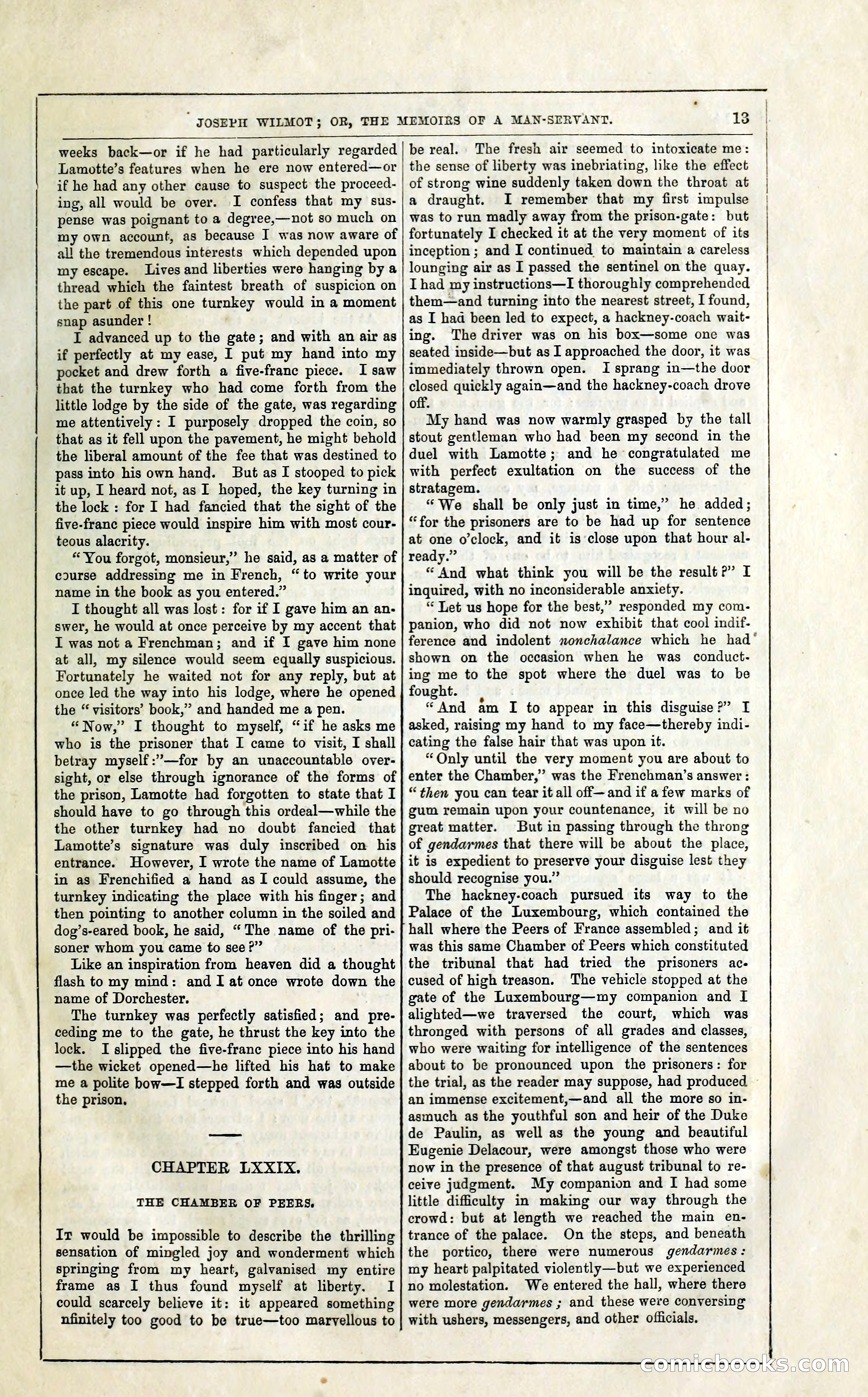
A restored page from Penny Dreadfuls, 1854. Page through the whole issue in the reader above.
📄 Transcribed text from this page (OCR, searchable)
Machine-transcribed from the original scan — historical spelling and the odd misread are preserved.
: JOSEPH WILMOT; OR, THE MEMOIRS OF A MAN-SERVANT. 13 weeks back—or if he had particularly regarded Lamotte’s features when he ere now entered—or if he had any other cause to suspect the proceed- ing, all would be over. I confess that my sus- pense was poignant to a degree,—not so much on my own account, as because I was now aware of all the tremendous interests which depended upon my escape. Lives and liberties were hanging by a thread which the faintest breath of suspicion on the part of this one turnkey would in a moment snap asunder ! I advanced up to the gate; and with an air as if perfectly at my ease, I put my hand into my pocket and drew forth a five-frane piece. I saw that the turnkey who had come forth from the little lodge by the side of the gate, was regarding me attentively: I purposely dropped the coin, so that as it fell upon the pavement, he might behold the liberal amount of the fee that was destined to pass into his own hand. But as I stooped to pick it up, I heard not, as I hoped, the key turning in the lock : for I had fancied that the sight of the five-franc piece would inspire him with most cour- teous alacrity. “You forgot, monsieur,” he said, as a matter of course addressing me in French, “to write your name in the book as you entered.” I thought all was lost: for if I gave him an an- swer, he would at once perceive by my accent that I was not a Frenchman; and if I gave him none at all, my silence would seem equally suspicious. Fortunately he waited not for any reply, but at once led the way into his lodge, where he opened the “ visitors’ book,” and handed me a pen. “Now,” I thought to myself, “if he asks me who is the prisoner that I came to visit, I shall betray myself:”—for by an unaccountable over- sight, or else through ignorance of the forms of the prison, Lamotte had forgotten to state that I should have to go through this ordeal—while the the other turnkey had no doubt fancied that Lamotte’s signature was duly inscribed on his entrance. However, I wrote the name of Lamotte in as Frenchified a hand as I could assume, the turnkey indicating the place with his finger; and then pointing to another column in the soiled and dog’s-eared book, he said, “The name of the pri- soner whom you came to see ?”’ Like an inspiration from heaven did a thought flash to my mind: and I at once wrote down the name of Dorchester. The turnkey was perfectly satisfied; and pre- ceding me to the gate, he thrust the key into the lock. I slipped the five-frane piece into his hand —the wicket opened—he lifted his hat to make me a polite bow—I stepped forth and was outside the prison, CHAPTER LXXIXx. THE CHAMBER OF PEERS. It would be impossible to describe the thrilling sensation of mingled joy and wonderment which springing from my heart, galvanised my entire frame as I thus found myself at liberty. I could scarcely believe it: it appeared something nfinitely too good to be true—too marvellous to er eae 6 a Se ee et) ae OP OL a be real. the sense of liberty was inebriating, like the effect of strong wine suddenly taken down the throat at a draught. I remember that my first impulse was to run madly away from the prison-gate: but fortunately I checked it at the very moment of its inception ; and I continued to maintain a careless lounging air as I passed the sentinel on the quay. Lhad my instructions—I thoroughly comprehended them—and turning into the nearest street, I found, as I had been led to expect, a hackney-coach wait- ing. The driver was on his box—some one was seated inside—but as I approached the door, it was immediately thrown open. I sprang in—the door closed quickly again—and the hackney-coach drove off. My hand was now warmly grasped by the tall stout gentleman who had been my second in the duel with Lamotte; and he congratulated me with perfect exultation on the success of the stratagem. “We shall be only just in time,” he added; “for the prisoners are to be had up for sentence at one o’clock, and it is close upon that hour al- ready.” “ And what think you will be the result?” I inquired, with no inconsiderable anxiety. “ Let us hope for the best,” responded my com- panion, who did not now exhibit that cool indif- ference and indolent nonchalance which he had’ shown on the occasion when he was conduct- ing me to the spot where the duel was to be fought. | “And am I to appear in this disguise?” I asked, raising my hand to my face—thereby indi- cating the false hair that was upon if. “Only until the very moment you are about to enter the Chamber,” was the Frenchman’s answer : “then you can tear it all off—and if a few marks of gum remain upon your countenance, it will be no great matter. But in passing through the throng of gendarmes that there will be about the place, it is expedient to preserve your disguise lest they should recognise you.” The hackney-coach pursued its way to the Palace of the Luxembourg, which contained the hall where the Peers of France assembled; and it was this same Chamber of Peers which constituted the tribunal that had tried the prisoners ac- cused of high treason. The vehicle stopped at the gate of the Luxembourg—my companion and I alighted—we traversed the court, which was thronged with persons of all grades and classes, who were waiting for intelligence of the sentences about to be pronounced upon the prisoners: for the trial, as the reader may suppose, had produced an immense excitement,—and all the more so in- asmuch as the youthful son and heir of the Duke de Paulin, as well as the young and beautiful Eugenie Delacour, were amongst those who were now in the presence of that august tribunal to re- ceive judgment. My companion and I had some little difficulty in making our way through the crowd: but at length we reached the main en- trance of the palace. On the steps, and beneath the portico, there were numerous gendarmes: my heart palpitated violently—but we experienced no molestation. We entered the hall, where there were more gendarmes ; and these were conversing with ushers, messengers, and other officials. The fresh air seemed to intoxicate me: a sKexey cS) (EO)