
Penny Dreadfuls, 1854 · page 271 of 399
Joseph Wilmot, or, The Memoirs of a Man-Servant — page 271: what you’re looking at
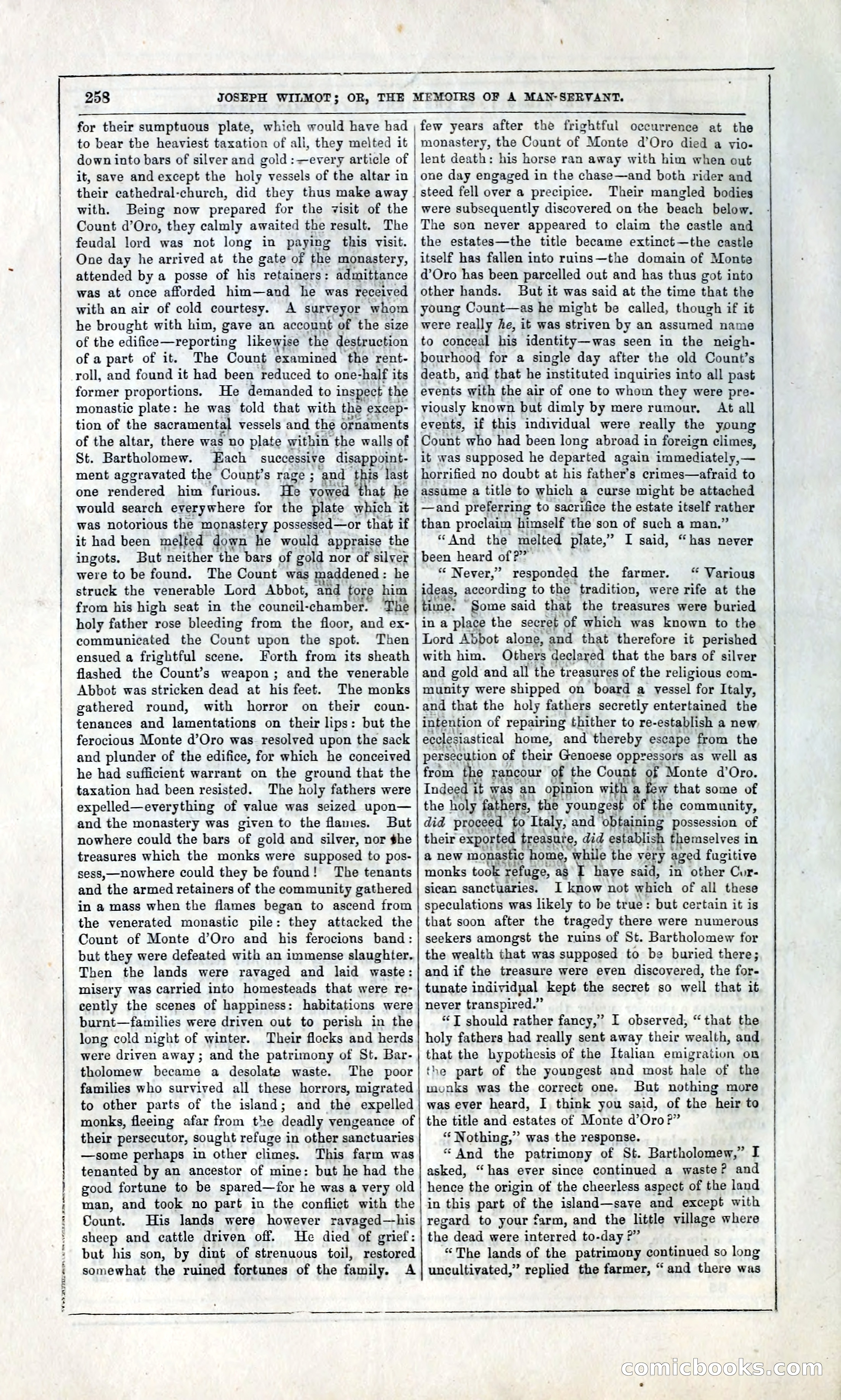
A restored page from Penny Dreadfuls, 1854. Page through the whole issue in the reader above.
📄 Transcribed text from this page (OCR, searchable)
Machine-transcribed from the original scan — historical spelling and the odd misread are preserved.
eee Eee Se > SUI oe rs es re eves 258 JOSEPH WILMOT; OR, THE MEMOIRS OF A MAN-SERVANT. for their sumptuous plate, which would have had to bear the heaviest taxation of ali, they melted it down into bars of silver and gold: —every article of it, save and except the holy vessels of the altar in their cathedral-church, did they thus make away with. Being now prepared for the visit of the Count d’Oro, they calmly awaited the result. The feudal lord was not long in paying this visit. One day he arrived at the gate of the monastery, attended by a posse of his retainers: admittance was at once afforded him—and he was received with an air of cold courtesy. A surveyor whom he brought with him, gave an account of the size of the edifice—reporting likewise the destruction of a part of it. The Count examined the rent- roll, and found it had been reduced to one-half its former proportions. He demanded to inspect | the monastic plate: he was told that with the excep- tion of the sacramental vessels and the ornaments of the altar, there was no plate within the walls of St. Bartholomew. Each successive disappoint- ment aggravated the Count’s rage ; and this last one rendered him furious. He vowed ‘that he would search everywhere for the plate which it was notorious the monastery possessed—or that if it had been melted down he would appraise the ingots. But neither the bars of gold nor of silyer were to be found. The Count was maddened: he struck the venerable Lord Abbot, ‘and tore him from his high seat in the council- chamber. ‘The holy father rose bleeding from the floor, and ex- communicated the Count upon the spot. Then ensued a frightful scene. Forth from its sheath flashed the Count’s weapon; and the venerable Abbot was stricken dead at his feet. The monks gathered round, with horror on their coun- tenances and lamentations on their lips: but the ferocious Monte d’Oro was resolved upon the sack and plunder of the edifice, for which he conceived he had sufficient warrant on the ground that the taxation had been resisted. The holy fathers were expelled—everything of value was seized upon— and the monastery was given to the flames. But nowhere could the bars of gold and silver, nor the treasures which the monks were supposed to pos- sess,—nowhere could they be found! The tenants and the armed retainers of the community gathered in a mass when the flames began to ascend from the venerated monastic pile: they attacked the Count of Monte d’Oro and his ferocions band: but they were defeated with an immense slaughter. Then the lands were ravaged and laid waste: misery was carried into homesteads that were re- cently the scenes of happiness: habitations were burnt—families were driven out to perish in the long cold night of winter. Their flocks and herds were driven away; and the patrimony of St. Bar- tholomew became a desolate waste. The poor families who survived all these horrors, migrated to other parts of the island; and the expelled monks, fleeing afar from the deadly vengeance of their persecutor, sought refuge in other sanctuaries —some perhaps in other climes. This farm was tenanted by an ancestor of mine: but he had the good fortune to be spared—for he was a very old man, and took no part in the conflict with the Count. His lands were however ravaged—his sheep and cattle driven off. He died of grief: but his son, by dint of strenuous toil, restored somewhat the ruined fortunes of the family. A few years after the frightful occurrence at the monastery, the Count of Monte d’Oro died a vio. lent death: his horse ran away with him when out one day engaged in the chase—and both rider and steed fell over a precipice. Their mangled bodies were subsequently discovered on the beach below. The son never appeared to claim the castle and the estates—the title became extinct—the castle itself has fallen into ruins—the domain of Monte d’Oro has been parcelled out and has thus got into other hands. But it was said at the time that the young Count—as he might be called, though if it were really he, it was striven by an assumed name to conceal his identity—was seen in the neigh- bourhood for a single day after the old Count’s death, and that he instituted inquiries into all past events with the air of one to whom they were pre- viously known but dimly by mere rumour, At all events, if this individual were really the young Count who had been long abroad in foreign climes, it was supposed he departed again immediately,— horrified no doubt at his father’s crimes—afraid to- assume a title to which a curse might be attached —and preferring to sacrifice the estate itself rather than proclaim himself the son of such a man.’ “And the melted plate,” I said, “has never been heard of Re “ Never,” responded the farmer. “ Various ideas, according to the tradition, were rife at the time. Some said that the treasures were buried in a place the secret | of which was known to the Lord Abbot alone, and that therefore it perished with him. Others declared that the bars of silver and gold and all the tr easures of the religious com- munity were shipped on ‘board a yessel for Italy, and that the holy fathers secretly entertained the intention of repairing thither to re-establish a new, ecclesiastical home, and thereby escape from the persecution of their Genoese oppressors as well as Sah the rancour of the Count of Monte d’Oro. Indee it Was an opinion with Va] ow that some of the holy fathe s, the youngest 0 the community, did proceed hy Ttaly , and obtaining possession of their exported Bh did establish themselves in a new monastic ome, while the very aged fugitive monks took refuge, a as I haye said, in other Cur- sican sanctuaries. I know not which of all these speculations was likely to be true: but certain it is that soon after the tragedy there were numerous seekers amongst the ruins of St. Bartholomew for the wealth that was supposed to be buried there; and if the treasure were even discovered, the for- tunate individual kept the secret so well that it never transpired.” “‘T should rather fancy,” I observed, “that the holy fathers had really sent away their wealth, and that the hypothesis of the Italian emigration on the part of the youngest and most hale of the monks was the correct one. But nothing more was ever heard, I think you said, of the heir to the title and estates of Monte d’Oro?” ‘“‘ Nothing,” was the response. “And the patrimony of St. Bartholomew,” I asked, “has ever since continued a waste? and hence the origin of the cheerless aspect of the land in this part of the island—saye and except with regard to your farm, and the little village where the dead were interred to-day ?” “The lands of the patrimony continued so long uncultivated,” replied the farmer, “and there was Giook as ES (E()